
Client retention gifts: grow loyalty with templates & 5 step checklist

The most effective client retention gift is timely, personalised, genuinely useful, and only lightly branded. It lands at a meaningful moment, such as a renewal or milestone, rather than a generic holiday date. Getting the timing and personalisation right matters more than the price tag. Some companies build this exact approach into ready-made and build-your-own gift boxes, so you can put the strategy into action without designing it from scratch.
TL;DR:
Gifts should be timed around milestones like renewals or project completions, not on fixed schedules or holidays, to maximize relationship impact.
Personalisation should be subtle, such as engraved initials or handwritten notes, avoiding heavy branding or logos that could seem promotional.
Budget tiers should align with the client’s value and occasion, with low-cost options for onboarding and premium hampers or donations for top-tier accounts.
Tracking preferences in a CRM ensures future gifts reflect client values, preventing repeated mistakes and enhancing personal relevance.
Sending gifts early in relationships or around key events helps reinforce trust and improves renewal and referral rates.
Table of Contents
What makes client retention gifts different from promotional swag
What are the best client retention gift ideas by occasion and budget?
How much should you spend, and how do you measure the impact?
A practical checklist for running a client gifting programme
Craig’s view: where gifting earns its keep, and where it doesn’t
What makes client retention gifts different from promotional swag
A retention gift is an intentional, milestone-anchored gesture designed to deepen a relationship rather than boost brand visibility, as Airawath’s gifting research puts it. Promotional swag chases impressions. A retention gift chases trust.
The mechanics are straightforward. A well-timed gift signals that you noticed something, an anniversary, a contract renewal, a hard-won project delivery, and that you cared enough to acknowledge it. That signalling triggers a mild sense of reciprocity, and unlike an email or a call, a physical gift stays visible on a desk or in a kitchen for weeks, quietly reinforcing the relationship every time the client sees it.
Personalisation that reflects a client’s actual values, rather than just their name on a mug, tends to land better than a generic item, according to MOO’s client gifting guide. Measuring the payoff doesn’t require complex analytics: track renewal rates, referral volume, and direct feedback in the weeks after a send, and patterns emerge fast. Retention gifting done thoughtfully is a lever for long-term revenue, not a cost centre with no visible return.
What are the best client retention gift ideas by occasion and budget?
Matching the gift to the moment matters more than matching it to a catalogue category. Here’s how to think about it across five common occasions and three budget tiers.
Welcome and onboarding. A small, useful item, think a quality notebook, a coffee sampler, or a letterbox gift for him or her, sets a warm tone before the relationship has proven itself.
Milestone and renewal. This is where personalisation earns its keep: a hamper reflecting known preferences, or a build-your-own gift box assembled around what that client actually enjoys.
Referral and thank-you. A slightly more generous gesture than usual, tied explicitly to the referral, tells a client their advocacy was noticed and valued.
Project win. Send something to mark a specific outcome, a delivered launch, a signed deal, close to the moment it happens, not weeks later.
Holiday and year-end. Useful, but only as one touchpoint among several. Relying on Christmas alone as your entire gifting calendar is where most programmes go stale.
Budget tiers give you a working framework rather than a rigid rule:
Low tier (£10 to £30): an affordable letterbox gift, a small consumables box, or a modest desk item. Good for onboarding and lighter-touch clients.
Mid tier (£30 to £150): curated hampers, premium hampers for men, or a themed experience box. This is the sweet spot for renewals and referral thank-yous.
Premium tier (£150+): bespoke, multi-item hampers, a subscription gift, or a charitable donation made in the client’s name for your highest-value accounts.
Within any tier, four idea categories cover most needs: consumables (food, drink, wellness items), desk or memory pieces (engraved items, keepsakes), experiences or subscriptions (tastings, memberships), and charity donations for clients who value cause-led gestures over material ones.
How do you personalise a gift without over-branding it?
Subtle personalisation reads as sincere. Heavy logoing reads as marketing, and clients can tell the difference instantly. A name engraved discreetly, a handwritten date marking the relationship’s start, or a short story card explaining why an item was chosen all do more work than a logo splashed across the front.
Engrave initials or a date rather than printing a full company name across the item.
Include a short, handwritten note referencing something specific to that client relationship.
Add a provenance or story card explaining where a product comes from or why it was selected.
Wrap sustainably where possible; it signals attention to detail and, for many clients, aligns with their own values around sustainable corporate gifts.
Store dietary needs, allergies, and stated preferences in your CRM so future gifts don’t repeat a mistake or clash with a restriction.
Pro Tip: Keep a single CRM field labelled “gift notes” per client contact, updated after every call where a preference comes up naturally. Six months later, that field does the personalisation work for you.
Project tools and CRMs genuinely earn their keep here. ClickUp’s gifting guide recommends using them to track preferences, set reminders, and manage budgets so nothing slips through at scale.
When should you send a client retention gift?
Milestone-led timing beats a fixed calendar every time. Five moments carry the most weight:
Onboarding, within the first two to four weeks of a signed agreement.
First deliverable, marking the point a client sees tangible results.
Renewal, ideally arriving before the renewal conversation, not after.
Promotion or award, when a named contact at the client achieves something publicly.
Referral, sent within a week or two of the introduction being made.
Holiday-only sending treats every client identically regardless of where they sit in the relationship, and clients notice the difference between a gift that arrived because it’s December and one that arrived because something happened. Build a four-to-six-week lead time into your process for ordering, especially for personalised or engraved items, so a milestone doesn’t slip past before the gift ships.
How much should you spend, and how do you measure the impact?
Spend should track the client’s value and the relationship stage, not a flat company-wide rule. A new account might warrant a modest welcome gesture; a long-standing account approaching renewal justifies a more considered spend.
Onboarding and lighter accounts: the low tier, roughly £10 to £30.
Renewals, referrals, and mid-value accounts: the mid tier, £30 to £150.
Strategic or top-tier accounts: premium spend above £150, sometimes including bespoke items or donations.
Measuring impact doesn’t need to be elaborate. Watch renewal rates in the quarter following a gift send, track referral counts against gifted versus non-gifted clients, and ask directly in review calls whether the gesture landed. Tiered spend guidance tied to relationship stage preserves budget while concentrating effort where it returns the most, per MOO’s research. When budgets tighten, digital gift cards, small group experiences, or a charitable donation gift all keep the gesture meaningful without the premium price tag.
A practical checklist for running a client gifting programme
A repeatable process beats reinventing the send every time. This sequence, drawn from how Sayheygifting structures its own gifting approach, covers the full cycle:
Select the moment (onboarding, renewal, referral, milestone).
Pick the appropriate spend tier for that client and occasion.
Personalise, name, date, story card, or a preference-matched item.
Confirm delivery timing against the milestone date, allowing lead time.
Follow up with a short note or call once the gift has landed.
Three short templates cover most sends:
Welcome: “We’re genuinely glad to be working with you. This small box is just to say welcome, and here’s to a great start.”
Renewal thank-you: “Thank you for another year together. It’s clients like you that make this work worthwhile, and we’re already looking forward to the next.”
Referral thank-you: “Thank you for introducing us to [name]. Recommendations like yours mean more than any marketing budget, and we wanted to mark it properly.”
Operationally, decide upfront whether you’re ordering single gifts as milestones arise or placing bulk orders ahead of a busy renewal quarter, and check whether eco packaging matters to the client base before you commit to a supplier.
Craig’s view: where gifting earns its keep, and where it doesn’t
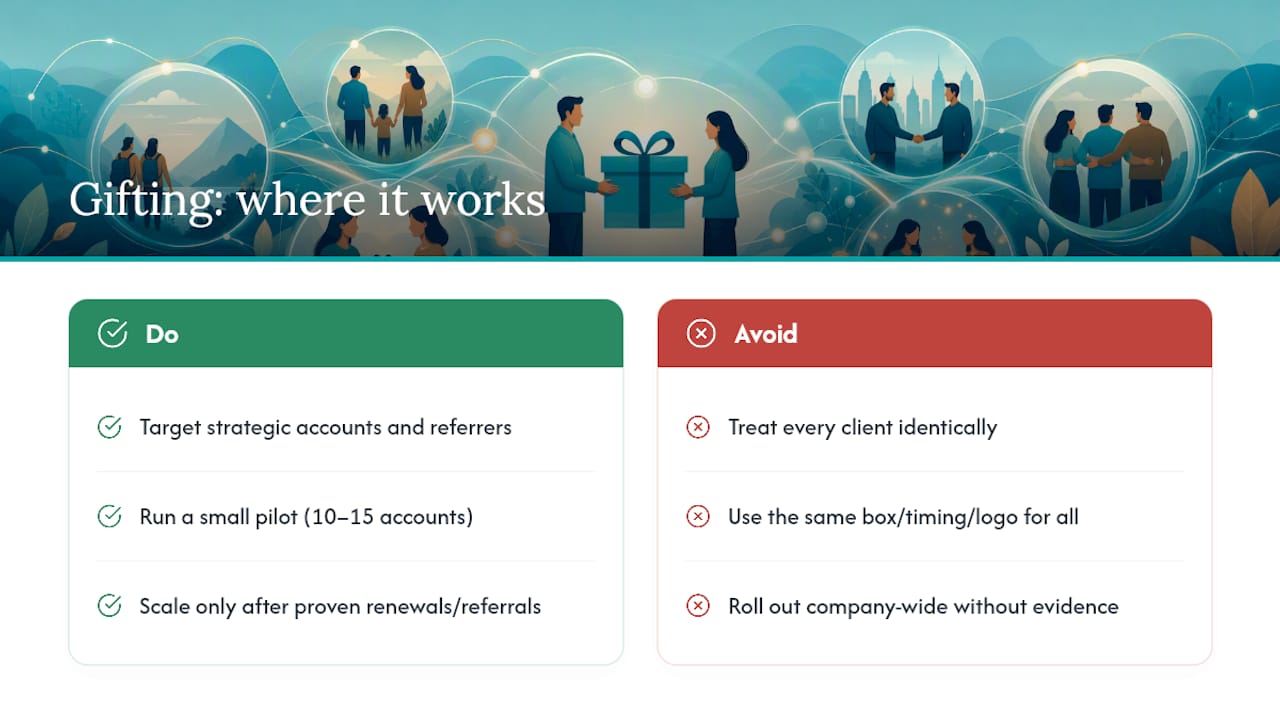
Gifting delivers the most leverage on strategic accounts and referral sources, the relationships where a renewal or introduction carries real revenue weight. The mistake I see most often is treating every client identically: same box, same timing, same heavy logo. That flattens exactly the personal signal a retention gift is supposed to send.
Run a small pilot with ten or fifteen accounts before rolling gifting out company-wide, and scale only once you can see it moving renewals or referrals.
— Craig
How Sayheygifting makes retention gifting easier to run
Sayheygifting is the practical alternative to designing a gifting programme from scratch: rather than briefing a supplier on every hamper individually, you build once and repeat. The range covers ready-made gift boxes for quick sends, a build-your-own gift box tool for personalised milestone gifts, and letterbox formats for lighter-touch onboarding moments, all with eco-friendly packaging as standard and the option to order a single sample or a full bulk run for renewal season.
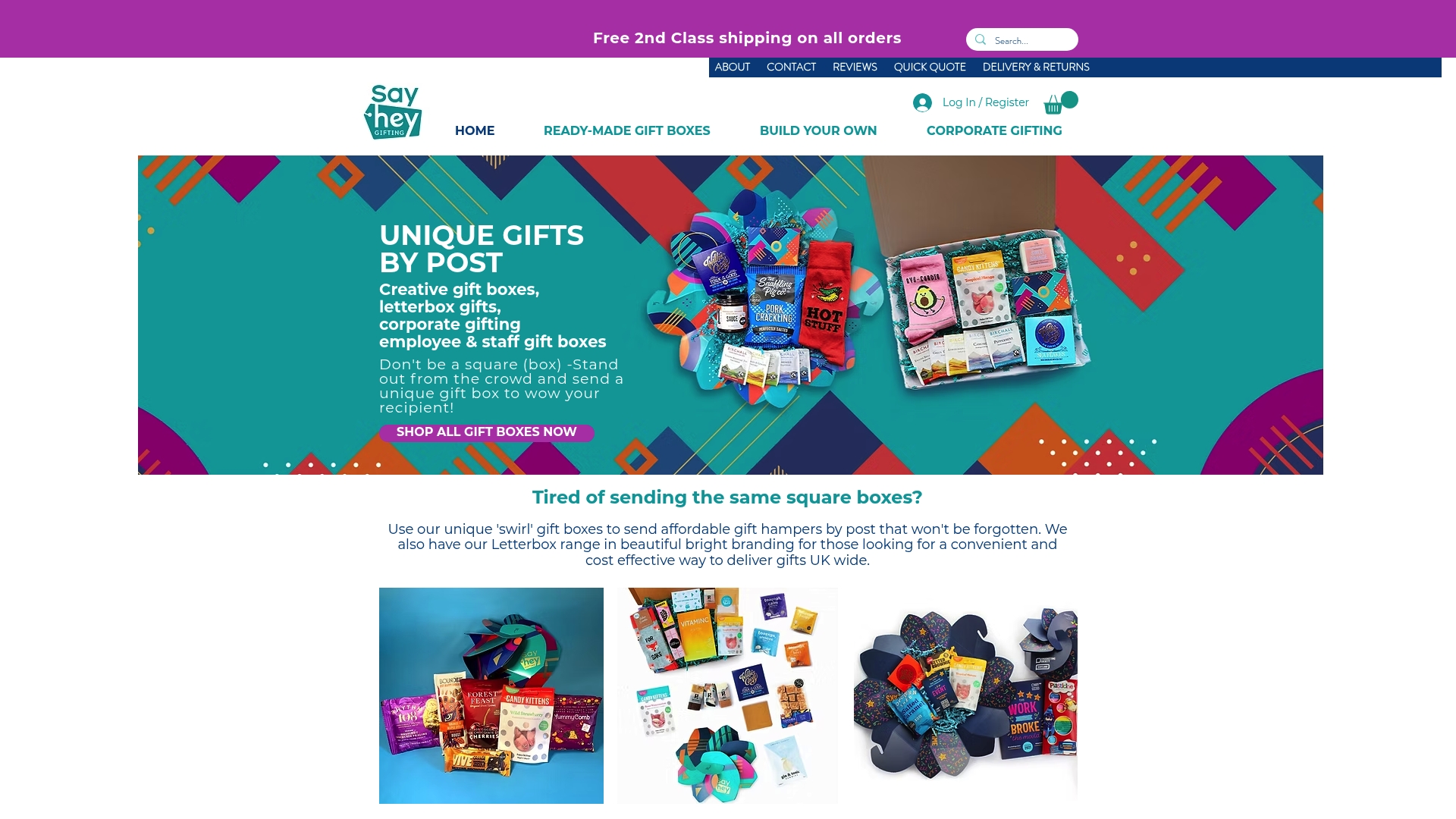
If you’re testing the milestone-led approach outlined above, start with a single sample order rather than committing to a full quarter’s programme. Browse the employee and client gift box range to see spend tiers in practice, or head straight to the employee gift box product page to place a trial order and see how it lands with one account before scaling to the rest of your client list.
Sources
FAQ
Are gifts to clients allowable?
Yes, in most business contexts client gifts are allowable, though tax deductibility rules and value limits vary by jurisdiction and gift type, so check the current guidance for your own tax authority before assuming a gift is fully deductible.
What is a good gift to give a client?
A good client gift is personalised, useful, and only lightly branded, such as a curated hamper, a letterbox box matched to known preferences, or a considered consumables set tied to a specific milestone.
What is the best corporate gift for clients?
The best corporate gift depends on the relationship stage: a modest, useful item works for onboarding, while renewals and top-tier accounts warrant a more considered, personalised hamper or bespoke box.
What are the rules for giving gifts to clients?
There’s no single universal rule, but good practice means keeping branding subtle, timing the gift to a genuine milestone rather than a sales push, and checking your own organisation’s gifting policy and local tax thresholds before sending anything of significant value.
Recommended

Comments