
Corporate gift messaging that actually gets read and remembered

Effective corporate gift messaging is short, specific and timely: personalise with one concrete reason why the recipient matters, match your tone to the relationship, and keep any branding modest. Get those three things right and even a small gift lands with weight.
Three rules make the difference between a message that gets binned and one that gets photographed for LinkedIn:
Specificity beats sentiment. Naming an actual achievement, project or date is more effective than a generic thank-you every time.
Tone follows relationship. Warm and informal for a long-serving colleague, measured and professional for a new client.
Timing amplifies meaning. A message that arrives with the gift, not days later, feels intentional rather than administrative.
Quick examples: to an employee, “Your work on the Harrogate rollout didn’t go unnoticed. Thank you.” To a client, “A small thank you for trusting us with your account this year.” To a prospect, “We enjoyed our first conversation, here’s to more of them.”
Key Takeaways
Corporate gift messaging works when it pairs one concrete, specific reason with a tone matched to the relationship, delivered at the moment the gift arrives.
Point | Details |
Specificity over sentiment | Name an actual achievement, date or project rather than writing a generic thank-you. |
Match tone to relationship | Formal for prospects and new contacts, warmer for employees and long-standing clients. |
Plan lead times by order size | Allow 4 to 6 weeks for large, bespoke seasonal programmes to avoid rush fees. |
Keep branding subtle | Debossed or tonal logos read as more thoughtful than large printed branding. |
Sayheygifting handles fulfilment | Ready-made and build-your-own gift boxes let you focus on writing the message, not chasing suppliers. |
Table of Contents
What is the best framework for corporate gift messaging?
The strongest corporate gift messages follow a five-part shape: greeting, reason, value statement, personal note, sign-off. It sounds mechanical written out like that, but the structure is what stops you staring at a blank card while a courier waits at reception.
Greeting. Use the recipient’s first name. For prospects or unfamiliar contacts, add a title or surname if your existing correspondence has been formal.
Reason. State plainly why you’re sending this. “To mark your five years with us” or “Thank you for closing out Q3 with us” both work because they’re facts, not flattery.
Value statement. One line connecting the gift to what the recipient actually did or means to the business. This is where generic messaging usually collapses into cliché, so anchor it to something real.
Personal note. A detail only this recipient would recognise, a shared joke, a specific milestone, a project name. This single line is what separates personalised gift writing from a mail-merge.
Sign-off. Match formality to the greeting. “Warm regards” for clients, first names only for close colleagues.
Scale the formula by relationship. Employee messages can run to three or four sentences and use first names throughout. Client messages tend to sit tighter, two to three sentences, professional but not cold. Prospect messages should be the shortest of all: a single clear reason, no overreach, no hard sell buried inside a thank-you note.
Pro Tip: Keep a running list of “gift-worthy” moments throughout the year, contract renewals, project completions, work anniversaries, so you’re never scrambling for a reason when the occasion arrives.
Concrete details worth inserting: a project name, a metric (“helped us hit 120% of target”), a specific behaviour (“always first to offer help on a deadline”). These work because specificity signals genuine attention rather than a template someone forgot to edit.
Ready-to-adapt templates for cards, emails and packing slips
Having a small set of reusable templates on hand saves time and keeps your messaging consistent across a whole gifting programme, whether that’s twelve staff or twelve hundred clients.
Card copy, employee recognition:
“Two years in and still the person everyone turns to on launch day. Thank you, [name].”
“Small gift, big thank you, for the way you handled the Bristol account this quarter.”
Card copy, client appreciation:
“Working with [company] this year has been a genuine pleasure. Here’s a small thank you.”
“To mark another year of partnership, we thought a little something was in order.”
Email templates:
Gift announcement subject line: “A little something’s on its way to you” or “Keep an eye on your letterbox, [name]”
Opening line: “We wanted to mark [reason] with something small, it should land with you by [date].”
Follow-up subject line: “Did it arrive safely?” paired with a short line inviting a reply or a photo.
Time your email to land close to delivery. For physical gifts, send the email the day the item is dispatched or arrives, not a week before, so the message feels connected to the experience rather than a separate admin task.
Packing-slip micro-lines (short, and printed rather than handwritten):
“Handpicked for you by the team at [company].”
“A thank you, delivered.”
QR-code video message script (15 to 20 seconds): open with the recipient’s name, state the reason in one sentence, close with a warm sign-off. Keep it unscripted-sounding, a slightly imperfect delivery reads as more sincere than a polished one.
How far ahead should you plan personalised corporate gifts?
Lead times scale with order size and the amount of personalisation involved, and this is where most gifting programmes come unstuck. A single engraved item can be turned around quickly. A bulk order of two hundred branded boxes with individual name cards cannot, and production and decoration timelines expand fast once quantity climbs.
Order size | Typical lead time | Notes |
Small (single items) | 3 to 6 working days | Engraving and card personalisation usually fit within standard dispatch. |
Medium (bulk orders) | 1 to 2 weeks | Allow extra time if mixing bespoke packaging with individual messages. |
Large (50+ items, seasonal) | 4 to 6 weeks | Plan seasonal programmes well ahead to avoid rush fees and stock shortages. |
Send on the day for milestone gifts, birthdays, work anniversaries, contract wins, so the timing itself carries meaning. For thank-you gifts tied to a project close, a short follow-up message a week later checking the item arrived safely adds a second, low-effort touchpoint.
Pro Tip: Build your gift-message calendar backwards from the event date, not forwards from today. It’s the only way to catch a six-week lead time before it catches you.
On personalisation boundaries: stick to professional territory. Reference achievements, tenure, projects and behaviours you’d happily mention in a team meeting. Avoid health, family circumstances, religion or politics, even when you know the detail personally, because a gift message is a public-facing document once it’s opened in front of colleagues.
Why this approach holds up in practice
The case for treating gift messaging as seriously as the gift itself isn’t guesswork. Sayheygifting’s own analysis in Why corporate gifts matter: the 2026 business case sets out why thoughtful recognition programmes move the needle on retention and client loyalty, not just goodwill. The mechanics of what makes gifting land are covered in more depth in What is corporate gifting and why does it matter?
A gift without a message that means something is just a transaction. The message is what turns a box of nice things into a moment someone remembers, and that’s true whether you’re spending £15 or £150 per person.
If you’re building a programme rather than sending a one-off gift, the employee gifting guidance covers message examples specific to team rewards and recurring recognition cycles.
Craig writes on workplace culture and corporate gifting strategy for Sayheygifting.
What UK legal and cultural rules apply to gift messages?
Gift messaging sits under the same anti-bribery scrutiny as the gift itself under the Bribery Act 2010, so avoid any language that implies expectation or exchange, phrases like “in appreciation of your decision” near a live procurement process are a genuine compliance risk, not just poor taste. Keep the message focused on relationship and recognition, never on outcome or influence.
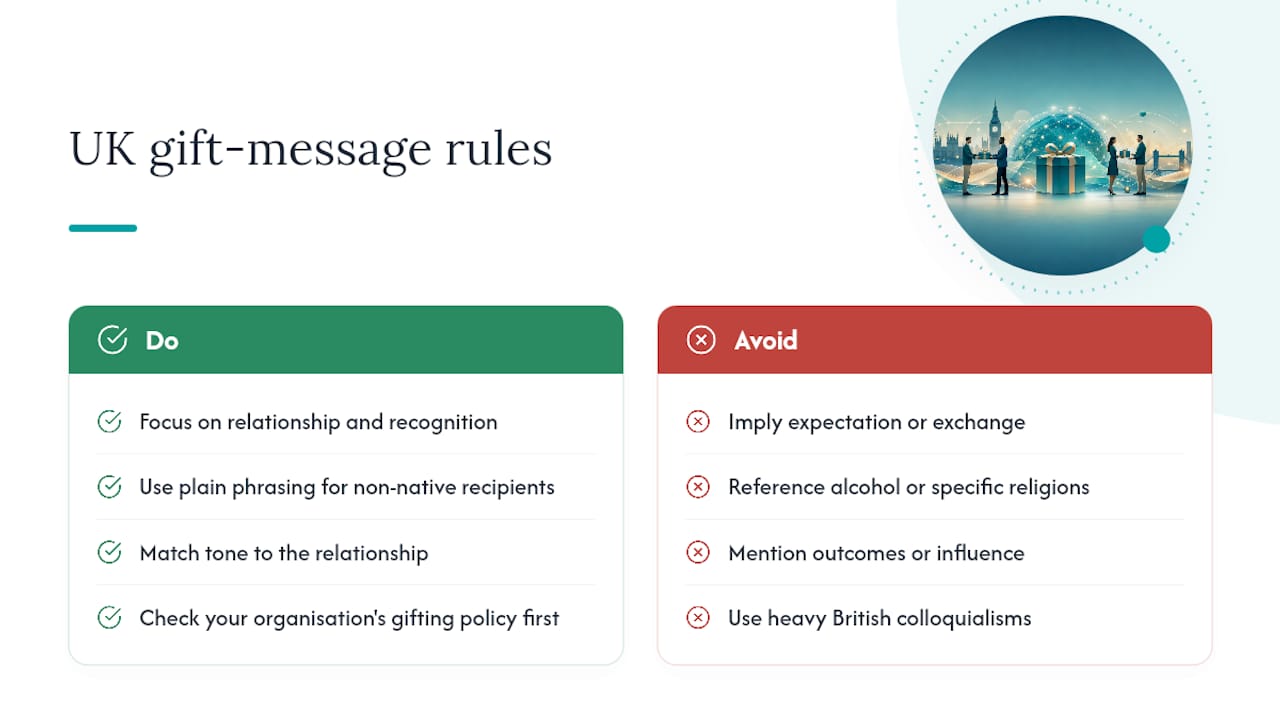
Cultural sensitivity matters just as much as legal caution. A message that leans heavily on British colloquialisms or humour may not translate well for international clients or colleagues, so keep phrasing plain where the recipient’s first language isn’t English. Avoid referencing alcohol, specific religious holidays, or dietary content unless you’ve confirmed it’s welcome, a “Christmas hamper” message to a multi-faith team is better framed around the year-end or the season generally.
Tone should always follow the relationship rather than the occasion: formal and neutral for external or newer contacts, warmer for established colleagues, but professional specifics (a project, a date, a role) rather than anything personal or private in either case. If your organisation has a gifting or hospitality policy, the message itself should never contradict it, checking with procurement or compliance before a bulk client send costs five minutes and saves a much longer conversation later.
What mistakes ruin an otherwise good corporate gift?
The gift usually isn’t the problem. The message is. The most common failure is genericness, a card that could be sent to anyone says, in effect, that it was. “Thank you for your business” attached to fifty identical hampers reads as a mail-merge because it is one.

The second mistake is mismatched tone. An overly casual message to a formal client relationship, or a stiff, corporate-sounding note to a team member you see daily, both create a small jolt of discomfort that undercuts the gesture. Sending the same message tier to every recipient regardless of relationship is a subtler version of the same error, planning gifts and messages by recipient tier first prevents the mismatch where a modest gift carries an over-familiar note or vice versa.
Timing failures are just as damaging. A thank-you message that arrives two weeks after the gift, or worse, before it, breaks the connection between the two entirely. Overbranding is another quiet killer: a logo stamped across every visible surface of a gift box turns a personal gesture into a marketing insert, subtle decoration such as debossing or tonal embroidery reads as far more thoughtful than a large printed logo.
Finally, watch for the throwaway gift paired with an earnest message, items that get kept and used earn a heartfelt note; a stress ball does not.
How does gift messaging fit into wider corporate communications?
Gift messaging shouldn’t sit in isolation from everything else your organisation says to staff and clients. If your internal communications are formal and structured, a wildly casual gift message creates dissonance, treat the tone of voice in your gifting programme as an extension of your existing brand voice, not a separate register invented for the occasion.
The same logic applies to timing and cadence. If your HR team already sends work-anniversary emails or your account managers send quarterly check-ins, a gift message tied to the same moment reinforces the relationship rather than duplicating it. Coordinate with whoever owns internal comms or client communications so a gift doesn’t land the same week as an unrelated formal announcement, the two competing for attention dilutes both.
Consistency across channels matters more than most HR teams assume. A card that says “we value your contribution” should echo language already used in performance reviews or recognition schemes, not introduce a new phrase employees haven’t heard before. For client-facing gifting, loop in whoever manages the account relationship so the gift message doesn’t contradict or duplicate a recent proposal, renewal conversation, or service update. Treated this way, a gift message becomes one more consistent touchpoint in a longer relationship, not an isolated gesture that arrives out of nowhere and disappears just as quickly.
The playbook that actually works, and what most guides get wrong
Most gifting advice treats the message as decoration, a nice-to-have line added after the gift has already been chosen. That ordering is backwards. The research consistently points the other way: personalisation and tone are what determine whether a gift is remembered at all, the object itself is almost secondary once you’re past a basic quality threshold.
The conventional advice that most needs retiring is the idea that longer or more elaborate messages show more effort. They don’t. A precise, well-timed two-sentence note beats a paragraph of generic warmth every time, because specificity is what readers actually notice, not volume.
If you’re building a programme from scratch, prioritise the framework and the tier system before you touch templates. Decide your spend bands and your relationship tiers first, then let the message tone follow logically from that decision. Skipping straight to “what should the card say” without that groundwork is exactly how mismatched, generic messaging creeps into an otherwise thoughtful gifting programme.
— Craig
Let Sayheygifting handle the gift while you focus on the message
Sayheygifting removes the logistics headache from personalised corporate gifting, so your time goes into the words that matter, not chasing suppliers on lead times. Whether you need ready-made employee gift boxes for a recognition programme or a fully build-your-own gift box run for client accounts, the fulfilment and packaging side is handled so your framework, tone and timing plan can go straight into practice.
For consumable options that pair naturally with a short, warm message, a coffee-led e-gift card works well as a lighter-touch alternative to a full hamper. Next steps are straightforward: pick your spend tier, choose a template from this guide, then get in touch through the corporate gifting page to talk through personalisation options and realistic lead times for your order size.
Sources
FAQ
What Should A Corporate Gift Message Say?
Name one specific reason the recipient matters, such as an achievement or milestone, then keep the tone matched to your relationship with them.
How Long Should A Corporate Gift Message Be?
Two to four sentences is usually enough. A precise, short message reads as more sincere than a long, generic one.
When Should I Send The Gift Announcement Email?
Time it close to delivery, the day of dispatch or arrival for physical gifts, so the message feels connected to the experience.
How Far Ahead Should I Order Personalised Corporate Gifts?
Small orders can be turned around within a week, but bulk or bespoke seasonal orders need 4 to 6 weeks of lead time.
Can Sayheygifting Help With Bulk Corporate Gift Messaging?
Yes, Sayheygifting supports bulk fulfilment for employee gift boxes and custom corporate orders, with consultation available on personalisation and timing.
Recommended

Comments