
Corporate gift delivery guide for UK office managers

Confirm the recipient’s eligibility and delivery window first, then book a fulfilment partner who can meet your lead time. That single step prevents the two most common failures: a declined gift and a missed delivery date.
Your three-step action plan:
Check eligibility. Confirm the recipient’s company gift policy and any dietary or allergy requirements before you order anything.
Choose your gift and tier. Match the format and spend to the relationship (employee, standard client, or VIP client).
Schedule delivery. Select your shipping mode based on urgency, then book early enough to allow for production and carrier lead times.
Quick pre-send checklist:
Recipient policy confirmed (HR or direct contact)
Dietary and allergy flags noted
Delivery SLA selected (same-day, next-day, or scheduled)
Personal message drafted and attached
Address verified (residential vs. business flag set)
Sayheygifting offers same-day despatch on ready-made boxes and multi-address fulfilment for larger campaigns, making it a practical starting point when you need to move quickly.
Pro Tip: Draft your personal message before you finalise the gift. The note often shapes which format feels right, not the other way around.
Table of Contents
Why does corporate gifting actually pay off for UK businesses?
A well-timed, thoughtfully personalised gift produces returns that a generic email never will, because it signals deliberate effort. The commercial case is straightforward: gifts tied to a single objective, whether client retention, employee recognition, or referral reward, tend to outperform scatter-gun gestures every time.
Timing and personalisation do most of the heavy lifting. Sending gifts before the December rush increases visibility and appreciation, because carriers experience significant delays in November and December. A gift that arrives in mid-November, when a client’s desk is clear, lands far better than one lost in a pile of Christmas post.
Common use cases and what they need:
New client onboarding. A letterbox gift or small hamper within the first fortnight sets a warm, professional tone without overstepping.
Deal close or project completion. A slightly elevated tier (drinks, pamper set, or experience) marks the milestone and creates a lasting memory.
Employee anniversary or milestone. Personalised recognition, ideally with a handwritten note, reinforces belonging and well-being.
Apology or retention gesture. A modest, sincere gift with a genuine message often repairs goodwill faster than a discount.
Marketing seeding. Branded items or curated boxes sent to influencers or press contacts spark conversations and extend reach.
Most UK firms tier budgets by relationship and keep gifts within the common £25–£100 range, opting for modest and personalised options rather than lavish ones. That approach reduces compliance risk and, counterintuitively, improves perceived thoughtfulness. A modest letterbox gift with a handwritten note often lands better than an elaborate hamper with a printed card.
Who can you send gifts to, and what are the UK rules?
Always check the recipient’s company gift policy before you send anything. Many policies set a limit between £25 and £100 for non-lavish gifts. A brief, polite question to HR or the recipient themselves prevents the awkward situation of a gift being declined or returned.
Sample policy-check email (copy and adapt):
UK government guidance is clear that gifts to public officials and regulated professions may be heavily restricted or prohibited entirely. When in doubt, consult the recipient’s organisation directly or refer to official guidance before proceeding.
Compliance checklist:
Public officials and civil servants: assume restrictions apply; ask before sending.
Regulated professions (solicitors, financial advisers, NHS staff): check sector-specific codes.
Procurement contacts and RFP windows: never gift during an active negotiation, contract renewal, or review period, as it changes how the gesture is read.
Anti-bribery: the Bribery Act 2010 applies to all UK businesses; gifts intended to influence a business decision are unlawful regardless of value.
Reporting line: avoid gifting upward as an individual. If recognising a senior colleague, use a voluntary team contribution with clear group provenance.
GDPR: address lists used for gift campaigns must be held and processed lawfully. Collect only what you need, store it securely, and delete it once the campaign is complete.
Pro Tip: Keep a short log of every gift sent, including recipient, value, occasion, and policy confirmation. If a compliance question ever arises, that record is your first line of defence.
How do you choose the right gift format and personalise it well?
Choose the smallest meaningful gift that fits the relationship and the policy constraints, then put your energy into the message rather than the price tag. Personalisation and the note matter more than spend, and they carry far less compliance risk.

Gift formats and who they suit best
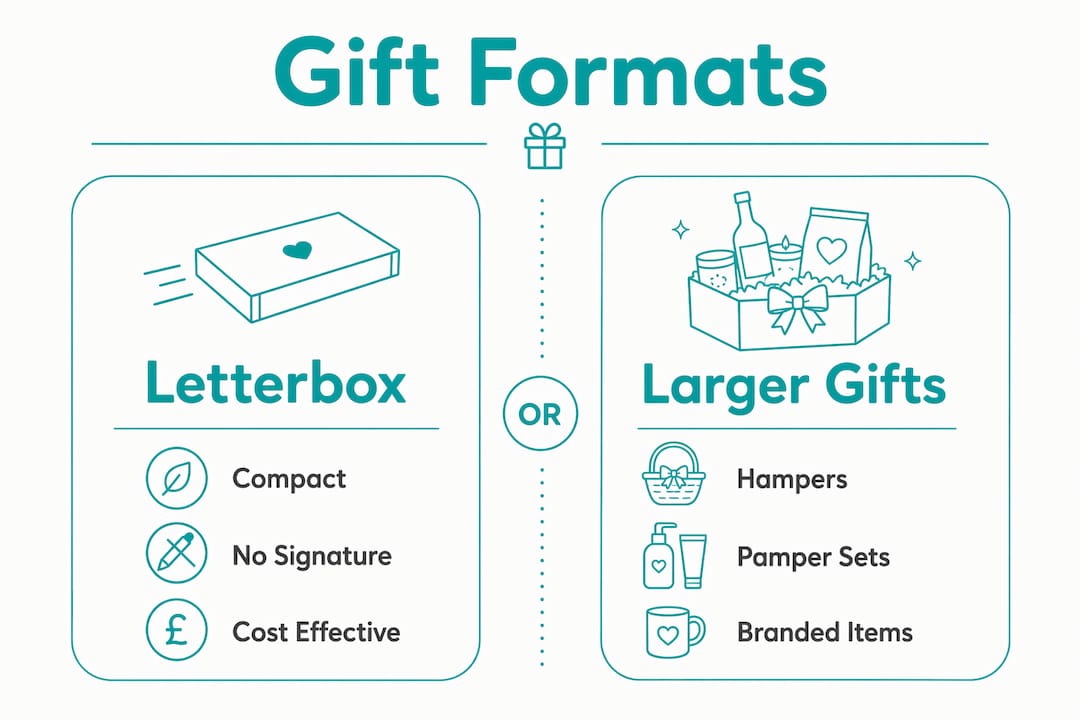
Letterbox gifts are the workhorse of corporate gifting. They fit through a standard letterbox, require no signature, and work equally well for remote employees and clients across the UK. They suit high-volume campaigns and lower-spend tiers.
Hampers carry a sense of occasion. A curated food and drink hamper is ideal for a VIP client thank-you or a team celebration where the gift will be shared. Shareable formats build a different kind of goodwill than personal ones.
Pamper and wellbeing sets resonate strongly for employee recognition, particularly for staff who have gone above and beyond. They signal that you see the person, not just the output.
Branded items work well for onboarding and marketing seeding, but keep branding subtle. A branded sleeve or tag on an otherwise beautiful gift feels considered; a logo plastered across every item feels promotional.
Experiences and digital gift options are worth considering for recipients with dietary restrictions or accessibility needs, where a physical product may not land well.
Personalisation options
Handwritten note (always the highest-impact addition, regardless of gift value)
Branded sleeve or belly band rather than full-box branding
Choice cards or digital gift links for recipients with restrictions
Recipient’s name on the outer packaging or inner card
Dietary and accessibility notes
Flag allergies and dietary requirements before ordering, not after. Offer vegetarian and vegan alternatives as standard for any food-based gift. For recipients with physical accessibility needs, consider packaging that opens easily and gifts that are not food-dependent. Non-food options, such as wellbeing hampers or experience vouchers, are a safe default when you are unsure.
What delivery options work best for UK corporate gift campaigns?
Pick the shipping mode to match your urgency and scale. For an urgent local VIP, a same-day courier is the right call. For a nationwide employee campaign, a multi-carrier platform gives you rate comparison, consolidated tracking, and better coverage.
Lead time reference table
Shipping mode | Typical lead time | Best for |
Same-day courier | 2–6 hours | Urgent local VIP gifts |
Next-day tracked | 1 business day | Individual client gifts, last-minute sends |
Standard tracked | 2–4 business days | Planned campaigns, non-urgent sends |
White-glove delivery | 3–7 business days | Fragile or high-value gifts requiring careful handling |
Personalised production | 5–10 business days | Custom-branded items, engraved or printed gifts |
For fragile or high-value gifts, white-glove delivery ensures careful handling and placement. Always request package dimensions, weight, and production timing from your supplier before committing to a carrier, because those figures determine which services are available and what they cost.
Scaled fulfilment checklist:
Address data cleaned and verified (residential vs. business flags set)
Duplicate addresses removed
Tracking numbers assigned and shared with recipients or a campaign coordinator
Proof of delivery required for high-value sends
Returns process agreed with supplier before despatch
Pro Tip: Run a pilot of 10–20 sample orders across representative recipient types before your full campaign. This uncovers address issues, packaging problems, and timing gaps at a scale where they are easy to fix.
For more on logistics planning and carrier selection, Sayheygifting’s operational guide covers the detail of multi-address fulfilment and peak-period scheduling.
How should you budget and procure corporate gifts at scale?
Set tiers by relationship first, then calculate the total landed cost per tier before you place a single order. Unit price is only part of the number; packaging, personalisation, shipping, and VAT all add up.
Cost breakdown by tier
Cost element | Employee tier | Standard client tier | VIP client tier |
Unit gift price | £25–£100 | £25–£100 | £25–£100 |
Packaging and presentation | Corresponding to gift tier complexity | ||
Personalisation (note, branding) | Corresponding to gift tier complexity | ||
Shipping (per unit) | Corresponding to logistics needs | ||
VAT | Included | Included | Included |
Most corporate gift policies set a nominal value ceiling commonly between £25 and £100, so the standard and VIP tiers above sit comfortably within typical compliance ranges. Always confirm the recipient’s specific policy limit before finalising spend.
Procurement checklist:
Purchase orders raised and approved before ordering
Sample order completed and signed off
Lead-time buffer added (minimum 5 business days for personalised items)
Supplier SLA confirmed in writing (on-time rate, damage policy, returns)
VAT invoice requested and filed for each order
Bulk pricing agreed for orders above a minimum quantity
Test pricing with a small pilot before scaling. Suppliers often offer meaningful discounts at 50, 100, or 250 units, and a pilot lets you negotiate from a position of demonstrated commitment rather than speculation.
How do you vet and choose a UK corporate gift supplier?
Require a sample order and documented proof of delivery before awarding any large campaign. That single requirement filters out most unreliable suppliers before you commit budget.
Minimum documents to request
Sample order with tracked delivery confirmation
GDPR data-processing agreement (for address lists)
Carrier insurance certificate for high-value sends
Returns and damage policy in writing
VAT registration number and invoice template
Vendor questions to ask
What is your fulfilment capacity per day, and how does that scale at peak periods?
Which carriers do you use, and can you offer white-glove for fragile items?
How do you handle address failures and returned parcels?
What is your process for GDPR-compliant address handling?
Can you support international shipping for recipients outside the UK?
What customisation options are available, and what are the minimum order quantities?
Red flags to watch for:
Refuses to provide a sample order
Cannot confirm tracking or proof of delivery
No carrier insurance for high-value items
Vague or verbal-only data-handling assurances
No clear returns or damage policy
Pilot metrics to record
Track four numbers during your pilot: on-time delivery rate, damage rate, address failure rate, and recipient feedback percentage. Those four figures give you an objective basis for awarding the full campaign or switching suppliers.
Ready-to-use templates and a campaign deployment checklist
Sayheygifting works with businesses of all sizes, from single-recipient thank-you sends to multi-address campaigns for hundreds of employees. The templates below are drawn from that operational experience and are ready to adapt.
HR policy request email
Sample gift note variations
For a client milestone:“Congratulations on [milestone]. It’s been a genuine pleasure working with you, and we look forward to everything ahead. With warm thanks, [Your Name and Company].”
For an employee anniversary:“Thank you for everything you bring to the team. [X] years in, and we’re so glad you’re here. With appreciation, [Manager Name].”
For a new client welcome:“Welcome aboard. We’re excited to get started and wanted to mark the beginning of what we hope will be a long and rewarding partnership.”
Campaign deployment checklist
Recipient list collected, verified, and GDPR-compliant
Gift tier assigned to each recipient
Dietary and allergy flags noted per recipient
Sample order placed and approved
Personalisation copy (notes, names) submitted to supplier
Production lead time confirmed
Shipping mode selected per recipient type (residential vs. business)
Tracking numbers collected and logged
Delivery confirmation checked against recipient list
Follow-up feedback request sent 3–5 days post-delivery
Pro Tip: Measure three simple KPIs after every campaign: delivery rate (parcels delivered vs. sent), feedback response rate (replies to your follow-up), and stakeholder satisfaction score. Even a quick five-question survey gives you the data to improve the next run.
A small pilot of 10–20 recipients, as described in the corporate events planning guide, consistently surfaces address hygiene issues and packaging gaps before they affect a full campaign.
Key takeaways
A successful corporate gift programme comes down to one rule: confirm eligibility and delivery logistics before you order, not after.
Point | Details |
Check policies first | Confirm the recipient’s gift policy and any value limits before placing any order. |
Tier your budget | Set employee, standard client, and VIP tiers; calculate total landed cost including shipping and VAT per tier. |
Plan logistics before buying | Verify dimensions, weight, and carrier options before selecting your gift format. |
Run a pilot first | A 10–20 unit sample order uncovers address, packaging, and timing issues before a full campaign. |
Use Sayheygifting | Sayheygifting offers ready-made boxes, build-your-own options, and multi-address fulfilment for UK campaigns of any size. |
What actually works in UK corporate gift programmes
The most consistent lesson from running UK gifting campaigns is that operational failures hurt more than creative ones. A beautiful gift that arrives three days late, or is declined because nobody checked the recipient’s policy, does more damage to a relationship than sending nothing at all.
Two patterns come up repeatedly. The first is address hygiene. Residential addresses collected via a spreadsheet shared across three departments are almost always incomplete or outdated. Running a quick verification pass, separating residential from business addresses and flagging any with missing postcodes, prevents a disproportionate share of failed deliveries. The second is carrier timing. Booking despatch in the first two weeks of November for Christmas campaigns, rather than waiting until December, sidesteps the worst of carrier congestion and gives you time to resend anything that goes astray.
The note is almost always underestimated. Recipients remember a specific, genuine sentence far longer than the gift itself. “We noticed how much effort you put into the [project name] launch” lands differently from “thank you for your hard work.” Specificity is what makes a message feel personal rather than printed.
Sayheygifting’s templates and employee gifting guides are built around these operational realities, which is why they tend to reduce first-campaign mistakes significantly.
Sayheygifting makes corporate gift delivery straightforward
When you need to move from plan to despatch without the usual back-and-forth, Sayheygifting is built for exactly that. Ready-made boxes ship quickly, build-your-own gift boxes let you match each recipient’s tier and preferences, and multi-address fulfilment handles the logistics of sending to dozens or hundreds of locations across the UK.
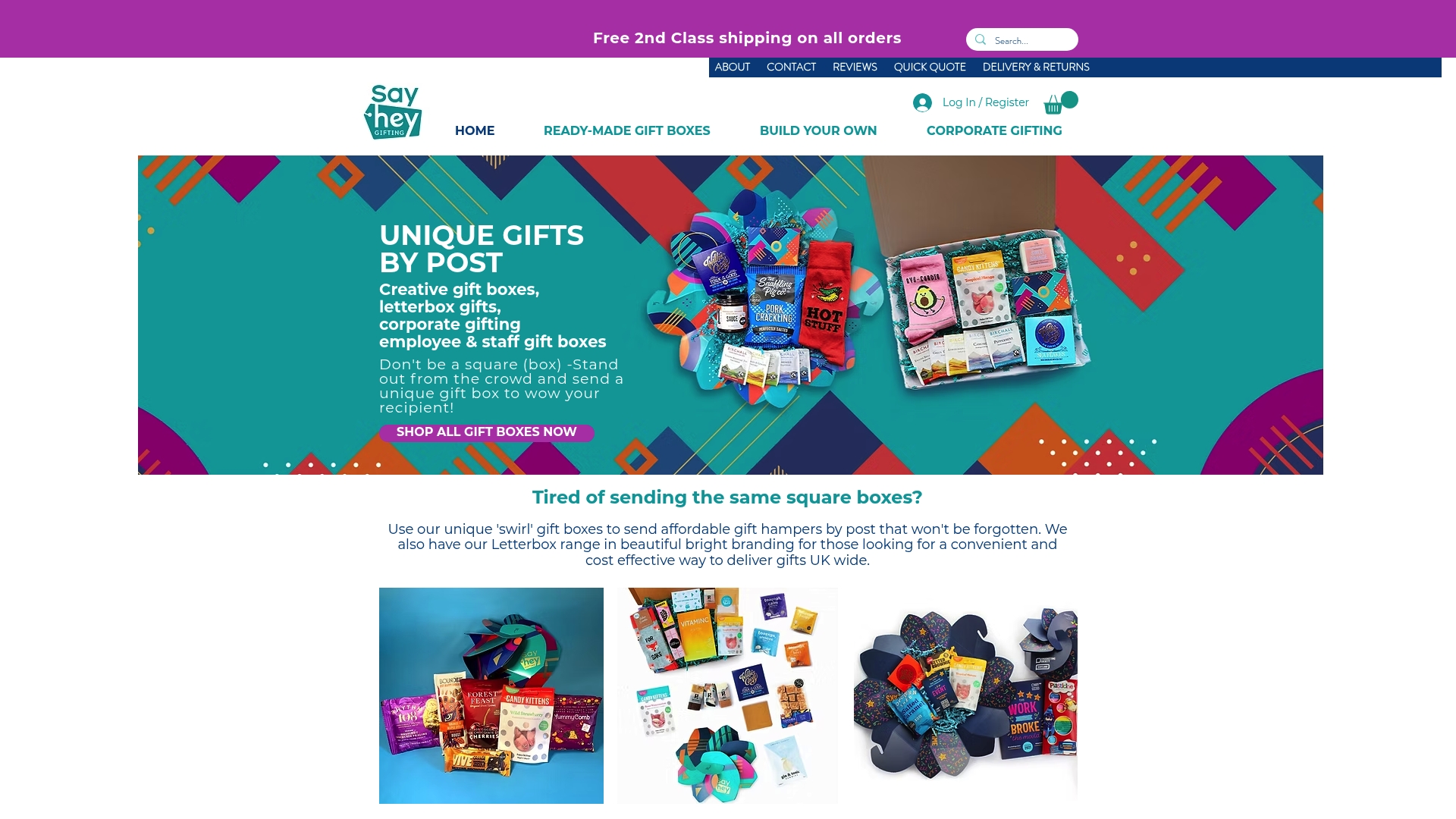
What Sayheygifting offers for corporate programmes:
Sample orders so you can approve quality before committing to volume
Multi-address fulfilment for nationwide employee and client campaigns
Letterbox gifts designed to deliver without a signature, ideal for remote teams
Custom branding options including branded sleeves and personalised notes
VAT-ready invoicing for straightforward procurement and finance sign-off
Christmas letterbox gift sets for seasonal campaigns, available for bulk orders
Whether you’re starting with a small pilot or scaling an existing programme, the right place to begin is the employee gift box page. Browse the range, request a sample, and have something in the post within days.
Useful sources and further reading
Use these references to verify compliance requirements, deepen your logistics knowledge, and build internal policy documentation.
UK government guidance on giving gifts — The authoritative source for public-sector gifting rules and restrictions. Consult this before sending to any public official or regulated professional.
Emily Post: corporate gift giving etiquette — Practical etiquette guidance covering timing, appropriateness, and procurement-window rules. Useful for building internal policy.
GiftList: executive corporate gifting guide — Covers budget tiers, nominal value norms, and the case for personalisation over spend. Good reference for procurement teams setting policy ceilings.
Airpals: corporate gifting guide — Detailed operational guidance on shipping planning, address verification, and white-glove delivery. Use this for logistics and vendor briefing.
Sayheygifting: corporate gifting logistics explained — Practical UK-focused guide to multi-address fulfilment, carrier selection, and peak-period planning.
Sayheygifting: employee appreciation gift guide for HR teams — HR-facing guidance on employee gift programmes, policy considerations, and recognition best practice.
Bottle in a Box: guide to corporate gifting — UK-specific overview of gift formats, occasions, and presentation options. Useful for gift-type selection and format comparisons.
This article is general guidance, not legal or tax advice. For your specific situation, particularly regarding the Bribery Act 2010 or sector-specific gift restrictions, consult a qualified professional or your organisation’s compliance team.
Recommended

The section list here reads like a general-interest mix rather than a niche trade publication. If you want career and lifestyle updates in the same feed as technology news, that combination is the main reason to bookmark it.