
Corporate gifting calendar for HR: Lock orders by October
A corporate gifting calendar is a date-based schedule that maps every gifting occasion across the year against ordering deadlines, so nothing lands late or gets forgotten. The priorities that matter most are Q4 holidays, new starter onboarding, work anniversaries, and everyday employee recognition. Your immediate task: add these dates to your planning tool now and set supplier lead-time reminders before the year fills up.
TL;DR:
Ordering custom and branded gifts should start at least two months before peak periods like Christmas to avoid delays and postal congestion.
High-tier recipients such as executives and top clients warrant premium, personalized gifts that justify larger budgets, while all-staff gifts should focus on cost-effective letterbox options.
International gifting requires additional planning, with at least one extra week for customs clearance and regional holidays to ensure timely delivery across different countries.
Including unexpected milestones and sector-specific observances in your calendar boosts engagement by creating personalized moments beyond standard holidays.
Effective planning combines procurement timelines with timing for samples and recipient lists, and it benefits from working with vendors that handle design, sourcing, and fulfillment seamlessly.
Table of Contents
Month-by-month corporate gifting calendar: what to send and when
Fulfilment and personalisation checklist before you send anything
How Sayheygifting plans and delivers a corporate gifting calendar
Lesser-known gifting occasions worth adding to your calendar
Integrating corporate gifting with wider engagement and marketing strategy
Why most gifting calendars fail before December even arrives
Month-by-month corporate gifting calendar: what to send and when
A gifting calendar only earns its keep when it tells you why a date matters, who receives something, and what to actually send. Below is a working structure you can copy straight into your HR planning tool, drawn from the way most corporate gifting calendars are built, month by month, with suggested gift types attached to each occasion.
January: New Year, new starters. Onboarding welcome gifts for anyone joining in Q1; a letterbox gift or desk hamper works well and sets a warm tone from day one.
February: Employee Appreciation Day (early March in some calendars, but planning starts in February) and Valentine’s-adjacent client thank-yous. Small, personal touches beat generic branded pens here.
March: International Women’s Day and end-of-quarter recognition. Wellness gifts or a curated care package suit both occasions.
April: Easter and spring onboarding cohorts. Seasonal treat boxes are inexpensive and easy to personalise at scale.
May: Mental Health Awareness Week. A wellness-focused gift box signals genuine care rather than a box-ticking exercise.
June: Mid-year reviews and Pride Month. This is a strong moment for manager-led recognition gifts tied to performance conversations.
July: Summer send-offs, sabbaticals, and client relationship check-ins. Lighter, warm-weather hampers travel well by post.
August: Quiet on the calendar for most businesses, which makes it a smart window for planning ahead rather than reacting.
September: Back-to-business season and new financial-year kick-offs. Good timing for client retention gifts as budgets reset.
October: Halloween-themed treats for staff, but more importantly, your last sensible window to place Christmas orders for anything customised.
November: Thanksgiving-adjacent client gifting (useful for international accounts), plus the start of peak dispatch season.
December: Christmas is the single busiest gifting month of the year, and the one most likely to expose a poorly planned calendar.
The pattern is clear once you see it laid out: predictable peaks cluster around Q4 and January onboarding, while opportunistic moments (mental health weeks, mid-year reviews, sabbaticals) reward HR teams who plan ahead rather than scramble. One overlooked insight worth building into your calendar deliberately: gifting programmes that blend predictable annual dates with unexpected milestone-driven surprises tend to land with more perceived value than a calendar that only fires on Christmas and birthdays. A mid-year “just because” gift often gets talked about more than the expected festive hamper, precisely because nobody was expecting it.
When to order: supplier lead times and a timing checklist
Every date on your calendar is only useful if you work backwards from it. Suppliers are consistently clear that November and December represent the busiest period for corporate gifting, and that ordering with 2 to 3 months of lead time is the difference between a smooth rollout and a last-minute scramble.
As a rough guide across gift categories:
Letterbox gifts: 2 to 4 weeks lead time, the most forgiving format for last-minute decisions.
Customised hampers: 4 to 8 weeks, longer if you need multiple SKUs or dietary variations.
Branded merchandise or boxes: 6 to 12 weeks, especially during Q4 when print and packaging suppliers are stretched thin.
Experiential vouchers: 2 to 6 weeks depending on the provider, though popular experiences can sell out closer to Christmas.
For a Christmas campaign specifically, aim to have branded or customised orders confirmed by early October. That gives suppliers room for personalisation, quality checks, and dispatch, with a buffer for the inevitable postal congestion that arrives every December.
Pro Tip: Build a two-week contingency into every delivery window during peak season. Postal delays don’t announce themselves in advance, and a gift that arrives after the occasion loses most of its impact.
Request samples early, ideally before you commit to a bulk order, and lock in your final recipient list at least two weeks before fulfilment begins.
Budgeting and recipient segmentation: who gets what
Not every recipient needs the same gift, and treating them identically usually means either overspending on everyone or underspending on the people who matter most to retain. A tiered approach, commonly used across corporate gift planning, gives you a defensible structure:
Executive and board-level: highest budget tier, reserved for premium hampers or fully custom boxes with a personal note.
High-value clients: second tier, focused on gifts that reinforce the relationship rather than generic branding.
Managers and team leads: mid-tier recognition gifts, often tied to specific achievements or project milestones.
All-staff distributions: the largest headcount, smallest per-head budget, where letterbox gifts do the heaviest lifting.
Scale each tier by headcount rather than a flat company-wide figure, and build in exceptions for service anniversaries or award wins that deserve a step up regardless of tier. Letterbox gifts are particularly efficient for broad staff distribution because postage and packing costs stay low even as headcount grows, which frees up budget to spend properly on your top tiers.
Fulfilment and personalisation checklist before you send anything
A gifting calendar tells you when. This checklist tells you how to actually get gifts out of the door without a last-minute panic.
Confirm headcount and collect a final recipient CSV, including postal addresses, at least 14 days before dispatch.
Gather dietary and allergy information for any food-based hampers before finalising contents.
Approve branding, artwork, and messaging, then request a physical sample for sign-off before the full run goes to print.
Choose your fulfilment route (single warehouse dispatch versus individual courier drops) and confirm delivery windows with your supplier.
Run an internal quality check on a small batch before the full send, then confirm delivery once the campaign lands.
Pro Tip: Send yourself a test gift alongside the main batch. It’s the fastest way to catch a packaging or personalisation error before your CEO does.
How Sayheygifting plans and delivers a corporate gifting calendar
At Sayheygifting, we build campaigns around the calendar, not the other way round. Whether it’s a Q4 rollout of custom Sayhey Swirl boxes or a build-your-own scheme for a growing team, our corporate gifting work is shaped by the same principle running through this guide: confirm addresses early, sample before you scale, and never let personalisation become an afterthought. Our work is designed around getting the timing right.
Guidance on international shipping for global recipients
If your business has staff or clients outside the UK, your calendar needs a second set of deadlines. International shipping introduces variables that domestic dispatch simply doesn’t: customs clearance, regional public holidays that don’t match the UK calendar, and carrier capacity that tightens dramatically in December.
As a working rule, add at least an extra week onto any international lead time beyond what you’d budget for UK delivery, and more for regions with known customs delays. Perishable items, especially food hampers, carry additional restrictions in many countries, so check import rules before you commit to a menu for an international client list.
Time zones and regional calendars matter too. A gift timed for Thanksgiving makes sense for US clients but says nothing to a team based in continental Europe, where the occasion doesn’t register. If you manage a genuinely global recipient list, it’s worth building a second, smaller calendar layer specifically for regional observances relevant to those markets, rather than assuming one UK-centric calendar fits everyone.
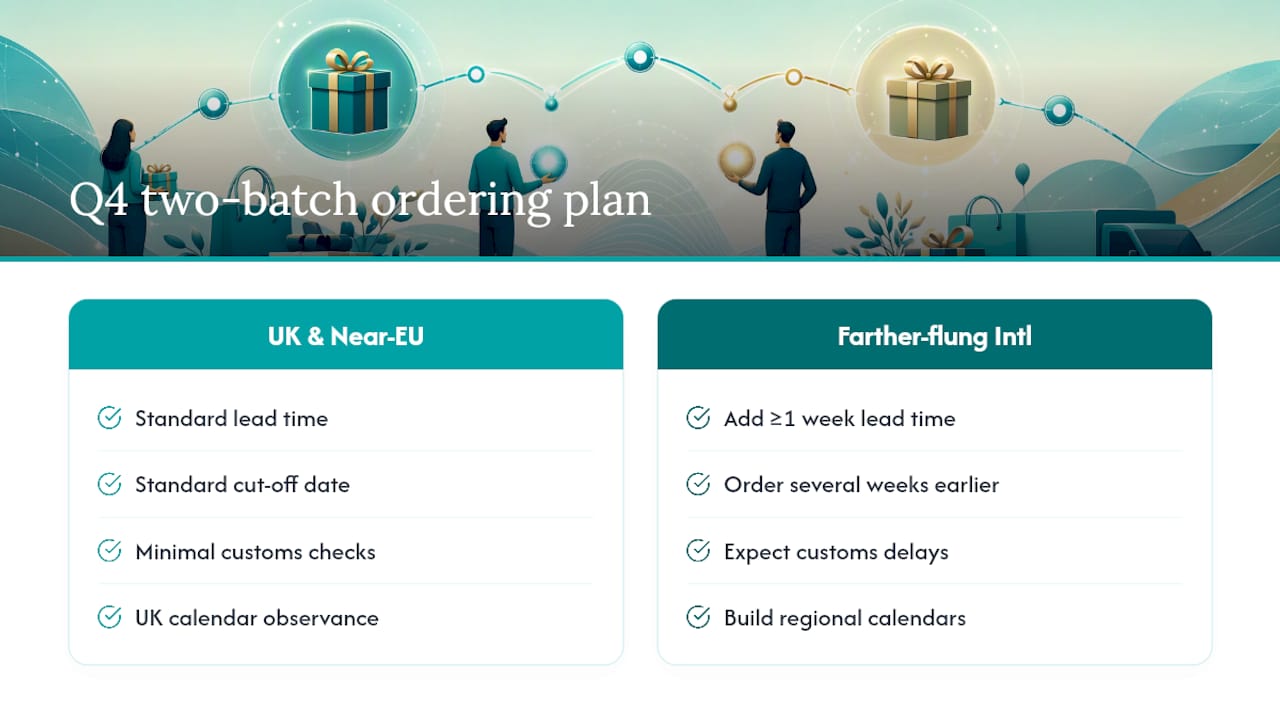
Practically, this means splitting your Q4 order into two batches with different cut-off dates: one for UK and near-Europe recipients with a standard lead time, and one for further-flung addresses ordered several weeks earlier. It’s an extra layer of planning, but it’s far less painful than a hamper arriving in January for a client who was supposed to receive it in early December.
Lesser-known gifting occasions worth adding to your calendar
Christmas and birthdays dominate most gifting calendars, but some of the most memorable gestures happen on dates nobody expects. Building these in gives your programme a rhythm that feels considered rather than mechanical.
Work anniversaries deserve more structure than most companies give them. A first-year anniversary calls for something different to a ten-year milestone, and treating them identically undersells genuine loyalty.
Project completion or client contract renewal dates rarely make it onto a standard calendar, yet they’re some of the most meaningful moments to acknowledge, precisely because a gift tied to a specific achievement carries more weight than one tied to a generic date on the calendar, as milestone-driven gifting consistently outperforms routine timing.
Industry-specific dates also matter more than people assume: World Teachers’ Day for education clients, National Nurses Week for healthcare partners, or sector-specific awareness weeks relevant to your client base. A gift that acknowledges a client’s own industry calendar, rather than yours, signals attentiveness that a generic Christmas hamper simply cannot.
Farewell and retirement gifting is another underused moment. A collective card or message alongside a gift adds a personal layer that a box alone can’t provide, and partners like Happy Milo specialise in exactly that kind of team-wide message for onboarding, farewells, and milestones.

Integrating corporate gifting with wider engagement and marketing strategy
Gifting works best when it isn’t treated as a standalone HR task sitting apart from everything else the business is doing. A gift sent alongside a wellbeing initiative reinforces the message far more effectively than either action on its own, and the same logic applies to marketing.
Using gifting personas is a useful mental model here: a “recognition” persona for top performers who need visible acknowledgement, a “wellness” persona for staff during high-pressure periods, and a “purpose-driven” persona for clients who respond to sustainability or values-led messaging. Matching the gift type to the persona rather than defaulting to one generic box for everyone makes each send feel considered rather than templated.
On the marketing side, client gifts often double as a soft-touch retention tool. A well-timed hamper sent alongside a contract renewal conversation or a new product launch does more relationship-building than a follow-up email ever will. The same applies internally: pairing a gift with an engagement survey launch, a wellbeing campaign, or a company milestone announcement gives the gesture a purpose beyond the box itself. Treat your gifting calendar as a layer that sits underneath both HR and marketing activity, not a separate line item competing for the same budget.
Why most gifting calendars fail before December even arrives
The conventional advice on corporate gifting spends most of its energy on gift ideas and almost none on the procurement mechanics that determine whether those ideas ever ship on time. That’s backwards. The single biggest failure point isn’t a bad gift choice, it’s a good gift choice made three weeks too late to execute properly.
What the evidence here actually supports is a shift in priority: treat your calendar as a procurement schedule first and a gift-idea list second. HR teams that build in ordering deadlines from January, rather than reacting to Christmas in November, consistently avoid the rush charges and stockouts that plague late planners. The teams that get this right aren’t the ones with the biggest budgets. They’re the ones who worked backwards from the delivery date months in advance.
If you take one thing from this guide, make it this: block out your supplier lead-time reminders today, before you spend another minute browsing gift ideas. The ideas are the easy part.
— Craig
Get your calendar into production with Sayheygifting
Sayheygifting is the practical alternative to piecing a gifting calendar together from spreadsheets and separate suppliers. We handle the design, sourcing, and fulfilment side of the calendar you’ve just planned, so you’re not chasing three vendors during your busiest week of the year.
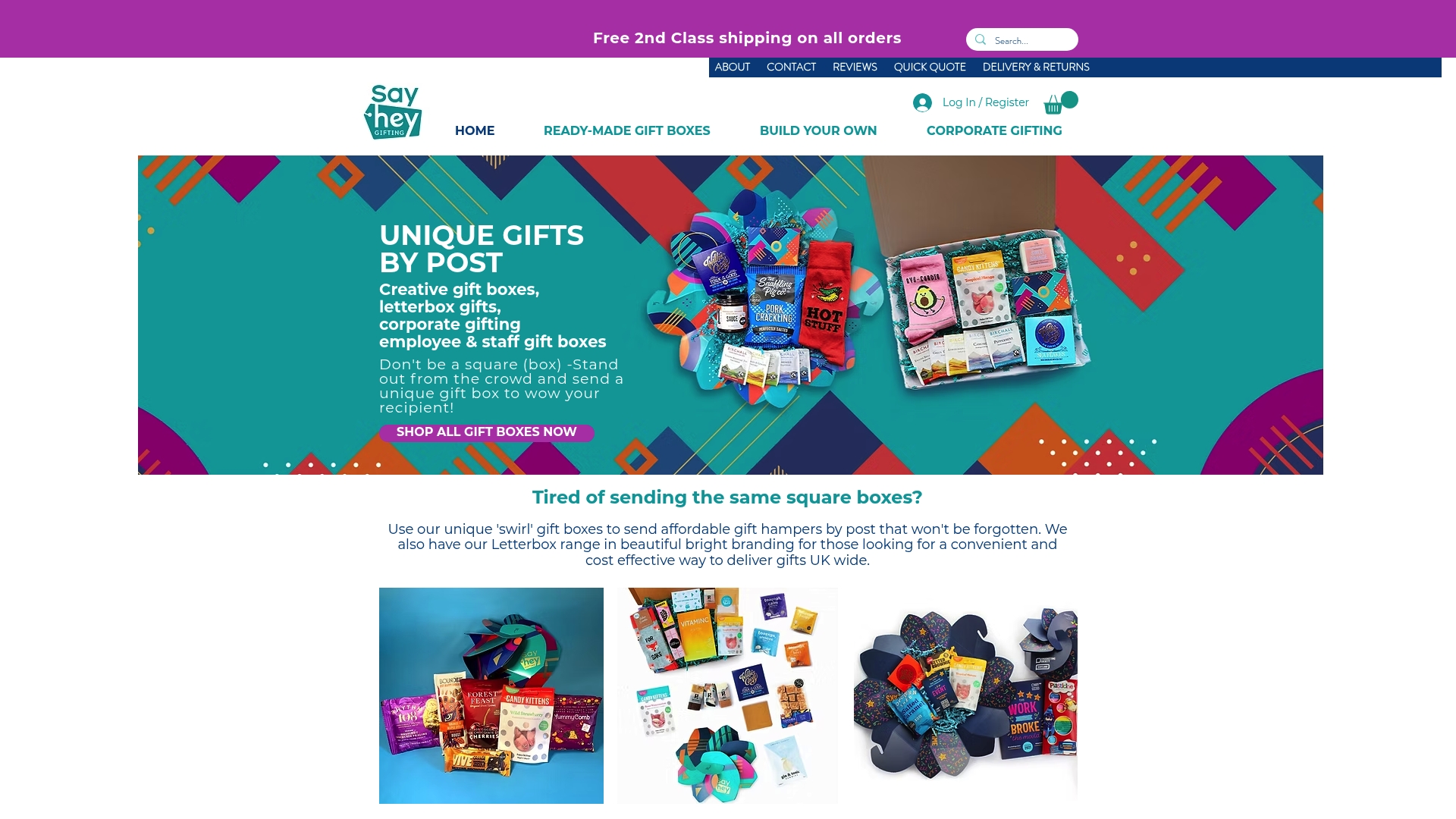
Our services map directly onto what this guide covers: custom corporate gifting for your top tiers, build-your-own options for flexible mid-tier recognition, and letterbox gifts for broad staff distribution without the postage headache. Boxes can be customised with company logos, and packaging is selected with sustainability considerations.
To get a quote moving, come prepared with your key dates, an approximate headcount, your budget band per tier, and a sense of preferred gift types (wellness, hampers, or letterbox). Head to our corporate gifting page to start the conversation before your next deadline creeps up on you.
Sources
FAQ
What Is a Corporate Gifting Calendar?
It’s a date-based schedule mapping gifting occasions across the year against supplier ordering deadlines, so HR teams plan procurement rather than reacting to each date as it arrives.
When Should We Order Christmas Corporate Gifts?
Aim to confirm branded or customised orders by early October, since suppliers recommend ordering 2 to 3 months ahead of peak December demand.
How Much Should We Budget Per Employee?
Budgets should scale by tier rather than a flat figure. Use an executive, client, manager, and all-staff structure, with letterbox gifts covering broad distribution affordably.
Does Sayheygifting Offer Bulk Ordering for Corporate Gifts?
Yes, Sayheygifting handles bulk and single orders for corporate gifting, including custom branded boxes, letterbox gifts, and build-your-own options, with pricing available on request.
What Gifts Work Best for Remote Employees?
Letterbox gifts are generally the most practical choice for remote or widely distributed teams, since lower postage and packing costs make broad distribution affordable.
Recommended

Comments