
Ready to copy gift message examples using the three beat formula
The best gift messages follow a simple three-beat formula: name the gift or occasion, add one specific detail about why it matters, then close with a warm, relationship-appropriate sign-off. Keep it to two to five sentences for most cards, or a single line for gift tags and gift-card envelopes. What follows is a full library of ready-to-copy examples, grouped by occasion and relationship, so you can borrow, adapt, or use them exactly as written.
TL;DR:
Specific details about the gift or occasion, such as naming the object and how it will be used, make messages more memorable and sincere.
Matching the sign-off to the relationship, whether casual or professional, enhances the message’s appropriateness and tone.
Keeping gift messages to two to five sentences ensures clarity, sincerity, and that the note gets read without over-explaining.
For small spaces, short lines naming the gift and a warm closing are effective, avoiding vague or overly generic wording.
Professional gift messages should be brief, warm, and focus on appreciation without over-sharing personal details or referencing prices.
Table of Contents
Quick starter lines for gift message examples in a hurry
Sometimes you have thirty seconds, a pen that’s running dry, and a card that needs filling. These openers work as complete messages on their own, or as the first beat of a longer note. Each one is built to sound like you wrote it, not a printed insert.
Warm and heartfelt openers, best for people you know well:
“Thinking of you always, and hoping this brings a smile.”
“You deserve every good thing, starting with this.”
“For someone who makes everything better just by being around.”
“A little something to say you’re loved more than you know.”
Light and funny openers, best for friends who appreciate humour over sentiment:
“I saw this and thought ‘that’s so them’ in the best way.”
“Consider this your official permission to be a bit extra today.”
“Warning: contains zero calories, all the love.”
“Not sorry for spoiling you. You’re welcome.”
Celebratory openers, best for milestones, promotions, and achievements:
“Cheers to you and everything you’ve earned!”
“Here’s to the next chapter. It’s going to be a good one.”
“You did the thing! This is your reward.”
Neutral, polite openers, best for acquaintances, new colleagues, or anyone you don’t know especially well:
“Wishing you a wonderful day.”
“Sending good wishes your way.”
“Hope this small gesture brings a bit of joy.”
For gift tags and gift cards where space is tight, stick to the shortest lines above and sign with initials or a first name. A good gift card message doesn’t need padding. One honest sentence naming the gift and its purpose beats three vague ones every time. If you’re tucking a note into a candle set or a small retail gift, brands like Custom Candle Co often print space for exactly this kind of short line, so keep your wording tight enough to fit a two-inch tag.
Gift message examples by occasion
Every occasion has its own emotional register, but the three-beat structure. Name it, detail it, close it. Works underneath all of them.
Birthday messages
Short: “Happy birthday to someone who makes every year better!”
Longer: “Happy birthday! I still remember how much you laughed when we found this, so it felt right to send it your way. Hope your day is full of cake and zero adulting.”
Best for: close friends and siblings who enjoy a personal callback.
Thank-you messages
Short: “This is already on my desk. Thank you!”
Longer: “Thank you so much for the [scarf/book/candle], it’s exactly my colour and I’ve already worn it twice this week. You always know what I love. Sending you all my thanks.”
Naming the object and describing where it now lives, on the desk, on the shelf, worn twice already, is the detail that makes a thank-you note feel real rather than obligatory. Best for: any recipient, adjust warmth to the relationship.
Anniversary messages
Short: “Happy anniversary to my favourite person.”
Longer: “Happy anniversary. Every year with you somehow gets better, and this year has been no exception. Here’s to many more, together.”
Best for: partners and spouses; adapt “partner” language for a couple you know well by naming both names.
New home messages
Short: “Welcome home! May it be full of good memories.”
Longer: “Congratulations on the new place! This is for your kitchen, because I have a feeling it’s about to see a lot of use. Wishing you many happy years there.”
Best for: friends and family; naming a room (“for your kitchen,” “for the garden”) is the specific detail that lifts this above generic.
Sympathy messages
Short: “Thinking of you during this difficult time.”
Longer: “I’m so sorry for your loss. [Name] meant so much to so many people, and that never fades. Sending you love and strength in the days ahead.”
Best for: close family or friends; keep tone gentle, avoid clichés like “everything happens for a reason.”
Congratulations messages
Short: “So proud of you. Well deserved!”
Longer: “Congratulations on the new job! I know how hard you worked to get here, and this is exactly the celebration you’ve earned. Here’s to what comes next.”
Best for: colleagues, friends, and family celebrating a promotion, graduation, or new venture.
Holiday and gift-card messages
Short: “Happy Christmas! Treat yourself to something you love.”
Longer: “Happy holidays! This is a small thank you for a year of laughs and support. Hope it treats you to something you wouldn’t normally buy yourself.”
If you’re choosing between a physical present and a card, a gift-card message benefits most from naming what the amount could go toward: “for the coffee habit you keep pretending you don’t have” says more than a plain “enjoy.”
Gift message examples by relationship
Tone shifts more with who you’re writing to than with the occasion itself. Here’s how to adjust for each relationship.
For a partner: warmth can run higher and more personal.
“You make ordinary days feel like something worth celebrating.”
“For the person who already has my whole heart, here’s something small too.”
For a close friend: humour and shared history work well.
“Found this and immediately thought of our disastrous weekend away. Enjoy.”
“You’re the reason I have any good stories at all. Thank you for being you.”
For family: sincerity without overexplaining.
“Love you always, Mum. Hope this makes you smile.”
“For the sibling who’s put up with me longer than anyone should have to.”
For a colleague: friendly but professional.
“Wishing you a well-deserved break. Thanks for everything this year.”
“You made this project so much smoother. Small thanks for a big effort.”
For a boss or manager: appreciative, never overly familiar.
“Thank you for your guidance and support this year. It’s genuinely appreciated.”
For an acquaintance: polite, brief, no assumed closeness.
“Wishing you all the best. Happy holidays!”
For group cards or tiny spaces, initials work better than full names. A first name plus initial (“Sam, T.”) reads as warm without crowding a signature line already carrying six other messages. Save full names for formal or professional cards where the recipient might not immediately place a first name alone.
How to write your own gift message using the three-beat formula
You don’t need to memorise a list of lines if you understand the shape behind them. The three-part structure, name it, detail it, close it, works because specificity is what makes a message land. A generic “thanks so much, love it” could apply to any gift from anyone. Naming the actual object and one true detail about it proves you noticed, and that’s what people actually remember.
Beat one: name the gift or occasion. “Thank you for the notebook” or “Happy birthday” gives the reader instant context.
Beat two: add one specific detail. This is where sincerity lives. Say what you’ll do with it, why it matters, or what memory it triggers. “I’ve already started filling the first few pages” does more work than any adjective could.
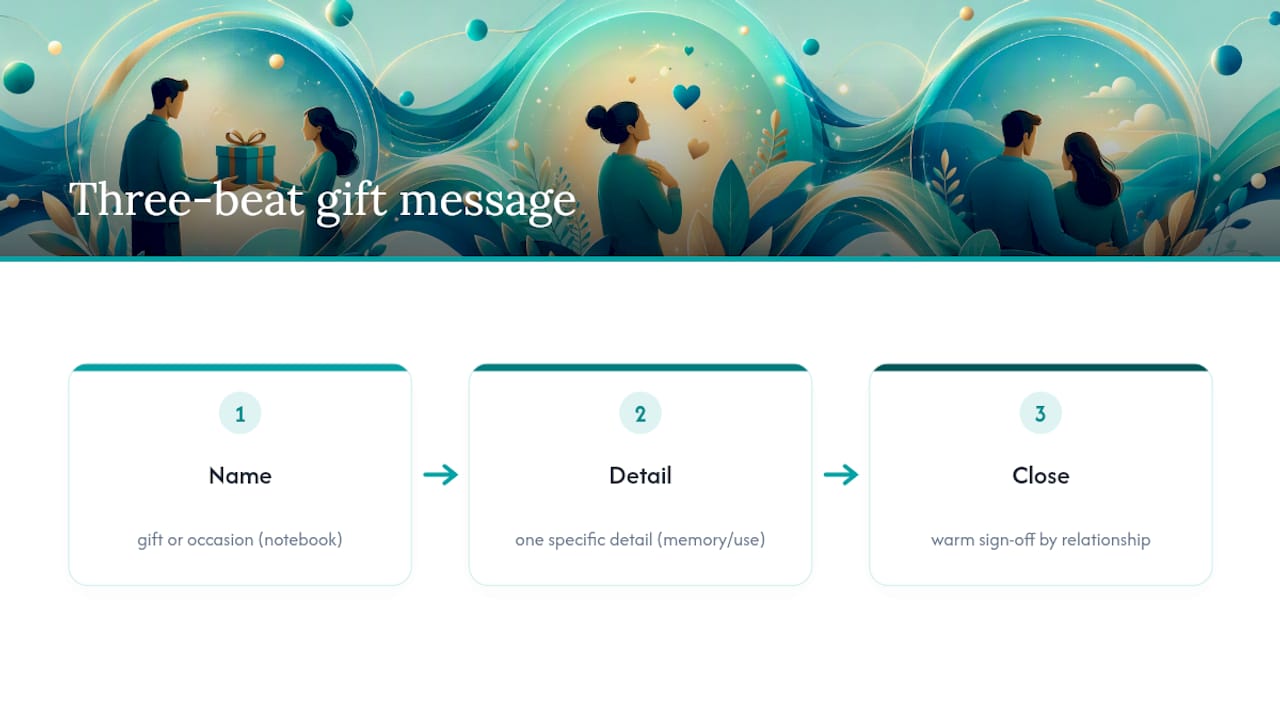
Beat three: close with warmth. Match the sign-off to the relationship, casual for friends, measured for colleagues, tender for family.
Four worked examples:
Thank you (colleague): “Thank you for the coffee gift set. It’ll be very welcome during the next big deadline. Really appreciate the thought.”
Birthday (sibling): “Happy birthday! This reminded me of the trip we took last summer, so it felt like the right pick. Hope this year is your best yet.”
Sympathy (friend): “Thinking of you this week. Your mum’s kindness touched everyone who knew her. Here for you, always.”
New job (friend): “Congratulations on the new role! You’ve wanted this for so long and you earned every bit of it. So proud of you.”
Two to five sentences is the practical sweet spot: long enough to include all three beats, short enough that it actually gets read rather than skimmed. When space is tight, drop straight to one sentence that does beats one and two at once. “Loving this candle already, thank you!” is complete on its own.
Short tag and gift-card lines for tiny spaces
Gift tags and card envelopes rarely give you more than a line or two. These work exactly as written:
“Enjoy every bit of this!”
“Small gift, big love.”
“You deserve this and more.”
“Just because.”
“A little treat for a lot of you.”
“Hope this makes your day.”
“For the person who deserves spoiling.”
“Sending smiles your way.”
“Happy everything!”
“You’ve earned this one.”
“Thinking of you today.”
“Wishing you all good things.”
For sign-offs in tiny spaces, initials plus an emoji work fine for close friends (“J x 🎉”) but skip emoji entirely for professional or older relatives who may not read them the same way. Write clearly rather than small; a message nobody can decipher defeats the point of writing one at all.
Corporate and professional gift message examples
Workplace gifting calls for a different register: warm, but never overly personal. Professional gift messages should acknowledge the recipient’s contribution or the working relationship rather than veering into private territory.
Short examples:
“Thank you for your hard work this year. Well deserved.”
“Wishing you a restful break. You’ve earned it.”
“A small thank you for everything you bring to the team.”
Longer examples:
“Thank you for your dedication this year. Your work has made a real difference to the whole team, and we wanted to mark that. Enjoy this small token of appreciation.”
“Congratulations on your work anniversary. It’s been a pleasure working alongside you, and we’re grateful for everything you contribute. Here’s to many more.”
“Happy holidays! Thank you for your continued hard work and support. We hope you have a wonderful break with those you love.”
Pro Tip: Keep professional messages under three sentences and avoid referencing salary, bonuses, or anything overly personal. Warmth plus brevity reads as sincere; length plus detail can tip into awkward. Businesses handling bulk gifting often need this tone applied consistently across dozens of cards, which is where a guide to employee gifting or a closer look at corporate gift messaging can help keep every note on brand.
Common mistakes and pro tips for gift messages that feel genuine
The biggest mistake is reaching for a cliché instead of a true detail. Experts caution against greeting-card poetry and over-explaining; clarity beats cleverness every time. Other pitfalls: quoting a song or a famous line instead of writing your own words, and mentioning specific money amounts, which can feel transactional rather than kind.
Skip generic phrases like “you shouldn’t have” unless followed by something specific.
Never quote someone else’s words as a substitute for your own.
Avoid naming prices or costs, even jokingly.
Don’t overexplain. One true detail outperforms three vague ones.
Pro Tip: Match your sign-off to the relationship, use one true detail rather than several generic ones, follow the three-beat formula, and when space is tiny, choose one sentence over a cramped paragraph. If you’re stuck, this one-line template covers almost anyone: “Thank you for [the gift], I’m already [specific use], and it means a lot.”
Sayhey Gifting’s perspective on messaging that actually lands
Craig has spent years watching businesses wrestle with the same problem: knowing what to buy is easy, knowing what to write is where people freeze. Sayhey Gifting specialises in creative corporate gifting with a range of gift boxes and hampers for various occasions. What we’ve found is that the message matters as much as the box it travels in.
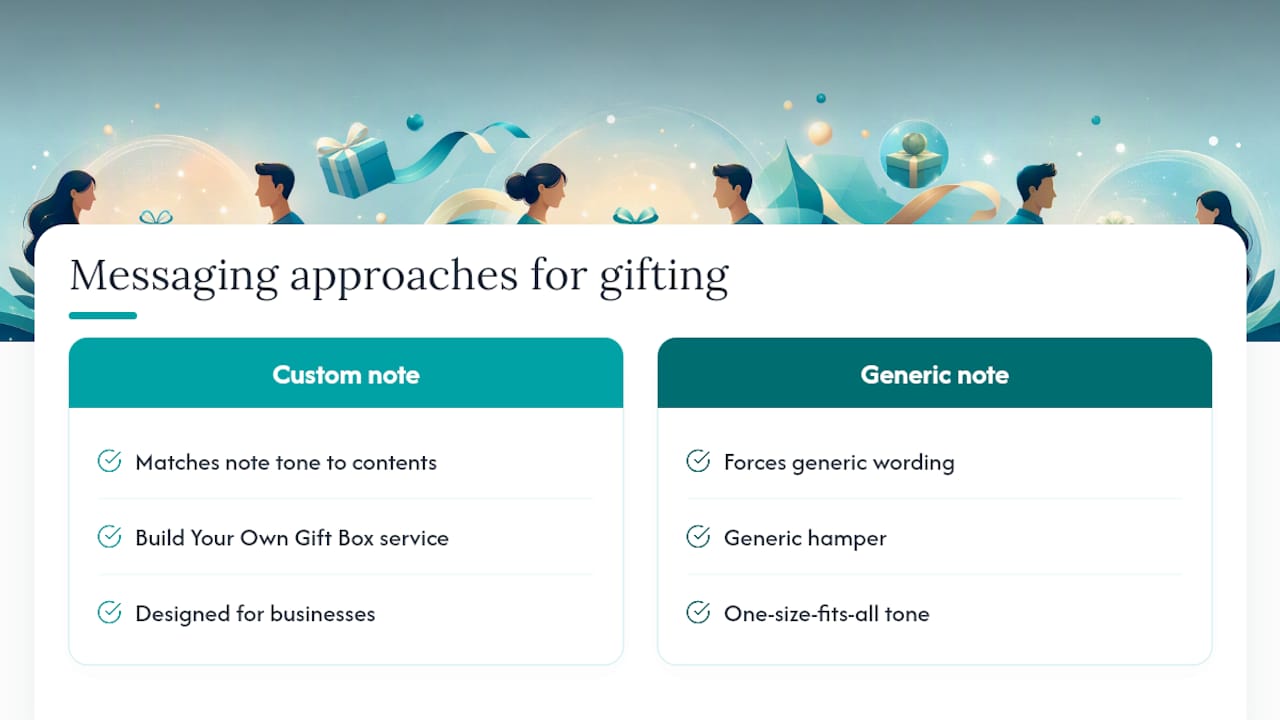
That’s largely why the Build Your Own Gift Box service exists. It lets a business match the note’s tone to the exact contents rather than forcing generic wording onto a generic hamper.
— Craig
Ready-made or custom, Sayhey Gifting covers both
Writing the perfect line is only half the job. If you’d rather skip the card shop entirely, Sayhey Gifting handles the whole thing, from box to note. Our corporate gifting service manages design, fulfilment, and sourcing at bulk or single-order scale, while custom branding on boxes and letterboxes comes at no extra charge. That means HR teams and managers get consistent, relationship-appropriate wording across every box without writing fifty individual cards by hand.
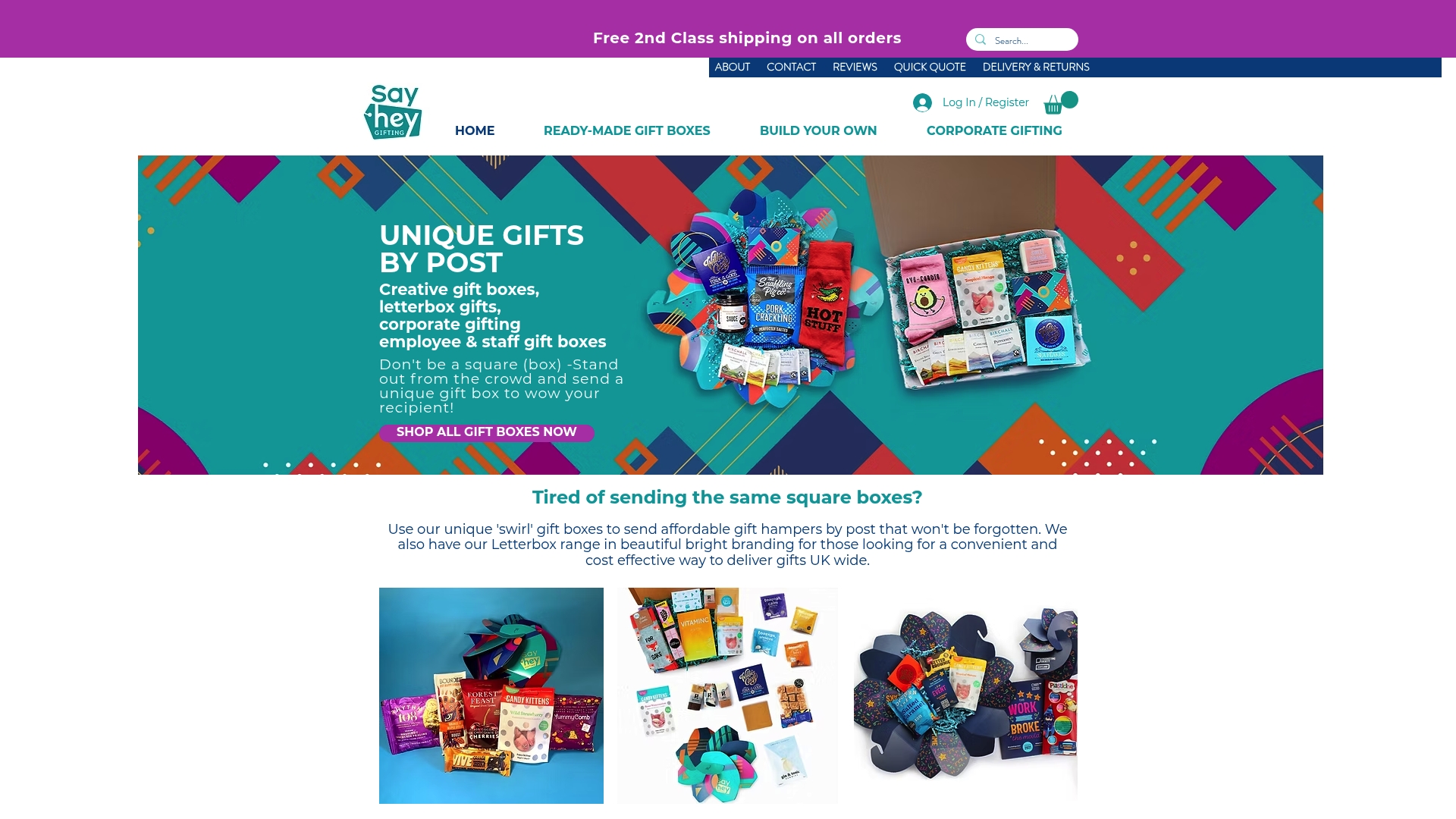
For individual gifts, the Build Your Own Gift Box lets you pick contents and pair them with your own message, while Letterbox gifts suit a smaller, doorstep-friendly surprise. They handle the practical side of delivery, enabling customers to focus on their gift messages. Start building a box on the corporate gifting page whenever you’re ready to send something that actually gets remembered.
Sources
FAQ
What’s a good short gift message?
A good short message names the gift and adds one true detail, such as “Loving this scarf already, thank you!” Two sentences at most is the recommended length for a short note, and one line is enough for a gift tag.
What is a simple message I can write on a gift card?
Keep it to one honest sentence naming the gift or occasion, then a warm close: “Happy birthday, hope this treats you to something fun.” Skip padding; a specific, brief line reads as more sincere than a longer generic one.
How do you write a gift message?
Use the three-beat formula: name the gift or occasion, add one specific detail about why it matters, then close with a sign-off matched to your relationship. This structure works for birthdays, thank-yous, sympathy, and corporate cards alike, adjusted only in tone.
What is a short and sweet message?
It’s typically one or two sentences that name the gift and show genuine warmth without over-explaining, such as “You deserve this and more, enjoy!” For handwritten notes on formal gifts like weddings, a slightly longer note is more appropriate than a one-liner.
Recommended

Comments