
How to personalise gifts for employees that truly resonate

Personalised gifts for employees are defined as recognition items tailored to the individual recipient through name printing, engraving, handwritten notes, or curated product selection. A June 2026 study of 480 employees across 15 enterprises found that personalised corporate gifting increases engagement scores by 18% to 27% compared to generic gifts. That gap is significant. It means a thoughtfully addressed gift box does measurably more for morale than an identical box with no personal touch. For HR professionals and team leaders, understanding how to personalise staff gifts well is one of the highest-return investments in workplace culture available.
What do you need before you personalise gifts for employees?
Effective personalisation starts with clean, accurate data. Before you brief a supplier or order packaging, you need three things confirmed: the employee’s preferred name, their role or occasion context, and the personalisation level you are applying.
Gathering the right employee data
Employee records in most HR management systems (HRMS) store legal names, not preferred names. Discrepancies between legal names, nicknames, and preferred names are common and cause real gifting awkwardness. A gift addressed to “Jonathan” for someone who goes by “Jon” signals the opposite of personal care. Collect preferred names through a short survey, manager input, or a dedicated field in your HRMS. Standardise capitalisation and remove trailing spaces before sending data to your supplier.

Choosing your personalisation level
Three levels exist, each with different costs and impact:
Card only: A personalised message card with the employee’s name and a manager’s signature. Lowest cost, highest emotional return per pound spent.
Packaging personalisation: Name printed on the box, ribbon, or tissue paper. Adds visible warmth when the gift is opened.
Gift item personalisation: Engraving or printing directly on the product itself, such as a mug, notebook, or flask.
Personalisation costs are a small addition relative to the perceived value they create. The perception of thoughtfulness rises sharply even at the card-only level, making it the most accessible entry point for teams with tighter budgets.
Personalisation level | Typical application | Best suited for |
Card only | Handwritten or printed message card | All team sizes, any budget |
Packaging | Name on box, ribbon, or wrapping | Mid-size teams, milestone gifts |
Gift item | Engraving, embossing, or printing on product | Senior recognition, long service awards |
Pro Tip: Run a quick data audit two weeks before your gifting date. Export your employee list, check for duplicates, missing preferred names, and inconsistent capitalisation. Fixing errors at this stage costs nothing. Fixing them after printing costs everything.
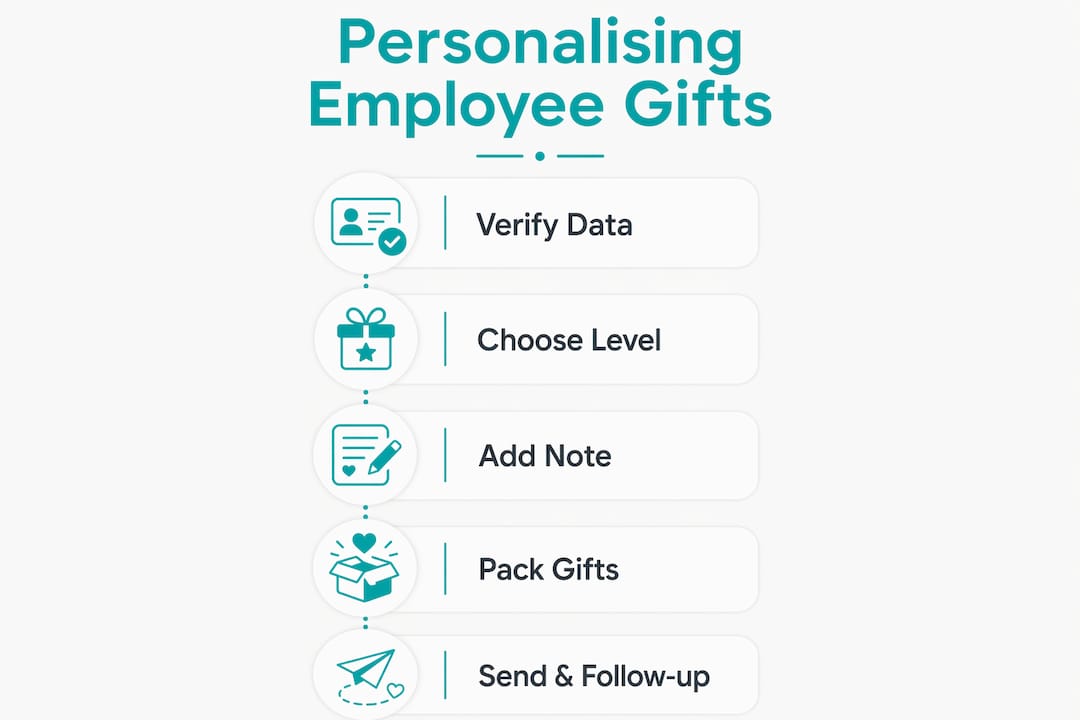
How to personalise employee gifts step by step
Once your data is clean and your personalisation level is confirmed, execution follows a clear sequence. Rushing any stage produces errors that undermine the entire effort.
Select gifts that match the individual or occasion. A gift chosen for a new starter differs from one celebrating a five-year anniversary. For new starters, a welcome box with practical items and a warm note sets the tone. For long-service recognition, a curated hamper or build-your-own gift box with premium items signals genuine appreciation. Where you know individual preferences, use them. A team member who is vegan, for example, should receive a gift that reflects that. Sayheygifting offers vegan-friendly options precisely for this reason.
Decide your personalisation method before briefing your supplier. Printing, engraving, and handwritten notes each require different lead times. Engraving typically needs the longest lead time. Handwritten notes can be added closer to dispatch. Confirm your supplier’s capabilities and deadlines in writing before committing to a delivery date.
Use variable data printing for teams of any size. Variable data printing allows each printed item in a batch to carry unique information, such as a different name on every card or box, without individual manual setups. This technology makes accurate personalisation at 500 or more units entirely achievable. It removes the manual error risk that comes with copy-pasting names into individual files.
Write or commission personalised message cards with manager signatures. The card is the emotional centrepiece of the gift. It should name the employee directly, reference something specific about their contribution, and carry the signature of their direct manager. Generic wording like “thank you for your hard work” is far less effective than “thank you for leading the client onboarding project so calmly under pressure.”
Run a quality check before dispatch. Print a sample batch and verify names, spellings, and message content against your original data file. Check that packaging personalisation matches the correct recipient. One error in a batch of 200 is one employee who feels overlooked.
Time delivery for maximum impact. Gifts arriving on a Monday morning, at the start of a new quarter, or on a work anniversary land with more meaning than those arriving mid-week with no context. Coordinate with your logistics provider to hit the intended date.
Pro Tip: Ask managers to send a brief personal message by email or in person on the same day the gift arrives. The combination of a physical gift and a direct verbal acknowledgement creates a recognition moment that employees remember for months.
What are the most common challenges in personalised gifting programmes?
Even well-planned programmes hit obstacles. Knowing where things typically go wrong helps you prepare before problems arise.
Inaccurate employee data. Poor data hygiene is the leading cause of name printing errors. Misspelled names or wrong preferred names reduce the perceived thoughtfulness of the gift immediately. Build a data verification step into your process every time, not just for large batches.
Generic or insincere wording. A personalised name on a box paired with a generic printed message defeats the purpose. The wording in the card must feel as considered as the gift itself. Brief managers with specific prompts if they struggle with what to write.
Delivery failures for remote or hybrid teams. Employees working from home need accurate home addresses, and those addresses change more often than office locations. Collect and verify home delivery addresses separately from your HRMS records, ideally within four weeks of your gifting date.
Balancing cost and quality at scale. Personalisation adds cost. The return, however, is disproportionate. Personalised gifts yield a significantly higher perceived value than their actual cost increase suggests. Prioritise card personalisation universally, then apply packaging or item personalisation selectively for milestone moments.
Monitoring outcomes. Run a short pulse survey two weeks after gifting. Ask employees how valued they felt and whether the gift felt personal. This data shapes your next programme and gives you evidence to present to leadership.
“Personalised gifts communicate respect and value, transforming recognition into emotional, motivational engagement. Personalisation builds trust, loyalty, and drives better retention.” Treating employees as individuals rather than job titles is the foundation of any recognition programme that actually works.
Why do personalised notes enhance staff gifts so powerfully?
The handwritten or personally worded note is the single most cost-effective element of any staff gift. Handwritten notes signed by direct managers significantly elevate gift impact by creating personal emotional connections that printed inserts cannot replicate. The reason is straightforward: a handwritten note requires time, and employees know it. That time signals genuine care.
Employees often keep handwritten notes visibly for years, pinned to desks or kept in drawers, long after the physical gift has been used. Digital recognition messages, by contrast, are typically forgotten within days. The tangible, physical nature of a note gives it staying power that no email or Slack message can match.
Effective notes share four qualities:
They use the employee’s preferred name in the opening line.
They reference a specific achievement, behaviour, or quality, not a generic role description.
They are signed by the employee’s direct manager, not a central HR team.
They are brief. Three to five sentences is the ideal length.
Manager involvement amplifies the gift’s value beyond what any product alone can achieve. When the person who sees an employee’s daily contribution takes time to write personally, the recognition feels earned rather than administered. That distinction is what personalised gifts communicate that generic gifts never can: you are seen as an individual, not a headcount.
Pro Tip: Create a simple message template for managers that includes three blanks: the employee’s name, one specific achievement, and one personal quality. This removes the blank-page anxiety that stops managers from writing notes at all, while keeping the result genuinely personal.
Key takeaways
Personalising employee gifts works because it replaces generic recognition with individual acknowledgement, and that shift produces measurable gains in engagement, loyalty, and morale.
Point | Details |
Data accuracy is non-negotiable | Verify preferred names and addresses before every gifting cycle to avoid errors that undermine thoughtfulness. |
Card personalisation delivers the highest return | A personalised note with a manager’s signature costs little but creates lasting emotional impact. |
Variable data printing scales accuracy | Use variable data printing for batches of any size to maintain personalisation without manual errors. |
Manager involvement multiplies impact | Gifts paired with direct manager recognition produce stronger loyalty than gifts sent from a central team. |
Measure outcomes every time | A short post-gifting pulse survey gives you data to refine your programme and justify investment. |
Why I think most companies are getting personalised gifting wrong
I have seen a lot of employee gifting programmes up close, and the most common mistake is treating personalisation as a design decision rather than a human one. Teams spend time debating box colours and ribbon styles, then send every employee the same printed card with the same three sentences. The name at the top does not save it.
The programmes that genuinely move people are the ones where a manager writes something true. Not polished, not long. Just true. “You kept the team calm during a difficult month” lands harder than any premium product inside the box. The gift is the vehicle. The message is the point.
The other thing I have noticed is that HR teams often underestimate how much remote employees need this. When you work from home, you miss the ambient recognition of office life: the overheard praise, the birthday cake in the kitchen, the visible acknowledgement. A thoughtfully curated staff gift arriving at someone’s front door, addressed to them by name, with a note from their manager, fills that gap in a way that a digital voucher simply does not.
My recommendation to every HR professional reading this: start with the note. Get managers writing three sentences each. Then build the gift programme around that habit. The physical gift amplifies the message. Without the message, it is just a box.
— Craig
Ready to make your next employee gift feel genuinely personal?
Sayheygifting makes it straightforward to put real thought into every gift, whether you are recognising one person or an entire team. Each employee gift box is curated with care and can be personalised with message cards, branded packaging, and product selections that reflect your team’s tastes and values.
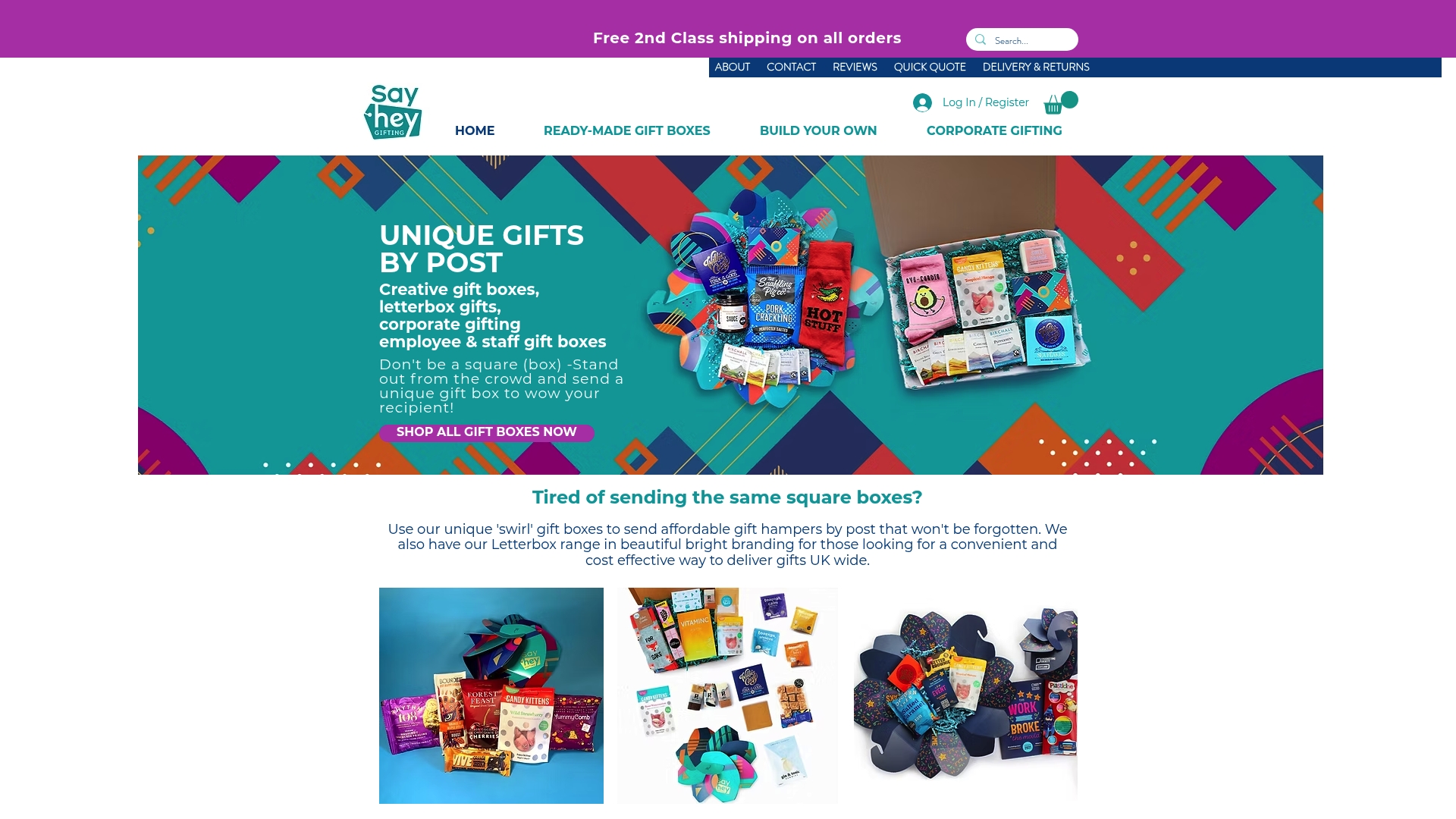
From custom branded corporate gift boxes for large-scale recognition programmes to individual letterbox gifts that arrive beautifully presented, Sayheygifting handles the detail so you can focus on the people. Every order is designed to feel like it came from someone who genuinely cares, because that is exactly the impression your team deserves.
FAQ
What does it mean to personalise gifts for employees?
Personalising gifts for employees means tailoring recognition items to the individual through name printing, handwritten notes, engraved products, or curated gift selection. The goal is to make each recipient feel seen as an individual rather than part of a generic group reward.
Why do personalised staff gifts improve engagement?
A June 2026 study found that personalised corporate gifting increases employee engagement scores by 18% to 27% compared to generic gifts. Personalisation signals individual recognition, which builds trust and motivates employees more effectively than standard rewards.
How do I collect the right data for personalised employee gifts?
Use your HRMS as a starting point, then verify preferred names and home addresses through a short survey or manager input. Clean and standardise your data at least two weeks before your gifting date to avoid printing errors.
Are personalised employee gifts expensive to produce?
Personalisation adds a modest cost, particularly at the card-only level, but the perceived value increase is disproportionate to the spend. Variable data printing makes accurate personalisation affordable even at large volumes.
What should a personalised note to an employee include?
An effective note uses the employee’s preferred name, references one specific achievement or quality, and is signed by their direct manager. Three to five sentences is the ideal length. Brevity and specificity matter far more than length or formality.
Recommended
Comments