
Why inclusion matters in staff gifting: an HR guide

Inclusive staff gifting is one of the most direct ways to strengthen belonging, reduce exclusion risk, and improve retention across your organisation. The single most important action you can take right now is to move from assumption-based gifts to a choice-first approach: let employees select from categories that suit their dietary needs, cultural background, and personal preferences, and always offer a discreet opt-out. Industry commentary summarises that prioritising inclusion can boost performance by 12% and uplift retention by 20%.
Table of Contents
Why inclusive gifting is a business imperative, not a nice gesture
A practical checklist for rolling out inclusive staff gifting
The Sayheygifting inclusive gifting checklist for UK HR teams
How to measure whether your inclusive gifting programme is working
Budgeting, timing, and UK tax considerations for inclusive gifting
Why inclusive gifting is a business imperative, not a nice gesture
The case for inclusive staff recognition goes well beyond goodwill. When employees feel genuinely seen and valued, the effects show up in measurable business outcomes: lower attrition, higher day-to-day engagement, and a stronger employer brand that attracts talent in competitive markets.

Employees increasingly expect employers to align gifting with company values and social issues, and generic, assumption-based gifts actively undermine that expectation. A hamper full of alcohol sent to a Muslim colleague, a Christmas-themed gift box sent to a Jewish or Hindu employee, or a heavily gendered wellness kit sent without any consideration of the recipient’s identity all communicate the same thing: we did not think about you specifically. That message erodes trust faster than no gift at all.
Operationally, inclusive programmes also reduce waste and complaints. When employees receive gifts they cannot use or that conflict with their beliefs, those items are discarded, donated, or quietly resented. A choice-led approach increases acceptance rates, reduces returns, and means your gifting budget is actually spent on something people value. That is a straightforward procurement win.

There is also a growing ESG dimension. Inclusive gifting supports employer brand and procurement choices linked to social value, such as sourcing from minority-owned or social enterprises. For organisations with sustainability commitments or social value reporting requirements, the supplier choices behind your gifting programme are part of the story. Aligning those choices with your DEI goals turns a routine HR spend into a values statement that resonates both internally and externally. You can read more about how this works in practice in our guide to gifts that reflect company values.
Common gifting mistakes that quietly exclude your team
Most gifting programmes go wrong not through malice but through assumption. The default approach, picking a single gift and sending it to everyone, treats a diverse workforce as a homogeneous group, and the gaps show up quickly.
Mistakes that harm inclusion:
Assumption-based gifts: Choosing food hampers without checking dietary requirements excludes colleagues who are vegan, halal, kosher, or managing allergies.
Single-holiday focus: Centring your entire recognition calendar on Christmas excludes colleagues who do not celebrate it, and can make non-Christian employees feel like afterthoughts for eleven months of the year.
Alcohol-containing gifts: Sending wine or spirits without checking is one of the most common and most avoidable errors. It excludes employees who do not drink for religious, health, or personal reasons.
Gendered choices: Defaulting to “pamper kits for women” and “beer hampers for men” reinforces stereotypes and can feel alienating for non-binary colleagues or anyone whose preferences do not match the assumed category.
Forcing personal disclosure: Asking employees to declare their religion, dietary restrictions, or health conditions to receive an appropriate gift creates a privacy problem and puts the burden of inclusion on the individual rather than the programme.
Overly personal items: Workplace gifting guidance consistently flags overly personal gifts as a source of discomfort; clothing, skincare, and anything that implies knowledge of someone’s body or appearance should be avoided unless the employee has explicitly chosen it.
The reputational risk is real. A single widely-shared social media post about an insensitive gift can undo months of DEI messaging. More quietly, the psychological safety cost accumulates: employees who feel unseen by their employer’s gifting choices are less likely to speak up, less likely to engage, and more likely to leave.
Pro Tip: To reframe a common gifting idea inclusively, take a food hamper and replace it with a “choose your own” box: offer four or five category options (sweet treats, savoury snacks, self-care, stationery, or a charitable donation) and let each employee pick one. The gesture remains warm and tangible; the choice makes it genuinely personal.
A practical checklist for rolling out inclusive staff gifting
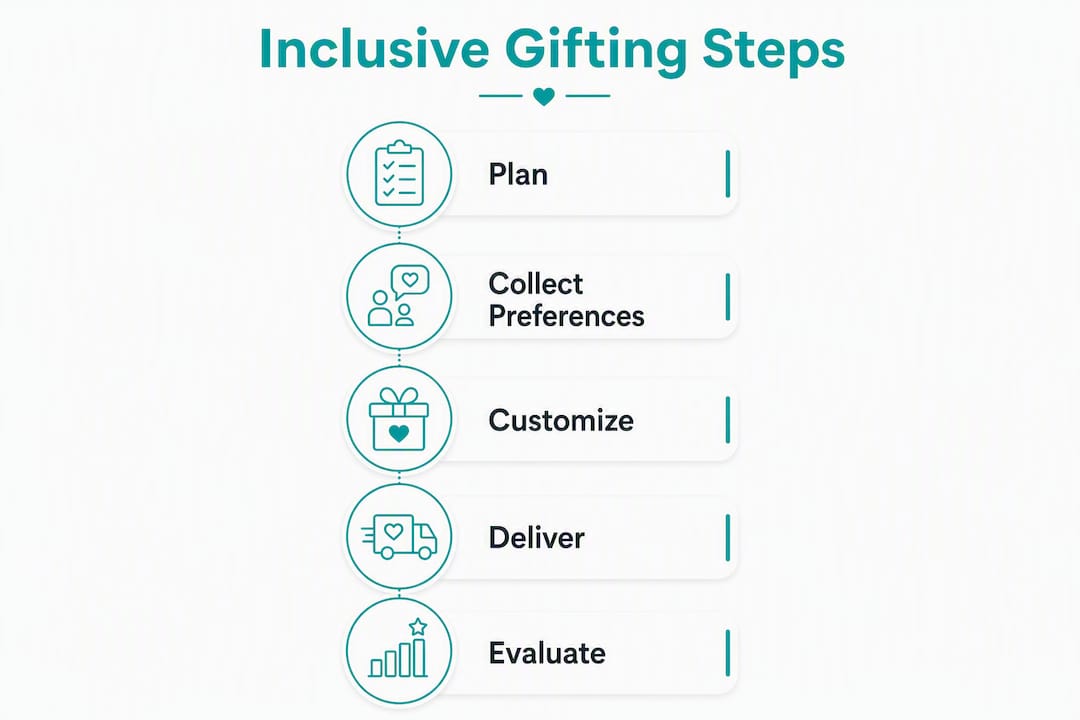
A well-designed inclusive gifting programme follows a clear sequence: plan with your people in mind, collect preferences without forcing disclosure, procure accordingly, fulfil equitably, and gather feedback to improve. The checklist below maps each stage to an owner and a realistic timing.
Stage | Action | Owner | Lead time |
Planning | Define gifting occasions, budget per head, and inclusion goals | HR / People team | 10 weeks before send date |
Preference collection | Send opt-in category survey (food, non-food, charitable, experience, decline) | HR / Internal comms | 7 weeks before send date |
Procurement | Select suppliers; confirm accessibility, vegan, and allergen options | Procurement / HR | 5 weeks before send date |
Fulfilment brief | Share recipient list with delivery preferences (home, office, letterbox) | HR / Gifting supplier | 3 weeks before send date |
Delivery | Stagger for remote, hybrid, and frontline staff; confirm receipt | Gifting supplier / Line managers | 1–2 weeks before occasion |
Feedback | Send short post-gift survey (3–5 questions) | HR | Within 1 week of delivery |
Privacy and data protection: collect preferences using category opt-ins rather than asking employees to declare specific dietary requirements or religious beliefs. A question like “Which category would you prefer?” with options including a discreet “I’d prefer not to receive a gift this time” is both GDPR-compliant and psychologically safe. Never store sensitive personal data (religion, health conditions) in your HR system solely for gifting purposes without explicit consent and a clear retention policy.
For frontline and remote employees, fulfilment needs extra thought. Letterbox-format gifts that do not require a signature work well for home delivery; digital gift cards or e-vouchers are a strong fallback for employees without a fixed delivery address. Avoid creating a two-tier outcome where office-based staff receive a physical gift and remote colleagues receive a digital-only token of lesser perceived value.
Pro Tip: Use a simple Google Form or Microsoft Forms survey with three questions maximum: preferred category, delivery address preference (home or office), and an opt-out tick box. Keep it anonymous at the aggregate level and share only fulfilment data with your supplier. This reduces friction, increases response rates, and keeps sensitive information out of spreadsheets.
Gift categories that genuinely work for diverse UK teams
The most inclusive gift categories share one quality: they give the recipient a meaningful degree of choice. Prescriptive gifts, however thoughtfully chosen, always carry the risk of missing the mark for someone. The categories below consistently perform well across diverse UK workforces.
Choice-led gift boxes: Curated boxes where employees select from a shortlist of items, or build-your-own formats, give the warmth of a physical gift with the dignity of personal choice. They work particularly well for hybrid teams because they can be fulfilled via letterbox delivery without requiring a signature.
Gift cards and e-vouchers: Gift cards are more inclusive than assumption-based presents because they allow recipients to choose items that fit their dietary, cultural, and accessibility needs. Opt for multi-retailer cards rather than single-brand vouchers to maximise relevance across your workforce.
Charitable donations in the employee’s name: Offering a donation to a charity of the employee’s choice is a values-aligned option that works across cultural and religious backgrounds. It is particularly appreciated by employees who prefer not to receive physical gifts.
Wellbeing and self-care items (non-food): Candles, notebooks, plants, or mindfulness tools avoid most dietary and religious sensitivities. Choose items with minimal fragrance or sensory intensity to accommodate colleagues with sensory sensitivities or allergies.
Experiences: Digital experience vouchers (cooking classes, online courses, cinema tickets) work well for remote and hybrid teams and can be redeemed at the recipient’s convenience. Avoid experiences that assume physical ability or require travel.
Practical items: Quality stationery, reusable water bottles, or tech accessories are low-risk, high-utility gifts that most employees appreciate regardless of background.
A note on occasion-neutral timing: rotating gifting moments across the year, rather than concentrating everything at Christmas, means colleagues from non-Christian backgrounds feel recognised throughout the year rather than as an afterthought. Work anniversaries, project completions, and wellbeing moments are all valid gifting occasions that carry no single cultural lens.
Pro Tip: When briefing a gifting supplier, specify “occasion-neutral packaging” so the box design does not feature Christmas trees, Easter eggs, or other holiday-specific imagery. A clean, warm design with your company branding works for every recipient, every time of year.
The Sayheygifting inclusive gifting checklist for UK HR teams
This checklist gives HR teams a ready-to-adopt framework for rolling out inclusive gifting at scale, from first planning meeting to post-delivery review.
Implementation timeline
Phase | Key actions | Owner | Timing |
Discovery | Audit last programme: what was sent, who declined, any complaints? | HR lead | 10 weeks out |
Design | Define categories, budget bands, and opt-out mechanism | HR + Procurement | 10 weeks out |
Preference survey | Distribute opt-in form; allow 2 weeks for responses | Internal comms | — |
Supplier brief | Share anonymised preference data; confirm allergen and accessibility options | Procurement | 5 weeks out |
Pilot (if new) | Run with one team or department first; gather feedback before full roll-out | HR lead | 4 weeks out |
Full fulfilment | Confirm delivery addresses; stagger for remote and frontline staff | Gifting supplier | 2–3 weeks out |
Review | Analyse uptake, satisfaction scores, and opt-out rate; document learnings | HR lead | 1–2 weeks post-delivery |
Sample preference questions (privacy-first)
Use these in your survey, keeping responses anonymous at the aggregate level:
Which gift category would you prefer? (Sweet treats / Savoury snacks / Self-care / Stationery / Charitable donation / Surprise me)
Where would you like your gift delivered? (Home address / Office / Digital only)
Would you prefer to opt out of receiving a gift this time? (Yes, please / No, I’d love one)
Never ask employees to state their religion, dietary restrictions by name, or health conditions. Category opt-ins achieve the same practical outcome without requiring sensitive disclosure.
Logistics checklist for fulfilment teams
Confirm all items are clearly labelled with allergen information where applicable.
Verify that packaging is accessible (easy-open, no excessive wrapping for colleagues with limited dexterity).
Offer a print or audio alternative for any digital redemption instructions.
Have a clear returns and swap process for items received in error or damaged in transit.
Ensure letterbox-format gifts are sized to fit standard UK letterboxes (typically 38cm x 26cm x 3.2cm) without requiring a signature.
Designing gift programmes with consent and psychological safety at their core reduces the risk of harm and increases the likelihood that every employee feels genuinely valued rather than processed. Sayheygifting’s custom and choice-led gift boxes are built with exactly this in mind: you brief us on your categories and preferences, and we handle the rest, from curation to UK-wide letterbox fulfilment.
How to measure whether your inclusive gifting programme is working
Three metrics tell you most of what you need to know: acceptance rate, satisfaction score, and opt-out trend. Track these across gifting rounds and you will quickly see whether your programme is landing well or whether adjustments are needed.
Acceptance/uptake rate: the percentage of employees who received and accepted a gift versus those who opted out or did not respond. A rising opt-out rate is a signal worth investigating; it may indicate that the gift categories are not resonating, that the opt-out process feels unsafe, or that communication was unclear.
Satisfaction score: a simple post-gift survey question, “How valued did you feel by this gift?” rated on a 1–5 scale, gives you a consistent metric to track over time. Segment by team, location, and role type to identify where the programme is working and where it is not.
Perceived inclusivity score: ask directly: “Did you feel this gift was chosen with people like you in mind?” This question surfaces exclusion that a satisfaction score alone might miss. An employee who accepted a gift but felt it was generic or culturally tone-deaf will answer this differently.
Sample post-gift survey questions:
How valued did you feel by the gift you received? (1 = not at all, 5 = very valued)
Did the gift feel relevant to you personally? (Yes / Somewhat / No)
Did you feel the gifting process respected your preferences and privacy? (Yes / No / Unsure)
Is there anything you would change about how we approach gifting next time? (Open text)
Running a pilot: if you are redesigning your programme, run it with one department of 15–30 people first. Compare acceptance rates and satisfaction scores against the previous round. Peer-to-peer recognition approaches can be layered in alongside the gifting pilot to surface everyday wins and reduce the perception that recognition is top-down only. A pilot also gives you a defensible evidence base when presenting programme changes to leadership or procurement.
Budgeting, timing, and UK tax considerations for inclusive gifting
A practical rule of thumb for inclusive gifting programmes: budget £20–£50 per head for a meaningful physical gift, £10–£20 for a digital or charitable option, and factor in fulfilment costs separately. Choice-led programmes often reduce waste sufficiently to offset the slightly higher per-unit cost of customisation.
Typical UK lead times
Gift type | Customisation level | Typical lead time |
Ready-made gift boxes | Low (off-the-shelf) | 3–5 working days |
Choice-led / build-your-own boxes | Medium | 10 working days |
Fully branded custom boxes | High | 3 weeks |
Gift cards (physical) | Low | 5 working days |
E-vouchers / digital gifts | None | Same day |
Charitable donation certificates | Low | 3–5 working days |
For large or geographically dispersed teams, stagger delivery windows by region or department to avoid fulfilment bottlenecks. Frontline staff without a fixed office address benefit most from letterbox-format gifts or digital alternatives; plan their fulfilment separately and confirm delivery addresses directly rather than assuming office delivery will reach them.
UK tax note: HMRC’s trivial benefits exemption allows employers to give employees gifts worth up to £50 per occasion without triggering a tax or National Insurance liability, provided the gift is not cash or a cash voucher, is not a reward for performance, and is not part of a salary sacrifice arrangement. Gifts above £50, or gifts that fall outside these conditions, may need to be reported on a P11D. This is general guidance only; confirm the current rules with your payroll team or a qualified tax adviser before finalising your programme. Values-driven gifting choices also increasingly factor into supplier selection under social value procurement frameworks, so aligning your gifting supplier with your ESG commitments can support wider reporting requirements. For a full breakdown of delivery options for dispersed teams, including letterbox and remote fulfilment, Sayheygifting’s HR guide covers the logistics in detail.
Key takeaways
Inclusive staff gifting works when it centres choice, respects privacy, and treats every employee as an individual rather than a demographic category.
Point | Details |
Choice over assumption | Opt-in category surveys and choice-led boxes remove the risk of culturally or personally insensitive gifts. |
Retention and performance gains | Industry commentary links inclusive recognition to measurable improvements: a 12% performance boost and 20% uplift in retention. |
Privacy-first preference collection | Collect category preferences, not personal beliefs; always include a discreet opt-out to protect psychological safety. |
Measure what matters | Track acceptance rate, satisfaction score, and perceived inclusivity score across every gifting round. |
Sayheygifting for scale | Sayheygifting’s custom, choice-led gift boxes and UK-wide letterbox fulfilment support inclusive programmes for teams of any size. |
Why inclusive gifting deserves more than a policy update
There is a version of inclusive gifting that lives entirely in a policy document: a paragraph about dietary requirements, a note about not sending alcohol, and a reminder to check the trivial benefits threshold. Organisations tick the box and move on. What that approach misses is the emotional reality of receiving a gift at work.
A gift is a signal. It tells the recipient how much thought their employer invested in them as a person. When that signal lands well, it creates a moment of genuine connection that a salary review or a performance bonus rarely replicates. When it lands badly, the damage is disproportionate to the cost of the item. An employee who receives a Christmas hamper they cannot eat, or a wine selection they do not drink, does not just feel overlooked in that moment. They file it as evidence about how the organisation sees them.
The shift from assumption-based to choice-led gifting is not complicated, and it does not require a large budget. What it requires is the willingness to ask rather than assume, to design the programme around the recipient rather than the convenience of the buyer, and to treat the opt-out as a legitimate and respected choice rather than an administrative inconvenience.
The organisations getting this right are not necessarily the ones with the biggest gifting budgets. They are the ones where HR teams have taken the time to ask their people what they actually want, and then acted on the answers. That is a habit worth building, and it starts with the next gifting round.
Sayheygifting can help you get inclusive gifting right
Putting together a genuinely inclusive gifting programme takes more than good intentions. It takes the right products, the right fulfilment infrastructure, and the confidence that every employee, whether they are based in London, Leeds, or working remotely from a rural postcode, will receive something that feels personal and considered.
Sayheygifting specialises in custom, choice-led gift boxes and letterbox gifts designed for UK HR teams who want to recognise their people without the guesswork of assumption-based gifting. From ready-made employee gift boxes to fully customisable build-your-own options, every solution is available for single or bulk orders with UK-wide letterbox delivery. If you are starting from scratch or redesigning an existing programme, a small pilot with one team is a low-risk way to test your approach, gather feedback, and build the evidence base to roll out at scale. Browse the full range and get in touch to discuss a pilot that works for your team’s size, budget, and timeline.
Useful sources and further reading
The sources below informed this guide and offer useful deeper dives for HR teams building the case for inclusive gifting internally.
The rising importance of values-driven corporate gifting — Forbes. Covers employee expectations around values-aligned recognition and the business case for moving beyond generic gifts.
22 ways to recognise employees at work — Achievers. Covers peer-to-peer recognition, frontline staff considerations, and reducing manager bias in recognition programmes.
The ethics of workplace gift giving — Insperity. Standard HR etiquette guidance on appropriate gift types, direction of gifting, and items to avoid.
Recommended
Comments