
Corporate Gifting Brief: 6 Fields for Supplier Quotes and UK Tax

A strong corporate gifting brief states the purpose, recipient profile, budget, timing, branding requirements and measurement plan in one document, so a supplier can price, sample and fulfil without back-and-forth. The outcome you are aiming for is a gift that strengthens relationships and reflects your brand values, not just a box that turns up on time. Before anything goes to a supplier, check your trivial benefits rules and your internal approval chain, because both affect what you can actually order.
TL;DR:
UK employers may give gifts up to £50 including VAT tax free only if they are noncash, noncontractual, and unrelated to specific work; close company directors face a £300 annual cap.
Confirm delivery addresses, dietary and accessibility needs, and sample approval before ordering, because each can affect supplier pricing, lead times, or recipient suitability.
Christmas gifting needs an early autumn brief, with sample approval before the full order, because December brings tighter product availability and slower courier networks.
Set a baseline KPI before gifts go out, then track delivery success, redemptions, and recipient feedback to report campaign results against spending.
When budgets are fixed, ask suppliers first about flexible delivery windows or split invoicing, since these terms are more negotiable than product prices.
Table of Contents
Quick corporate gifting brief checklist
A good brief answers every question a supplier would otherwise have to chase you for. Miss one of these and you will lose days to email threads instead of getting samples moving.
Purpose and recipient group: say whether this is for employees, clients or a mixed list, and why you are gifting now.
Quantities and delivery split: total number of gifts and how many addresses they need to reach.
Budget: per-recipient spend and total budget, plus who signs off the invoice.
Timing: the date gifts must arrive by, and when samples need approving.
Branding and personalisation: logo use, colours, messaging, and any name or role personalisation.
Measurement: what success looks like and how you will report it internally.
Within each of those headline fields, a few extra details save real time:
Confirm whether delivery goes to one office, several sites, or individual home addresses.
Note any dietary or accessibility needs across the recipient list, especially for food-based gifts.
Flag your approval process: who needs to see a sample before the full run is confirmed.
State your invoicing preference, including purchase order numbers if your finance team requires them.
Mention any past gifting campaigns the supplier should know about, good or bad.
A brief this tight tends to get a faster, more accurate quote, because the supplier is not guessing at the things that change price and lead time.
Gift ideas organised by recipient and occasion
The right gift depends far more on who is receiving it and why than on what looks impressive in a catalogue. A market-facing roundup of corporate gifts for employees and clients covers bulk and customisable options across several price points, which is a useful starting point when you are drafting your own shortlist.
For employees, consider:
Wellness boxes for teams managing heavy workloads or returning from leave.
Letterbox gifts for remote or hybrid staff who are not in an office to collect anything.
Experience vouchers for milestone recognition, where a shared moment matters more than an object.
For clients and prospects:
Curated hampers sent after a contract signing or a successful project close.
Premium branded items for long-standing accounts where the relationship justifies a higher spend.
Event follow-up gifts sent within a week of a conference or client meeting, while the interaction is still fresh.
Occasion shapes the choice as much as recipient type does. New starters often respond well to a welcome box that doubles as an introduction to company culture. Milestone anniversaries suit something more personal, perhaps with a handwritten note. A simple thank-you gift works best when it is immediate rather than batched into a quarterly round. Christmas and large events call for planning well ahead, since volume and delivery windows both tighten in December.
For broad, frequent gifting, budget roughly a modest per-head spend, while smaller, high-value recipient lists such as top clients or senior milestones may warrant a higher spend. Whatever tier you choose, ask your supplier to confirm vegan, allergen and accessibility options before you commit to a product line, since a hamper that cannot accommodate dietary needs will undercut the goodwill it was meant to build.
Budget guidance and the tax rules that affect employee gifting
Getting the budget right means checking the tax treatment before you finalise spend, not after the gifts have shipped. For employers in the United Kingdom, HMRC’s trivial benefits exemption sets the ceiling most gifting briefs need to work within.
The trivial benefits exemption allows employers to give a gift costing no more than £50 including VAT without reporting it or paying tax or National Insurance on it, provided the gift meets every condition of the exemption. That £50 figure is a cap on cost, not an average, so a mixed order where some boxes cost more than £50 will fail the test for those recipients even if the overall average sits under the limit.
A few conditions catch people out:
The gift must not be cash or a cash-equivalent voucher, such as a gift card that can be exchanged for cash.
It must not be given under a contractual entitlement or as part of a salary package.
It must not be provided in recognition of particular services, meaning a reward tied to hitting a target or completing a project does not qualify, as HMRC’s guidance on recognition of services makes clear.
Directors of close companies face an annual cap of £300 across all trivial benefits received in the tax year.
A seasonal hamper sent as a goodwill gesture, with no link to performance, typically qualifies. HMRC’s own examples include a turkey, an ordinary bottle of wine or a box of chocolates given at Christmas as a gesture of goodwill. The same hamper sent as a bonus for exceeding a sales target would not qualify, because it fails the “not in recognition of services” test.
Keep a simple record for each gifting round: recipient list, cost per item including VAT, and the reason for the gift. That record is what you would show HMRC in an enquiry, and it costs nothing to maintain if you build it into your brief from the outset. Our HMRC-compliant guide for 2026 walks through worked examples if you want a second reference point.

Branding, personalisation and presentation best practice
How a gift looks when it arrives says almost as much as what is inside it. Specify your logo files, preferred print placement and brand colours in the brief itself, rather than leaving a supplier to guess from your website. If you want foil, embossing or a specific finish, say so early, since these affect both cost and lead time.
Presentation details worth briefing explicitly:
Box design and whether you want a branded exterior or a more understated finish.
Filler material, especially if you want it to be recyclable or plastic-free.
Inserts such as a printed card, a handwritten note option, or a QR code linking to a message.
Sustainable packaging requirements, including whether you need FSC-certified or widely recyclable materials.
Personalisation at scale is easier than most buyers expect, provided you supply a clean spreadsheet with names and roles mapped to each gift. Most suppliers can add a name card or short personal line without materially extending the timeline, as long as the data arrives in one file rather than piecemeal emails.
Pro Tip: Brief one strong brand touchpoint, such as a branded sleeve or a card, rather than printing your logo on every item inside the box. Recipients tend to value the gift more when it feels like a gift rather than a marketing exercise.
Fulfilment and timeline: how long to allow and common logistics pitfalls
Timelines are where gifting briefs most often fall apart, usually because the order is placed later than the product and branding work actually needs.
Allow longer lead times for custom runs than for ready-made orders, since branded packaging and personalisation both add production days.
Build in a sample approval step before confirming the full quantity, and treat that sign-off as a hard gate rather than a formality.
Avoid placing Christmas orders in December: courier networks slow down and product availability tightens as the season peaks, so confirm your brief by early autumn if gifts need to land before the holidays.
Check packaging quality on the sample itself, not just the product inside it, since damaged boxes undercut the unboxing experience you are paying for.
Ask your supplier about contingency stock for any single component that might run short, particularly with food or drink items.
Confirm how delivery splits will be communicated, especially for multi-address orders where some recipients are remote and others are in an office.
A brief that states these points up front avoids the most common failure mode: a beautifully designed gift that arrives a week late or with crushed packaging.
Measuring impact: what to track and how to report return on gifting
A gifting brief should name its success metrics before the order goes out, not after. On the quantitative side, track delivery success rate, any voucher or experience redemption rate, and direct responses such as thank-you messages or survey replies. On the qualitative side, a short survey, informal team feedback, or notes from account managers on client reactions all add texture that numbers alone miss.
Set a baseline KPI in the brief itself, such as expected response rate or redemption rate.
Agree reporting frequency with whoever owns the budget, typically a short note after each campaign rather than a lengthy report.
For a simple ROI estimate, compare the cost per recipient against a measurable outcome, such as reduced turnover over time or renewed contract value for client gifts.
Track non-financial impact too, including engagement survey scores or qualitative comments, since gifting’s effect on morale rarely shows up in a single financial line.
Reporting does not need to be elaborate. A concise summary with spend, response rate and recipient feedback is usually enough to justify the next round of budget.
How to write a corporate gifting brief: a copyable template
Use the structure below as a starting point, then adjust the detail to match your recipient list and budget.
Purpose: “This gifting round recognises [occasion] for [recipient group].”
Recipients: “We are gifting [number] people across [number] delivery addresses.”
Budget: “Per-recipient budget is [amount], total budget is [amount], approved by [role].”
Timing: “Gifts must arrive by [date], with sample approval needed by [date].”
Branding: “Logo files attached, brand colours are [colours], personalisation needed for [detail].”
Measurement: “Success will be measured by [metric], reported to [role] by [date].”
A worked example: a Christmas letterbox brief for a hybrid team might read: “We are sending a Christmas letterbox gift to 200 employees across home and office addresses, a set budget per recipient including delivery, vegan and nut-free options required for recipients, logo on an outer sleeve only, gifts must arrive by the agreed date, with sample approval needed beforehand, success measured by an internal thank-you message count and a short staff survey in January.”
Before signing off, run through a short approval checklist: has finance approved the total spend, has HR or the client lead approved the recipient list, and has someone physically checked a sample box. On negotiation, most suppliers will flex on delivery windows and invoicing terms (split invoicing across departments, for instance) more readily than on price, so lead with those asks if budget is fixed.
Practical lessons from running corporate gifting programmes
The briefs that work best are usually the shortest ones, not the longest. A supplier can do far more with six clear fields than with three pages of inspiration images and no numbers. One pattern worth remembering: recipients notice thoughtful personalisation (a name, a note, a flavour choice) far more than they notice an expensive product with no personal touch at all.
Pro Tip: Order slightly fewer premium items and spend the difference on personalisation. A smaller, well-chosen gift with a name on it tends to land better than a larger generic one.
— Craig
How Sayhey Gifting can help with your next brief
Once your brief is written, we handle the rest. Our custom corporate gifting service covers design, fulfilment and product sourcing, so the six fields in your brief become a finished, branded gift without you managing separate suppliers for print, packaging and delivery.
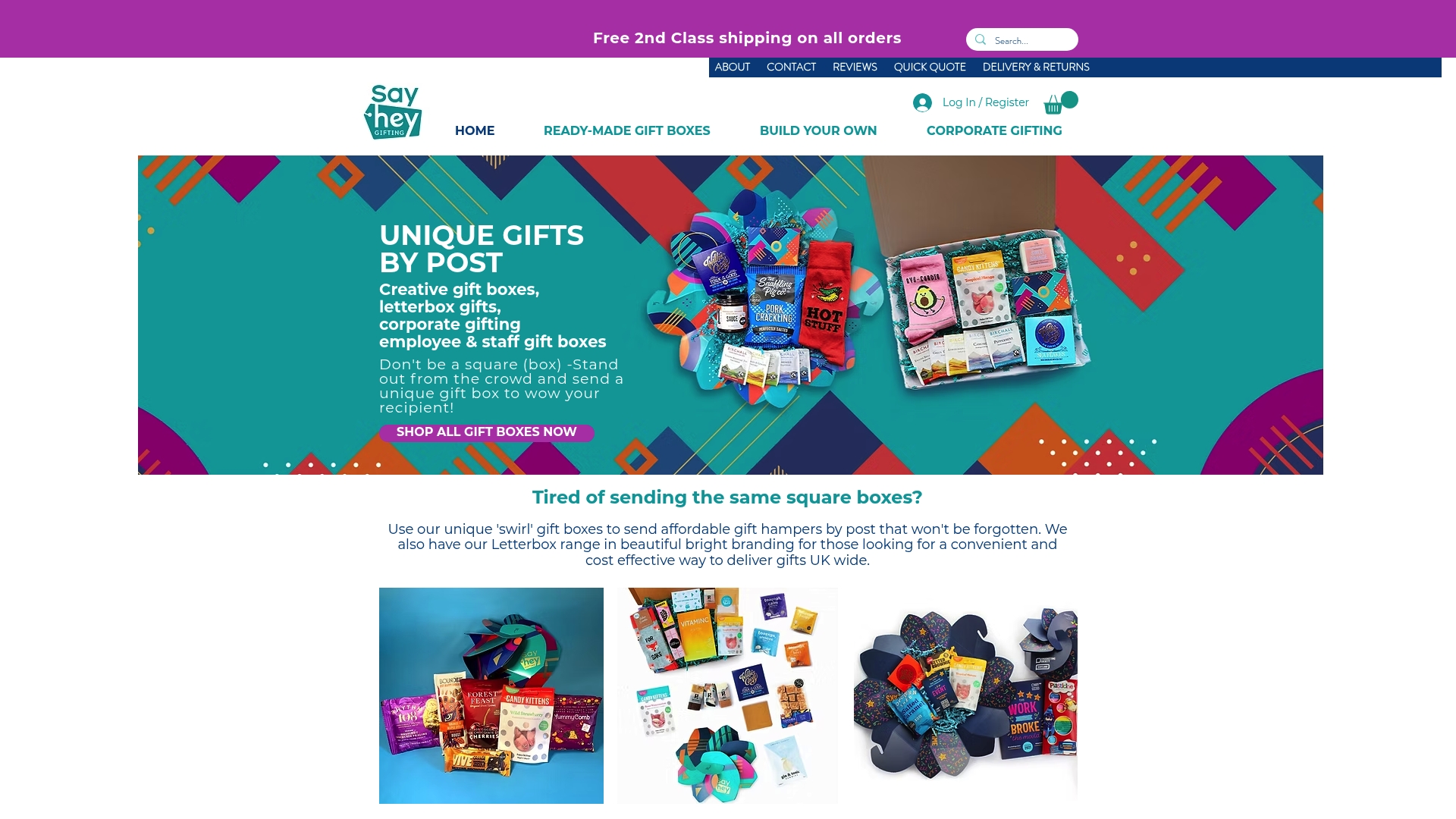
Our Sayhey Swirl box is a design exclusive to us, built for a memorable unboxing moment rather than a generic branded box.
Our build your own gift box tool lets you control contents directly when your brief has specific dietary or personalisation needs.
Our letterbox gifts suit remote and hybrid teams who cannot collect a parcel from an office.
We add your logo to packaging at no extra charge, and we use environmentally friendly packaging.
If you are ready to move from brief to order, request a quote through our corporate gifting page, and we will confirm UK delivery timelines once we have your recipient numbers and dates.
This article is general information, not a substitute for advice from a qualified financial advisor. Consult a qualified financial professional about your own circumstances before acting on anything here.
FAQ
What should a corporate gifting brief always include?
A corporate gifting brief should state the purpose, recipient profile, budget per person and in total, delivery timing, branding requirements and how you plan to measure success. Including all six lets a supplier quote and sample accurately on the first pass rather than needing follow-up questions.
How much can employers spend on employee gifts tax-free?
Under HMRC’s trivial benefits exemption, an employer can give a gift costing up to £50 including VAT without it being taxed, provided it is not cash, not contractual, and not a reward for specific work. Directors of close companies face an additional annual cap of £300 across all trivial benefits in a tax year.
Can a gift linked to performance still qualify as a trivial benefit?
No. HMRC’s guidance on recognition of particular services states that a gift given in recognition of specific work or performance does not qualify for the trivial benefits exemption, regardless of its cost.
How far in advance should we brief a supplier for Christmas gifting?
Confirm your brief by early autumn where possible, since courier networks and product availability both tighten closer to December. Building in time for sample approval before the full order is confirmed also protects against last-minute packaging or quality issues.
How do we measure whether a corporate gifting campaign worked?
Track a mix of measurable signals, such as delivery success and voucher or experience redemption, alongside qualitative feedback from a short survey or informal team comments. Setting a baseline KPI in the brief itself, before the gifts go out, makes the results easier to report afterwards.
Sources
Recommended
Comments