
Plan 4–6 Weeks Ahead: Client Gift Timing for UK Gifting Teams
Send client gifts promptly after genuine positive moments, such as a completed project, a successful onboarding, or a warm referral, so the gesture clearly connects to what earned it. Avoid gifting immediately before procurement decisions, tenders, or renewals, where timing can look like influence rather than appreciation. A few thoughtful sends a year, tied to real moments rather than the calendar, is usually enough to keep a relationship warm.
TL;DR:
Sending gifts within a week of project completions or milestones reinforces genuine recognition and avoids appearing as an influence tactic.
For new clients, a welcome gift within five business days builds a positive tone before any relationship friction develops.
Gift timing for renewals should be after the client confirms the decision, preventing the appearance of bribery or undue influence.
Gifting during active tenders or procurement processes is risky and should be avoided until after the outcome is publicly confirmed.
Operationally, allow four to six weeks for custom orders and verify delivery details and approvals early to ensure timely arrival of gifts.
Table of Contents
When is the best time to send a client gift?
The occasion matters more than the calendar date. A gift that lands within days of a genuine win feels like recognition. The same gift sent six weeks later, with no obvious trigger, feels like an afterthought or, worse, a sales tactic.
Here are the moments that consistently work, and why timing shifts the meaning of the gesture:
Project completions and go-lives. Send quickly, ideally within a week, so the recipient makes an instant mental link between the outcome and your appreciation.
New client welcome and onboarding. A welcome gift within the first five business days sets a warm tone before the relationship has had time to develop any friction.
Referral acknowledgement. Thank the introducer promptly. This should recognise the introduction itself, never promise a reward tied to whether the referral converts into business, which strays close to an inducement.
Renewals and anniversaries. Send after the renewal is confirmed, not before, and use the moment to celebrate the length of the relationship rather than to nudge the decision.
Personal milestones. A promotion, an industry award, or a team success at the client’s end is worth marking, particularly for contacts you deal with regularly.
“Just because” mid-year gestures. Used sparingly, an unexpected gift outside any obvious trigger point can stand out precisely because it wasn’t scheduled.
Practical gifting guidance consistently points to the same pattern: a welcome gift after signing, a small gesture after a difficult implementation, and a fast referral thank you outperform generic, undated sends. The gift itself rarely does the heavy lifting. The moment does.
How does timing change across the client lifecycle?
Client gift timing isn’t a single rule. It shifts depending on where the relationship sits, and getting the stage wrong can undo the goodwill you’re trying to build.
Onboarding calls for speed. A welcome gift within the first five business days after signing tells a new client they made the right call, while the decision is still fresh in their mind.
Active delivery rewards momentum. Send milestone gifts within days or, at most, a couple of weeks of the event itself. A gift that arrives a month after a successful launch reads as an administrative afterthought rather than genuine recognition.
Renewals need the opposite instinct to onboarding: patience. Send the thank-you gift after the client has confirmed renewal, not before. According to Bribery Act 2010 joint prosecution guidance, renewal gifts are safer once the decision is made, because a pre-decision gift can look like it was designed to sway the outcome, however innocent the intent.
Prospects and active tenders are the one window where the safest move is often to hold back entirely. Gifting during a live procurement process, however well meant, invites the wrong interpretation. A few practical rules worth keeping close:
Never link a gift’s value or timing to the likelihood of winning business.
If a tender is running, wait until the outcome is confirmed before sending anything beyond a standard, low-value branded item.
When in doubt about where a prospect sits in their process, ask your account team before scheduling a send.
What tax and anti-bribery rules affect gift timing?
Two separate rulebooks shape when and how much you can give: HMRC’s VAT treatment, and the Bribery Act 2010’s test of proportionality. Both change the calculus on timing, not just value.
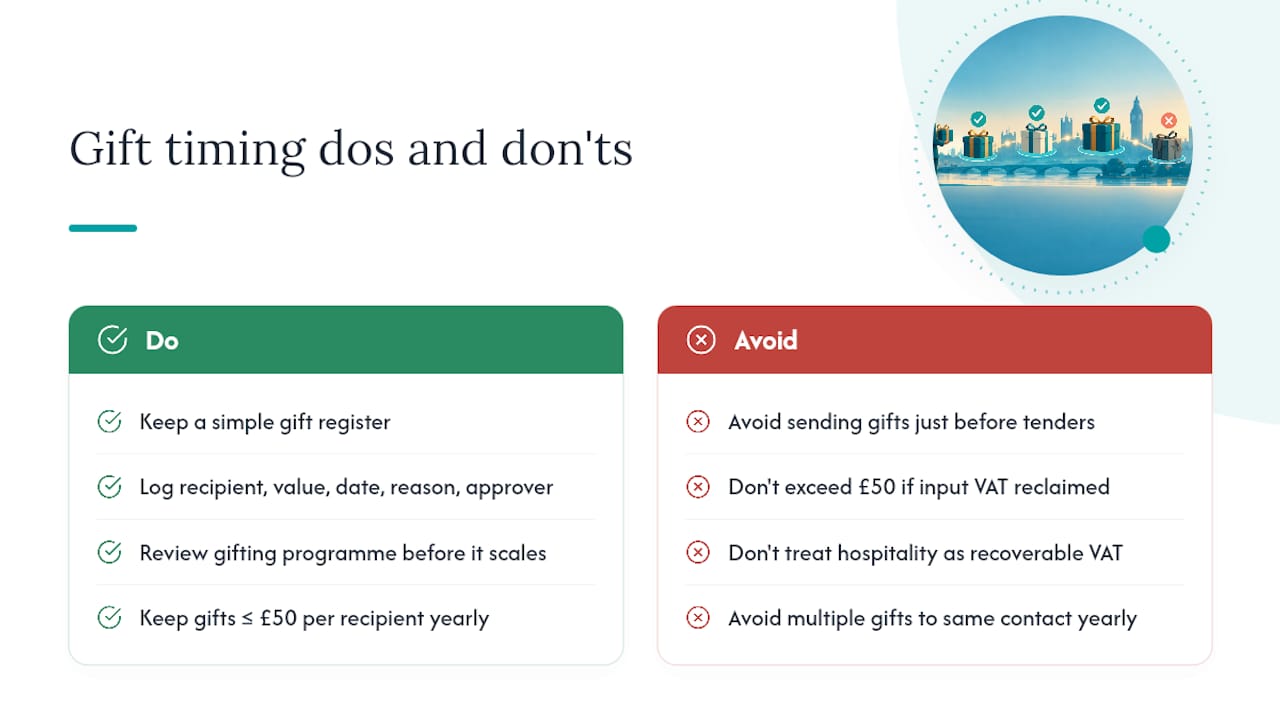
On VAT, HMRC’s guidance on business promotions sets a clear line: gifts to the same person totalling no more than £50 excluding VAT in any 12-month period generally avoid an output tax charge. Go over that threshold, and if input VAT was reclaimed on the purchase, output tax becomes due on the full value, not just the excess. That £50 figure is a running annual total per recipient, which matters if you’re sending a welcome gift, a renewal gift, and a Christmas hamper to the same contact in one year.
The £50 rule in practice: if a single client contact receives a £35 onboarding gift and a £40 renewal gift within 12 months, the combined £75 breaches the threshold, triggering output tax on the whole amount where input VAT was claimed.
Hospitality complicates this further. HMRC’s notice on business entertainment generally blocks VAT recovery on client entertainment, which sits under different rules to a goods-based gift. This is exactly why finance teams should review any gifting programme before it scales past a handful of ad hoc sends, since the VAT position on a bottle of wine differs from the VAT position on a client dinner.
On the anti-bribery side, Bribery Act 2010 guidance is built around proportionality and good faith, not a fixed monetary cap. Timing a gift immediately before a tender decision, a contract renewal, or a procurement review raises the risk profile of an otherwise reasonable gesture, regardless of its value. Keep a simple gift register logging recipient, value, date, reason, and approver. It costs almost nothing to maintain and gives you a clear answer if anyone ever asks why a gift was sent when it was.
How often should you send client gifts?
Frequency matters as much as the moment itself. Send too rarely and the relationship feels transactional; send too often and even a thoughtful gift starts to feel routine.
Aim for one to three meaningful gifts a year for most client relationships, reserving higher frequency only for your genuinely strategic or highest-value accounts.
Let relationship triggers lead, not the calendar. A project win in March deserves a gift in March, not a note that it’s been folded into the December send.
Resist full automation. A system that fires gifts on a fixed schedule regardless of context loses the very thing that made the gesture land in the first place: relevance.
Use unscheduled mid-year gestures sparingly. Precisely because they’re unexpected, they carry more weight than anything the client can predict.
Know when to skip. A client’s no-gifts policy, an active dispute, or a recent large gift within the same 12-month window are all good reasons to pause rather than push a send through regardless.
Most professional relationships don’t need constant gestures to stay warm. They need the right one at the right time.
How far ahead should you plan client gift logistics?
Timing decisions collapse quickly without the operational groundwork to back them up. A perfectly chosen moment means little if the gift arrives two weeks late.
Custom or branded bulk orders typically need a lead time of four to six weeks to allow for artwork approval, stock confirmation, and delivery scheduling. Keep a non-personalised fallback option on hand for moments that arrive with little warning; a milestone worth celebrating shouldn’t wait on a branding proof.
Delivery address is a decision point too, not a default setting:
Default to office delivery unless you have a specific reason not to.
Use home delivery only when you know the recipient’s preference and have a verified address, since sending a personal parcel to a workplace, or vice versa, undermines the thoughtfulness you’re aiming for.
Confirm dietary requirements before selecting hamper or food-based gifts, particularly for recurring corporate accounts.
Check the client’s own gifting or procurement policy before committing to value or format, some organisations cap what staff can accept.
Keep a gift register, tracking recipient, value, date, reason, and approver. Beyond supporting VAT and anti-bribery compliance, it stops the easily avoidable mistake of two people on your team sending the same client a gift in the same quarter.
Pro Tip: Build your fallback gift into your standard stock, not as an emergency purchase. A simple, well-presented letterbox gift that ships in 48 hours saves a milestone when a custom order won’t make the deadline.
For teams managing volume, resources on collecting addresses and approvals for bulk orders and general fulfilment planning are worth building into your process early, rather than after the first missed deadline.
When should you send seasonal or holiday client gifts?
The year-end rush is the single biggest cause of late corporate gifts, and it’s almost entirely avoidable with earlier planning.
Ship in the window between late November and early December. This avoids courier delays, client office closures over the festive period, and the last-minute scramble that comes with everyone ordering at once.
Missed the window? A staggered January send, or a simple New Year message to the team, often lands better than a gift that arrives after the client has already gone back to work and moved on mentally.
Plan bulk fulfilment well ahead of the November window, and build in extra lead time for anything perishable or personalised, since these categories are hit hardest by seasonal courier congestion.
Consider the client’s own calendar sensitivities. Not every client celebrates Christmas, and a generic seasonal gift can misfire where a moment-based gift wouldn’t.
For teams running a company-wide seasonal programme, locking in order deadlines by October, well before the scramble starts, tends to produce far smoother corporate gifting calendars than reactive, last-minute ordering.
A five-step checklist and message templates for timed gifting
Turning timing rules into practice comes down to a short, repeatable routine.
Identify the moment. What just happened that warrants recognition?
Check the policy. Does the client accept gifts, and is there a value cap?
Choose a proportionate gift. Match the value and formality to the moment and the relationship stage.
Confirm lead time and delivery. Can it arrive within the window that still feels connected to the moment?
Record to send. Log recipient, value, date, reason, and approver.
Four short templates cover most timing moments:
Onboarding welcome: “Welcome aboard, [Name]. We’re genuinely looking forward to working with you, this is just a small gesture to say so.”
Referral thank you: “Thank you for introducing us to [Company]. We really appreciate you thinking of us.”
Post-project congratulations: “Congratulations on getting [Project] live. It was a pleasure working alongside your team.”
Renewal thank you: “Thank you for another year working together. We’re glad to have you with us.”
On the fulfilment side, collecting a verified delivery address and internal approval upfront, rather than chasing them once a moment has already passed, is usually what separates a gift that lands on time from one that arrives as an apology for being late.
What are the most common client gift timing mistakes?
Most timing failures fall into a handful of repeatable patterns, and nearly all of them are avoidable with a five-minute check before you hit send.
Gifting during live negotiations, procurement, or disputes. Even a modest, well-intentioned gift can look like an attempt to sway the outcome.
Waiting too long after a milestone. A gift sent two months after a project win has lost its connection to the achievement.
Skipping the basics. Not checking client policy, dietary needs, or a current address turns a thoughtful gesture into an administrative headache.
Failing to record sends. Without a log, it’s easy to duplicate a gift to the same contact within the same 12 months, tripping the VAT threshold or simply looking careless.
Why timing beats extravagance in client gifting
The best client gift I’ve seen used well wasn’t expensive. It was a small hamper that arrived two days after a client’s difficult system migration finally went live, with a note that referenced the late nights their team had put in. Nobody remembers the packaging. They remember that someone noticed.
Moment first, product second, every time. Budget and design matter far less than whether the gift shows up while the reason for it is still fresh. That’s why any gifting programme worth scaling needs finance and compliance involved early, not bolted on afterwards once the VAT threshold has already been breached twice.
— Craig
Get client gift timing right with Sayheygifting
Knowing the right moment doesn’t help much if fulfilment can’t keep pace with it. Sayheygifting is built around exactly that gap: custom corporate gifting, design, product sourcing, and UK-wide fulfilment that work around the lead times a genuine welcome, renewal, or milestone gift actually needs.
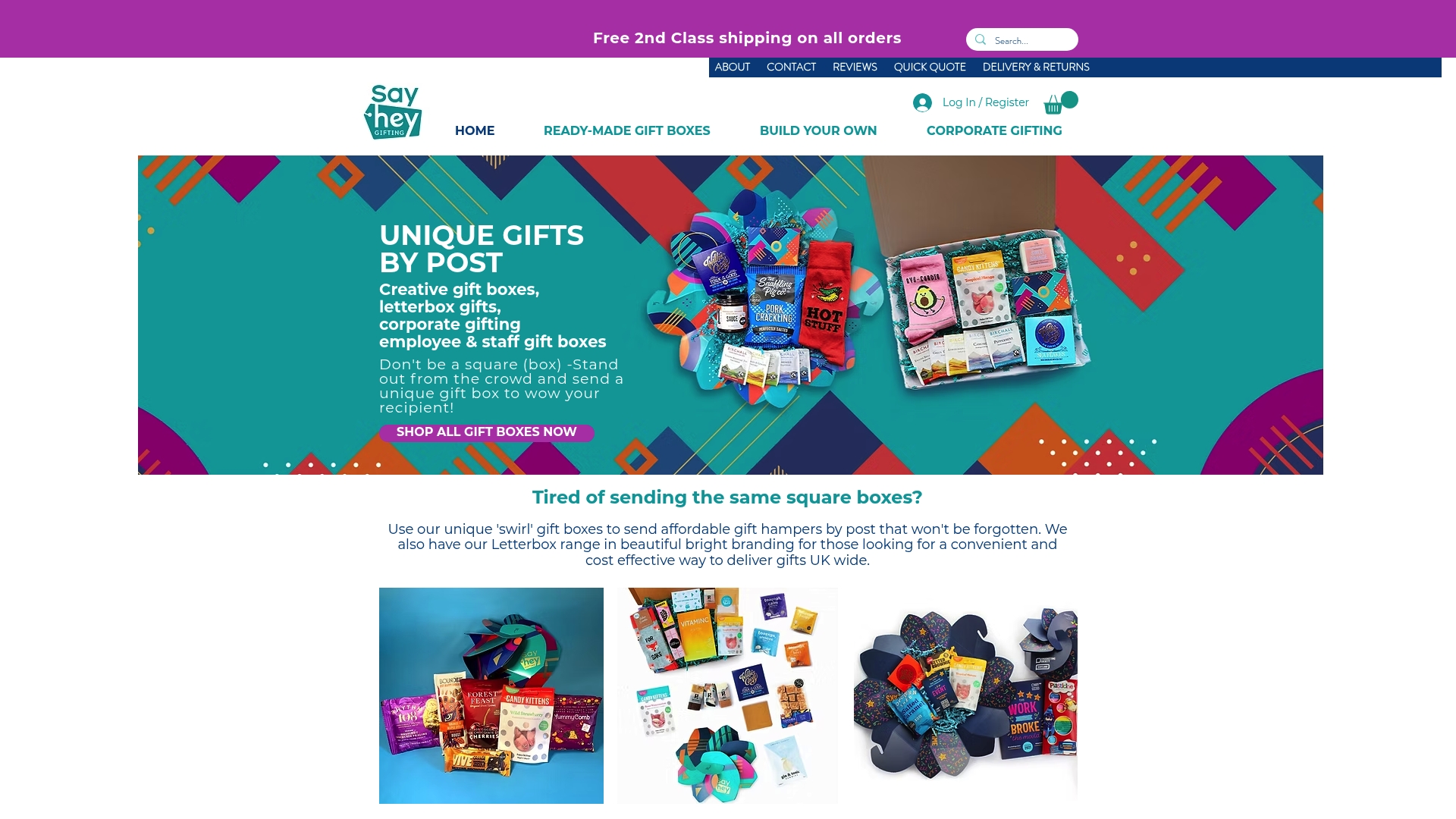
They collect delivery addresses and approvals upfront to help avoid delays in bulk sending for onboarding waves or renewal cycles. For fast-turnaround moments, letterbox gifts fill the gap when a custom order won’t land in time, while the build your own gift box option lets you match value and formality to the occasion without starting from scratch each time. Every custom box carries your branding at no extra charge, alongside the environmentally friendly packaging the business has built its reputation on. If you’ve got a moment coming up, whether that’s a renewal date or a project go-live, get in touch with the corporate gifting team now to lock in a delivery window before it becomes a scramble.
Sources
FAQ
What are the HMRC rules for gifts to clients?
HMRC allows business gifts of goods to the same person without an output VAT charge as long as the total cost stays at or below £50 excluding VAT in any 12-month period. Exceed that and input VAT was reclaimed, output tax becomes due on the full value, not just the amount over the limit.
What is the £50 gift rule?
It’s the HMRC threshold covering business gifts of goods: keep total gifts to one person at or under £50 excluding VAT across a rolling 12 months and no output tax charge applies. This is a cumulative annual total per recipient, so multiple smaller gifts to the same client contact can still breach it.
What are the rules for giving gifts to clients?
Beyond the VAT threshold, the Bribery Act 2010 requires that gifts stay reasonable, proportionate, and given in good faith, never timed to influence a live decision such as a tender or renewal. Keeping a simple gift register showing recipient, value, date, and reason helps demonstrate that intent if it’s ever questioned.
Is it appropriate to accept gifts from a client?
It’s generally fine to accept a modest, proportionate gift from a client, but check your own organisation’s policy first, since many companies set value caps or require disclosure. Avoid accepting anything offered close to a decision you’re making about that client’s business, as the same timing risk that applies to giving gifts applies just as much to receiving them.
Recommended
Comments