
Avoid £50 VAT Traps: UK Corporate Gifting Tax for Finance Teams

HMRC treats most client gifts as non-deductible business entertainment, but a handful of statutory exceptions change the outcome: branded small gifts under £50, free samples of your own product, and genuine staff trivial benefits. The same £50 figure governs VAT recovery, while close companies face a £300 annual cap on director gifts. Check your records against these thresholds, and for anything unusual, speak to your accountant before you buy.
TL;DR:
Gifts to clients are generally considered non-deductible entertainment costs unless they are branded items that serve as advertising and cost £50 or less per recipient.
Free samples of your products are deductible only if they are genuine promotional items given to the public during normal trade.
VAT on gifts is only exempt if the total value to each recipient stays at or below £50 within any rolling 12-month period; exceeding this triggers VAT liabilities on the full amount.
Employee gifts can be tax-free if they meet four conditions, including a maximum value of £50 and not being cash or a reward for performance, with close companies capped at £300 annually.
Proper recordkeeping of gift purpose, recipient, and cost is crucial to avoid penalties and ensure compliance with HMRC gift rules.
Table of Contents
How HMRC treats client and customer gifts as standard
The starting position, set out in BIM45065, is that a gift to a client or customer counts as business entertainment. That classification matters because entertainment costs are generally disallowed as a trading expense, whatever the intention behind the gesture. A hamper sent to say thank you for a contract, a case of wine at Christmas, or a set of gift vouchers all fall into this bracket unless a specific exception applies.
The reasoning is practical rather than punitive: HMRC wants to stop businesses dressing up hospitality and goodwill spending as ordinary running costs. So the default consequences are straightforward.
The cost cannot be deducted against corporation tax or income tax profits.
Input VAT on the purchase is generally restricted in the same way as other entertainment costs.
The classification applies regardless of how thoughtful, personalised or modest the gift feels to the giver.
That default is the reason exceptions exist at all, and why getting the detail right on branding, samples and staff gifts genuinely changes what you can claim.
Exceptions that make client gifts deductible
Two routes let you sidestep the entertainment rule entirely. The first, under BIM45070, is the conspicuous advertisement exception: a gift that carries a clear, lasting advertisement for your business can be deducted, provided the total cost to any one recipient stays at or under £50 in the relevant accounting period. The rule specifically excludes food, drink, tobacco and vouchers exchangeable for goods, so a branded item has to be something else entirely.
Branded stationery, mugs or diaries printed with your logo typically qualify, because the advertisement is visible every time the item is used.
A branded hamper or bottle of wine usually fails, even with a logo sticker, because food and drink are excluded outright.
Gift vouchers, branded or otherwise, never qualify under this exception, whatever their value.
The second route, under BIM45071, covers free samples of your own product given out to the public in the ordinary course of trade, such as a food producer sending taster packs to prospective retailers. That exception exists to support genuine promotional sampling, not to reclassify seasonal client hampers as marketing.
Pro Tip: If you want a gift that feels premium and still qualifies, choose a single branded item over a mixed hamper. A logo-etched item under £50 protects the deduction; a bundled gift box rarely does.
VAT on business gifts and the £50 per-person rule
VAT follows a similar shape to the income tax rule, but the trigger is cumulative rather than per gift. Under HMRC’s VAT guidance on business gifts, you do not need to account for output VAT on gifts to a single recipient as long as their total value stays at or under £50, excluding VAT, within any rolling 12-month period. Cross that line, and you must account for output VAT on the full cost of all gifts to that person, not just the amount above £50.
A tracked total of £50 or less per recipient in any 12-month period keeps a business clear of output VAT, according to HMRC’s VAT guidance; breach it once and the whole year’s gifting to that person becomes taxable.
Define your 12-month window consistently, whether that is a rolling year from each gift or your accounting period.
Log every gift by recipient name and company, not just by transaction, so cumulative totals are visible at a glance.
Reconcile your gifting log against VAT returns at least annually to catch any recipient who has quietly gone over £50.
Say a client receives a £30 hamper in March and a £25 branded gift in October. Individually, both look fine, but the combined total of £55 tips them over the threshold, meaning VAT becomes due on the full £55, not the £5 excess. Our detailed guide to the VAT £50 rule walks through more worked examples for finance teams setting up tracking for the first time.
Gifts to employees: trivial benefits, P11D and PSA choices
Staff gifts have their own exemption, and it is more generous than the client rules. HMRC’s trivial benefits guidance sets out four conditions that must all be met for a gift to employees to escape tax and National Insurance entirely.
The cost of the benefit does not exceed £50 per employee.
It is not cash or a cash-equivalent voucher that can be exchanged for cash.
It is not something the employee is contractually entitled to.
It is not given as a reward for services or performance.
That last point catches out more employers than the others. A gift tied to hitting a sales target or finishing a project is a reward, not a trivial benefit, and becomes taxable however small it is. Close companies face an extra constraint too: directors and their families are capped at £300 in trivial benefits per tax year, so a run of small thoughtful gestures still needs tracking against that annual ceiling.
Where a business gives many small taxable benefits across a team, whether occasional lunches, event tickets or larger gift boxes that exceed £50, a PAYE Settlement Agreement can be simpler than reporting each one on a P11D, because it lets the employer settle the tax and National Insurance centrally rather than through payroll for every individual.
Pro Tip: Keep genuine trivial benefits and performance rewards on entirely separate purchase orders. Mixing the two on one invoice makes it much harder to prove the gift wasn’t a reward if HMRC ever asks. Our guide to P11D staff gifts covers the reporting choice in more depth.
Gifts to clients and suppliers outside the employee rules
Suppliers sit in the same bracket as clients for tax purposes: HMRC does not distinguish between the two when applying the business entertainment rule in BIM45065. A thank-you hamper to a long-standing supplier is treated exactly like one sent to a customer, meaning the same default disallowance applies, and the same branded-item or free-sample exceptions are the only ways round it.
This matters most at year end, when many businesses send a wave of thank-you gifts to everyone they have worked with across the previous twelve months. If your accounts team is not distinguishing between client, supplier and employee recipients on the purchase ledger, it becomes very difficult afterwards to work out which gifts might qualify for an exception and which were correctly disallowed.
The practical point worth remembering is that intent does not change the tax treatment. A supplier gift sent out of genuine appreciation for a good working relationship is assessed on the same criteria as one sent for pure business development, because HMRC looks at the nature of the gift and the recipient relationship, not the sentiment behind it. Vouchers, wine, hampers and most gift boxes sent to suppliers will therefore usually be non-deductible, while a branded, low-cost item under £50 has the same chance of qualifying as it would for a client.
Where a business works with a large supplier network, it is worth building supplier gifting into the same recordkeeping system used for clients, rather than treating it as a separate, informal budget line that nobody reconciles at year end.

Tangible gifts versus gift vouchers: why the tax treatment differs
Vouchers are treated more strictly than almost any other gift type across the whole of this area. Under the conspicuous advertisement exception, vouchers are explicitly excluded, so a branded £40 voucher to a client will never qualify for the small gifts deduction, however clearly it carries your logo. The reasoning is that a voucher functions too much like cash to count as genuine promotional advertising.
For employees, the position under the trivial benefits exemption is more nuanced. A non-cash voucher, one that can only be exchanged for goods or a specific experience rather than cash itself, can still qualify as a trivial benefit if it meets the other three conditions and stays at or under £50. A voucher that can be redeemed for cash, however, is treated as a cash-equivalent and falls outside the exemption entirely, regardless of its value.
Tangible gifts, by contrast, have more routes to favourable treatment. A physical item can be branded to meet the advertisement exception for clients, or judged on its own merits as a trivial benefit for staff, without the cash-equivalence question ever arising. That flexibility is one reason many finance teams find physical gift boxes easier to classify correctly than vouchers, even when the voucher would have cost less to administer.
Corporate gifting during COVID-19 and other temporary reliefs
There is no dedicated temporary tax relief for corporate gifting tied to the COVID-19 pandemic, and the core rules in BIM45065, the trivial benefits exemption and the VAT £50 threshold have applied in broadly the same form throughout the period covered by this guidance. Many businesses did increase employee gifting during that time, sending care packages and wellbeing boxes to staff working from home, but those gifts were assessed against the same trivial benefits conditions that apply now.
Where confusion crept in was around the purpose test. A wellbeing box sent to support morale during a difficult period is not automatically a reward for performance, so it can still qualify as a trivial benefit provided it meets the £50 limit and the other three conditions. The key is documenting the reason for the gift at the time it was given, rather than relying on the circumstances to speak for themselves years later if HMRC ever queries it.
If your business introduced a recurring wellbeing or care package programme during that period and has continued it since, it is worth revisiting the recordkeeping now to confirm each round of gifts still meets the trivial benefits conditions, particularly the non-reward test, rather than assuming the original justification still applies automatically.
Penalties and compliance risks for incorrect gift treatment
Misclassifying a gift carries the same risks as any other incorrect tax treatment: understated corporation tax, under-declared VAT, and potentially unpaid PAYE and National Insurance on staff benefits that should have gone through payroll or a PAYE Settlement Agreement. HMRC can charge interest on any tax paid late as a result, and penalties on top where it decides the error was careless or deliberate rather than an honest mistake.
The most common failure point in practice is not dishonesty but poor tracking, particularly on the VAT side. A business that fails to monitor cumulative gift values per recipient can easily breach the £50 VAT threshold without realising it, especially when gifts to the same client are bought through different departments or expensed on different cards throughout the year.
The safest position is treating every gift, however small, as a recorded transaction with a stated purpose, recipient and cost from the outset. Retrospective reconstruction of a year’s gifting, trying to work out after the fact who received what and when, is where genuine errors creep in, and it is exactly the kind of gap HMRC looks for in a compliance check.
Corporate gifts and other tax reliefs, including charitable giving
Corporate gifting sits alongside, rather than overlapping with, the reliefs available for charitable donations. Gifts to charities and certain other specified bodies fall under different provisions from client and employee gifting, referenced alongside the exceptions in BIM45065, and businesses should not assume that a gift with a charitable flavour, such as a hamper donated to a local cause, automatically attracts the same relief as a direct cash donation under Gift Aid or the corporate charitable deduction rules.
The two systems are worth keeping separate in your records. A genuine cash or qualifying donation to a registered charity has its own relief route entirely outside the gifting exceptions covered here, while a gift of goods to a client, supplier or employee is assessed purely on the tests already set out: the entertainment default, the advertisement exception, the free samples exception, or the trivial benefits rules.
Where businesses run both a client gifting programme and a corporate giving or sponsorship scheme, the cleanest approach is to code them separately from the point of purchase, so that year-end reporting does not conflate a promotional gift with a genuine charitable contribution. The tax outcome, and the paperwork HMRC expects, differs enough between the two that mixing them on one ledger line tends to create more questions than it answers.
What actually counts as a corporate gift under UK tax law
HMRC’s manuals do not offer a single tidy definition, but the practical scope is clear from how BIM45065 and its related pages are written: a corporate gift is anything of value given by a business to a client, supplier, employee or member of the public without a corresponding payment, where the giving is connected to the business rather than a personal relationship. That covers physical items, gift vouchers, hospitality-adjacent gestures like hampers, and branded merchandise alike.
What determines the tax treatment is not the label on the box but three factors: who receives it, what it contains, and why it was given. A £40 branded pen given to a supplier is treated entirely differently from a £40 bottle of wine given to the same supplier, even though both are corporate gifts in the everyday sense, because only the pen can meet the advertisement exception. Similarly, a hamper given to an employee as a genuine gesture of goodwill is treated differently from the identical hamper given as a bonus for meeting a sales target, because the second fails the non-reward condition for trivial benefits.

In short, “corporate gift” is a useful working label for anything your business buys and gives away, but the tax rules care about the recipient, the contents and the purpose far more than the term itself.
Balancing memorable gifting with staying on the right side of HMRC
The pitfall we see most often is businesses treating one gifting budget as a single category, when HMRC sees several distinct ones. A hamper bought to thank a client and a hamper bought to reward an employee’s performance sit under completely different rules, yet they often come from the same purchase order and the same vague budget line. Separating promotional, employee and supplier gifting from the outset, with a purpose recorded against every purchase, solves most of the compliance headaches before they start.
Design still matters within those constraints. A well-branded box can feel considered and generous while still meeting the advertisement exception, provided the branding is genuine rather than a token sticker. For deeper detail on delivery timing and VAT tracking, our business gift tax rules guide is a useful next stop.
— Craig
How Say Hey Gifting helps you stay compliant and memorable
Getting the tax treatment right does not mean your gifting has to feel corporate or forgettable. Say Hey Gifting builds custom corporate gifting around what you actually need, whether that is a run of branded boxes under the £50 threshold for clients, or a wellbeing gesture for your team that meets the trivial benefits conditions with room to spare.
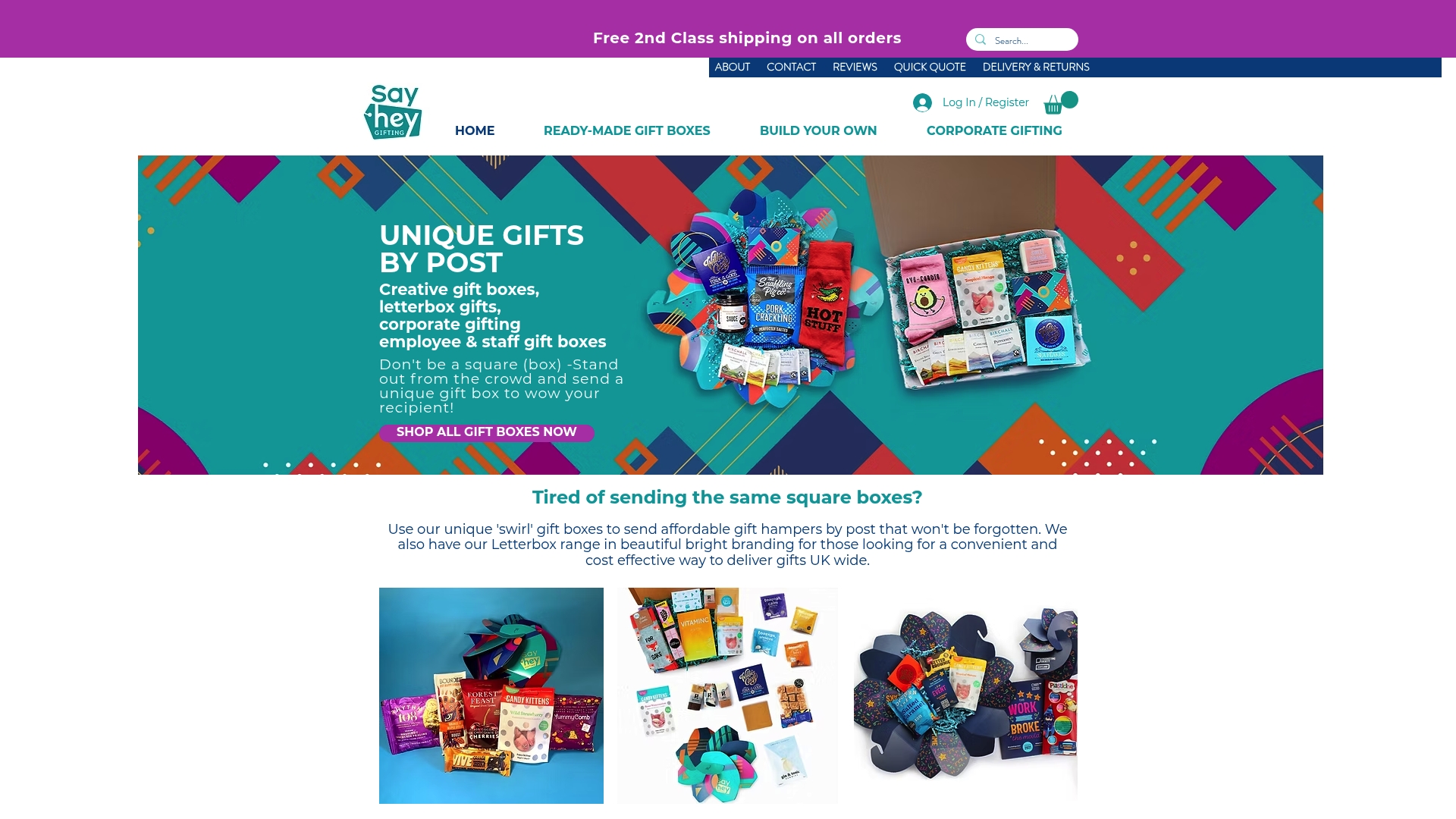
Custom branded gift boxes and letterboxes, designed to help you meet the advertisement exception where it applies.
Design, fulfilment and product sourcing can be arranged to help your finance team get a clear invoice per recipient for recordkeeping.
Employee gift boxes and letterbox gifts sized to sit comfortably within trivial benefit and VAT limits.
We can help you design gifts with compliance in mind, and we always recommend checking anything unusual with your accountant first. Start with our corporate gifting page to see what fits your team.
Authoritative HMRC and practical resources to read next
BIM45065, BIM45070 and trivial benefits guidance for the core rules.
Our own guides on VAT and corporate gifts and P11D staff gifts for implementation detail.
A useful outside perspective on seasonal staff gifting from an HR and engagement angle.
Sources
FAQ
What are the tax rules for gifting in the UK?
Business gifts to clients are generally treated as entertainment and are not deductible, unless they carry a conspicuous advertisement and cost £50 or less per recipient, as set out in BIM45065. Employee gifts can be tax-free under the trivial benefits exemption if they meet four specific conditions, including the £50 cost limit.
How much can you gift from a business?
There is no single overall limit, but the figures that matter are £50 per client per 12 months for VAT purposes, £50 per employee gift for the trivial benefits exemption, and a £300 annual cap on trivial benefits for directors of close companies. Above these thresholds, tax and VAT treatment changes for that gift or recipient.
How do HMRC know if you have gifted money?
HMRC identifies gifting through business records, invoices and VAT returns during routine checks or compliance reviews, rather than through any automatic reporting of individual gifts. Accurate recordkeeping of who received what, when and at what cost is what protects a business if HMRC asks questions later.
What are the HMRC rules for gifts to clients?
Gifts to clients are treated as business entertainment by default and are not deductible, following BIM45065. The main exception is a branded item costing £50 or less per client that carries a genuine advertisement, excluding food, drink, tobacco and vouchers, under BIM45070.
Recommended
Comments