
15 common staff appreciation errors HR teams must fix

Most recognition programmes fail for three reasons: they are inconsistent, impersonal, and unmeasured. Fix those three and the majority of morale problems resolve themselves. The most damaging common staff appreciation errors include recognising people too rarely, using generic praise that could apply to anyone, hiding recognition behind closed doors, skipping peer-to-peer moments, and never checking whether any of it actually lands. Each has a straightforward remedy.
Quick-scan: the highest-impact mistakes and their one-line fixes
Infrequent recognition → adopt a 24-hour acknowledgement rule after any notable contribution
Generic praise → name the specific action and its impact every single time
No transparency on criteria → publish clear, written standards for what earns recognition
Untrained managers → run a 90-minute recognition skills session before any programme launches
Recognition invisible to the team → share praise publicly, with the employee’s consent
Only monetary rewards → pair financial gestures with personal, written acknowledgement
No measurement → track pulse scores and participation rates monthly
60-second manager audit: When did someone on your team last receive specific, named praise? And do you know how each team member prefers to be recognised?
Pro Tip: If you cannot answer both audit questions confidently, that gap is where your recognition programme is leaking.
Key takeaways
The single most important fix for any recognition programme is consistency: specific, timely, personal acknowledgement given regularly by trained managers will outperform any platform or one-off gesture.
Point | Details |
Consistency over ceremony | Frequent, specific praise matters more than annual awards or one-off events. |
Personalisation doubles impact | Deloitte research shows personalised recognition has roughly twice the effect of generic praise. |
Measure leading and lagging indicators | Track pulse scores monthly and turnover quarterly to know whether recognition is working. |
Train managers on proximity bias | A recognition heatmap audit each quarter helps identify and correct uneven distribution. |
Sayheygifting complements recognition | Personalised employee gift boxes reinforce named recognition moments without replacing manager-led praise. |
Your 7-day action plan:
Day 1: Run the 60-second manager audit. Answer both questions honestly.
Day 2: Pull a recognition distribution report for the last 90 days.
Day 3: Send a one-question preference survey to your team.
Day 4: Draft transparent recognition criteria tied to two or three company values.
Day 5: Book a 90-minute manager training session within the next 30 days.
Day 6: Set up a low-friction peer recognition channel in your existing tools.
Day 7: Define two measurable goals and schedule your first quarterly review.
Table of Contents
The 15 common staff appreciation errors — and what to do instead
How to tell whether your appreciation programme is actually working
Your quick rollout checklist for launching or relaunching recognition
Why the smallest recognition changes tend to produce the biggest results
How Sayheygifting supports your recognition programme without replacing it
The 15 common staff appreciation errors — and what to do instead
1. Recognising people too rarely
Only 23% of employees strongly agree they receive enough recognition, according to Gallup data. Sporadic praise — a word at the annual review, a mention at the Christmas party — does not build the psychological safety or motivation that consistent acknowledgement creates. People need to feel seen regularly, not occasionally.
Fix: Adopt the 24-hour rule. When a team member does something worth noting, acknowledge it within 24 hours. A brief Slack message, a short email, or a word before the end of the day all count.
Script: “I noticed you handled that client call really calmly under pressure this afternoon. That kind of composure makes a real difference to the team.”
2. Using generic, impersonal praise
“Great job, everyone” is well-intentioned but largely meaningless. Deloitte research summarised by People Management suggests personalised recognition has roughly twice the impact of generic praise. When recognition could apply to any person in any role, it signals that the manager has not really paid attention.

Fix: Use the SBI model: Situation, Behaviour, Impact. Describe what happened, what the person did, and why it mattered.
Script: “In yesterday’s project debrief (situation), you flagged the budget risk before anyone else spotted it (behaviour). That saved us at least two weeks of rework (impact).”
3. Keeping recognition criteria unclear
When people do not know what earns recognition, the programme feels arbitrary. Favouritism, whether real or perceived, erodes trust faster than almost any other workplace dynamic. Employees who cannot see a fair, transparent system quietly disengage.
Fix: Publish written criteria. Tie recognition explicitly to company values and behaviours, and share examples of past recognition so the standard is visible. Review criteria with your team at least once a year.
4. Skipping manager training
Line managers deliver the majority of day-to-day recognition, yet most receive no training on how to do it well. HBR’s guidance on specific praise shows that naming the action and its impact increases the motivational effect significantly. Without that skill, even well-meaning managers default to vague compliments that do not land.
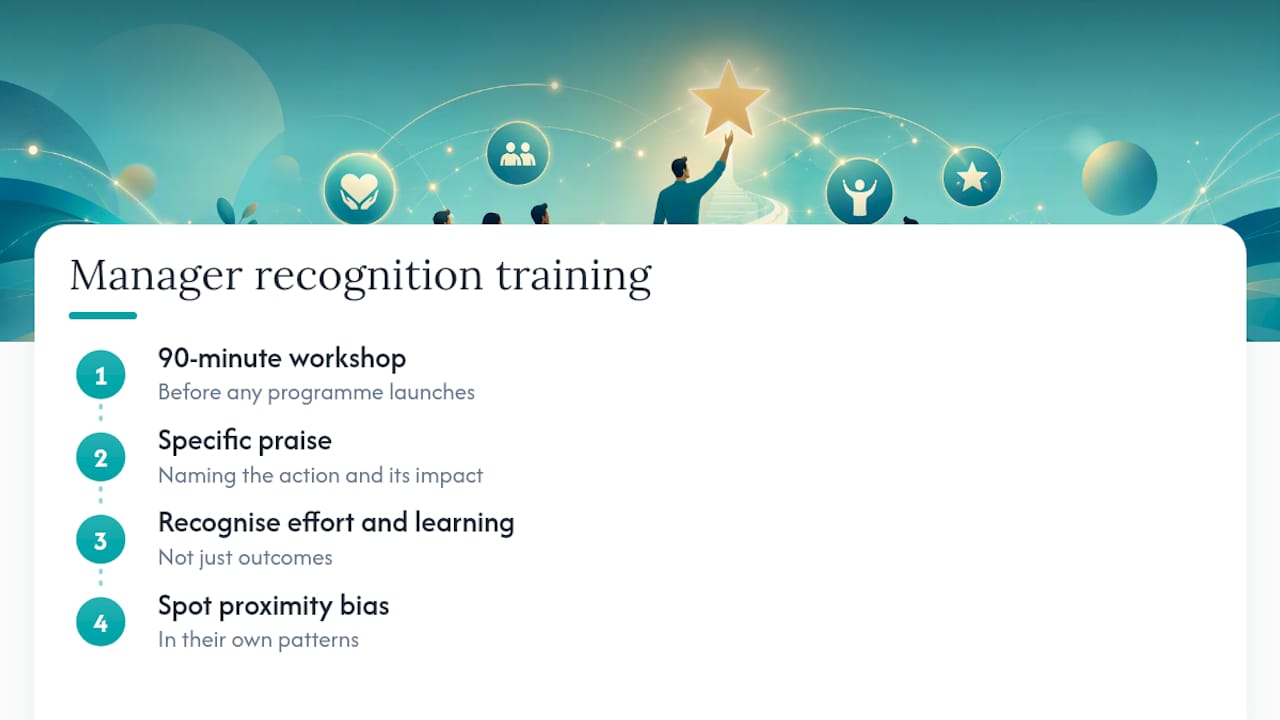
Fix: Run a 90-minute recognition skills workshop before any programme launches. Cover: how to give specific praise, how to recognise effort and learning (not just outcomes), and how to spot proximity bias in their own patterns.
5. Leaving recognition out of daily workflows
If recognition requires logging into a separate platform, filling in a form, or waiting for a monthly meeting, most managers simply will not do it. Friction is the enemy of habit.
Fix: Embed recognition into the tools your teams already use. A dedicated channel in your existing messaging platform, a standing agenda item in weekly one-to-ones, or a simple shared document where wins are logged all reduce the effort barrier significantly.
6. Launching without clear goals or measurement
A recognition programme with no defined success criteria is essentially a gesture. Without knowing what you are trying to move — turnover, absenteeism, engagement scores — you cannot tell whether the programme is working or simply creating the appearance of caring.
Fix: Set two or three measurable goals before launch.
7. Celebrating only the loudest contributors
Hero-focused recognition — spotlighting the same high-profile individuals repeatedly — leaves steady, reliable contributors feeling invisible. CrewHR’s morale research identifies “feeling invisible” as one of the five root causes of poor workplace morale, and it is one that recognition can directly address.
Fix: Audit your last three months of recognition. Who has been named? Who has not? Deliberately seek out the people who quietly keep things running and name their contributions specifically.
8. Ignoring how individuals prefer to be recognised
Calling someone out in a company-wide meeting is motivating for some people and genuinely distressing for others. Assuming everyone wants the same experience is one of the most common staff morale boosting mistakes, and it can make recognition feel like a punishment rather than a reward.
Fix: Ask. A simple one-question preference survey (“How do you prefer to be recognised — publicly, privately, or in writing?”) takes minutes to run and transforms the quality of every recognition moment that follows.
9. Relying too heavily on one-off monetary rewards
A gift card or bonus is appreciated, but it does not substitute for consistent, personal acknowledgement. One-off financial gestures without accompanying verbal or written recognition tend to feel transactional rather than genuinely warm.
Fix: Pair any monetary reward with a specific, personal note. The note is often what people remember and keep. Budget for both the gift and the time to write something meaningful alongside it.
Pro Tip: Recognition programmes that rely solely on financial rewards often see diminishing returns within six months. Sustained, personal acknowledgement is the element that keeps motivation alive between reward moments.
10. Not measuring whether recognition is working
Launching a programme and never checking its impact is one of the most overlooked errors in employee recognition. Without data, you cannot distinguish a thriving culture from one that looks active on the surface but is not moving the needle.
Fix: Track at least two metrics from the outset: a leading indicator (pulse survey scores, participation rates) and a lagging indicator (turnover, absenteeism). Review them quarterly and adjust.
11. Keeping recognition invisible to the wider team
Private praise is valuable, but recognition that only the recipient and their manager ever hear about misses a significant cultural opportunity. Visible recognition signals to the whole team what good looks like and creates a positive feedback loop.
Fix: With the employee’s consent, share recognition in a team channel, a company newsletter, or a brief mention in an all-hands meeting. The social reinforcement amplifies the original moment considerably.
12. Overlooking peer-to-peer recognition
Manager-only praise creates a top-down dynamic that limits how often recognition happens. Peers often notice contributions that managers miss entirely, particularly in cross-functional or remote teams. Bravo’s practitioner guidance highlights peer-to-peer acknowledgement as one of the most underused levers in recognition programmes.

Fix: Create a simple, low-friction mechanism for peer recognition. A dedicated team channel, a shared “wins” document, or a brief peer shoutout at the start of team meetings all work well without requiring a dedicated platform.
13. Disconnecting recognition from company values
Recognition that feels random or personality-driven does not reinforce the behaviours an organisation actually wants to see more of. When praise is tied explicitly to a company value, it gives the recognition meaning beyond the individual moment and helps the whole team understand what the culture rewards.
Fix: When giving recognition, name the value it reflects. “The way you handled that complaint embodies our commitment to client care” is more powerful than “well done” and more useful to the team as a cultural signal.
14. Relying only on formal, scheduled recognition
Annual awards ceremonies and quarterly shoutouts have their place, but they cannot carry the full weight of a recognition culture. Formal moments are too infrequent and too predictable to sustain day-to-day motivation.
Fix: Balance formal recognition with spontaneous, informal appreciation. A handwritten note, a brief voice message, or a genuine “thank you” in the corridor costs nothing and often means more than a structured award.
15. Making the process too complicated
Bureaucratic recognition systems discourage participation. If nominating a colleague for recognition requires a 500-word submission, three approvals, and a two-week wait, most people will simply not bother. Complexity is one of the quieter recognition programme pitfalls.
Fix: Keep the process to three steps or fewer. The best recognition systems are the ones people actually use. Simplicity drives participation; participation drives culture.
How to tell whether your appreciation programme is actually working
Measurement turns a recognition programme from a good intention into a managed process. The metrics below give you both early signals and longer-term proof of impact.
Leading indicators (show up quickly, within weeks):
Pulse survey scores on “I feel valued at work” items
Employee Net Promoter Score (eNPS)
Participation rate in peer recognition channels or tools
Manager recognition frequency (how often managers log or share recognition)
Lagging indicators (take months to move, but confirm real change):
Voluntary turnover rate
Absenteeism rate
Internal application and promotion rates
Employee referral rates
Metric | Frequency | Owner |
Pulse survey (felt valued) | Monthly | HR Business Partner |
eNPS | Quarterly | HR Director |
Peer recognition participation | Monthly | HR/Team Leads |
Manager recognition frequency | Monthly | HR Business Partner |
Voluntary turnover | Quarterly | HR Director |
Absenteeism rate | Monthly | Line Managers |
Internal application rate | Quarterly | Talent Acquisition |
Warning signals to watch for: high variance in recognition scores between teams (suggests manager-level inconsistency), falling participation in peer recognition tools after the first month (suggests friction or lack of habit), and eNPS scores that plateau despite active programme activity (suggests recognition is not reaching the right people or is not personalised enough).
Your quick rollout checklist for launching or relaunching recognition
A phased approach prevents the most common launch mistakes and gives you real data before you scale.
Pre-launch (weeks 1–2):
Audit the last 90 days of recognition. Who received it? Who did not? Which teams are underserved?
Survey employees on their recognition preferences (public, private, written, verbal).
Define two or three measurable goals with a clear 90-day review point.
Write and publish transparent criteria tied to company values.
Pilot phase (weeks 3–8):
Select one team or department as your pilot group (ideally 10–30 people).
Brief line managers with a 90-minute skills session before the pilot begins.
Set up a low-friction recognition mechanism within existing tools.
Collect pulse survey data at weeks 2, 4, and 8.
Pilot plan template: Sample size: one team of 10–30. Duration: 8 weeks.
Rollout (weeks 9–12):
Share pilot results with leadership and adjust based on feedback.
Roll out to the full organisation with a clear communications plan.
Schedule quarterly reviews to keep the programme from drifting.
Manager communication snippet: “From [date], we’re making recognition a more visible part of how we work. You’ll notice a new channel in [platform] for team shoutouts. The goal is simple: when someone does something worth noting, say so specifically and promptly.”
What not to do: Do not launch with a single all-hands event and call it a recognition programme. One-off recognition theatre — a party, a certificate ceremony, a single email from the CEO — creates a brief spike in goodwill that fades within weeks if it is not backed by consistent, manager-led behaviour.
What to teach line managers so recognition lands fairly
Proximity bias is one of the most damaging forces in recognition: managers naturally notice and praise the people they see most often, which disadvantages remote workers, quieter contributors, and those in less visible roles. Training is the most direct way to correct it.
Core training modules for line managers:
Specific, timely praise: practise the SBI model (Situation, Behaviour, Impact) until it becomes instinctive
Recognising effort and learning: HBR’s work on learning from failure shows that praising intelligent attempts, not just successful outcomes, builds psychological safety and broader participation
Proximity bias awareness: managers review their own recognition patterns across remote, hybrid, and in-person team members
Fairness in criteria: every manager should be able to explain, in plain language, what earns recognition in their team
Mini roleplay scripts:
Public praise (team meeting): “Before we move on, I want to call out [name]. This week they [specific action], which meant [specific impact]. That’s exactly the kind of [value] we’re aiming for as a team.”
Recognising low-visibility work: “I know this project ran quietly in the background, but I want to name what [name] did. They [specific action] over the past [timeframe], and without that, [consequence]. Thank you.”
Corrective feedback with recognition: “The outcome wasn’t what we hoped for, but the way you approached [specific element] showed real [value]. Let’s talk about what we’d adjust next time.”
HR audit prompt: Build a recognition distribution heatmap. Map every recognition given in the past quarter by manager, team, and role type. If remote workers, part-time staff, or specific departments are consistently absent from the map, that is a training and accountability issue, not a coincidence.
Pro Tip: Ask managers to review their recognition heatmap before every quarterly one-to-one cycle. The act of reviewing it alone tends to shift behaviour.
When gifting genuinely helps — and when it does not
Gifts work best as a complement to consistent recognition, not as a substitute for it. Deloitte’s research is clear that personalised recognition outperforms generic gestures by a significant margin, and that principle applies to gifts as much as to verbal praise.
What the evidence supports:
A well-chosen, personalised gift reinforces a recognition moment that has already been named and celebrated. It creates a lasting physical reminder of the acknowledgement. Used this way, gifting is one of the most effective ways to appreciate employees because it extends the emotional impact of the original moment.
Gifting dos:
Capture individual preferences before purchasing (dietary requirements, lifestyle interests, allergies)
Offer same-value options across the team so no one receives a visibly lesser gift
Include an opt-out or swap option for employees who prefer a donation or alternative
Pair every gift with a specific, personal written note
Use gifting as part of a structured recognition moment, not as a standalone gesture
Gifting don’ts:
Do not use a gift to compensate for months of poor day-to-day recognition
Do not assume everyone drinks alcohol, eats the same foods, or shares the same interests
Do not send identical gifts to every employee without any personalisation
Do not rely on annual gifting (Christmas, birthdays) as your primary recognition touchpoint
Preference capture template: “We’d love to make sure any recognition gifts feel genuinely personal. Could you take two minutes to let us know: any dietary requirements or allergies? Any interests or hobbies you’d love us to consider? Would you prefer a gift, a donation to a charity of your choice, or an experience?”
Equitable gifting rule set: Set a consistent per-person budget. Offer at least two gift options at the same price point. Always include an opt-out. Document choices so you can personalise future gifts without asking again.
For a practical overview of gift options suited to different team sizes and occasions, the employee appreciation gift guide for HR teams covers the key considerations in detail.
Why the smallest recognition changes tend to produce the biggest results
The most common mistake I see HR teams make is treating recognition as a programme rather than a behaviour. They invest months in platform selection, approval workflows, and launch events, then wonder why participation drops off after week three. The truth is that the most powerful recognition moments cost nothing and take under a minute: a specific, timely, genuine acknowledgement of what someone did and why it mattered.
CrewHR’s morale research maps poor morale to five root causes, two of which — feeling invisible and feeling undervalued — are directly addressed by consistent, personal recognition. You do not need a sophisticated platform to fix those. You need managers who have been taught to notice, and a culture that gives them permission to say something.
The teams I have seen transform their engagement scores fastest are not the ones with the most elaborate programmes. They are the ones where a manager sends a specific, warm message within 24 hours of a contribution, where peer shoutouts happen naturally in team meetings, and where recognition is tied to something the team actually cares about. That is the gift that keeps on giving, and no platform or budget can replicate it without the human behaviour underneath.
How Sayheygifting supports your recognition programme without replacing it
The most thoughtful recognition programmes pair consistent, manager-led acknowledgement with personalised gifts that make the moment tangible. Sayheygifting’s employee gift boxes are designed for exactly that role: a beautifully presented, customisable gift that arrives at the right moment and feels genuinely personal, not like a bulk order.
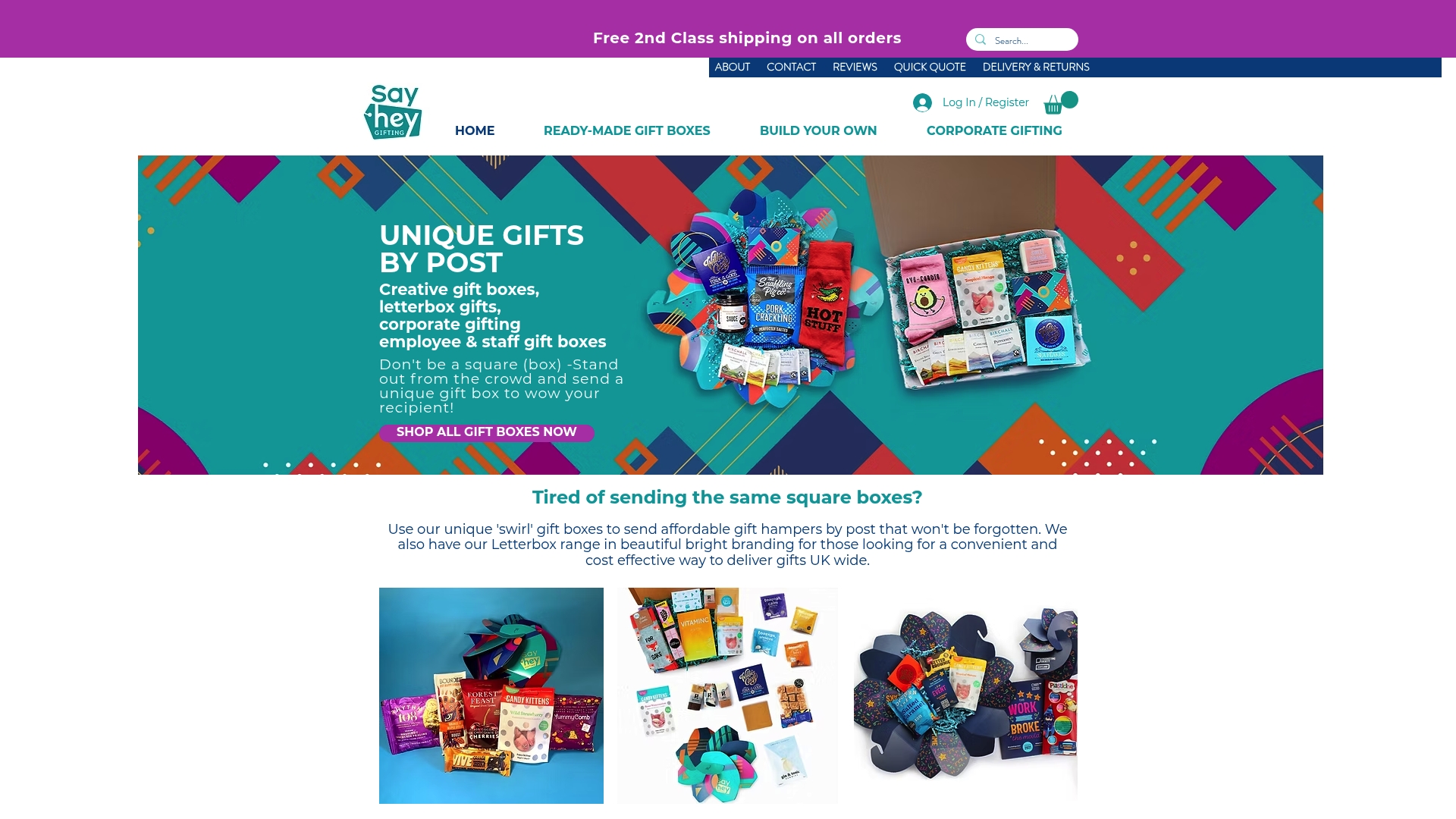
For HR teams managing recognition at scale, Sayheygifting handles the logistics that slow programmes down: preference capture, dietary considerations, branded packaging, and reliable delivery to remote and hybrid team members. The build-your-own gift box option lets you tailor each gift to the individual, which maps directly onto the preference-capture step in your rollout checklist. Redemption and order data also give you a practical signal of participation and reach. Browse the full range of employee gifts and place your first order today.
Sources
FAQ
What are the most common mistakes managers make with staff recognition?
The most frequent errors are recognising people too rarely, using generic praise that lacks specificity, and overlooking quieter contributors in favour of high-profile team members. Training managers on the SBI model (Situation, Behaviour, Impact) addresses all three.
What are some effective ways to appreciate employees without relying on bonuses?
Specific, timely verbal or written praise, peer recognition moments, public acknowledgement tied to company values, and personalised gifts paired with a handwritten note all carry significant motivational weight without requiring a large budget.
How do you avoid common employee recognition programme pitfalls?
Set transparent criteria before launch, train line managers, embed recognition into existing workflows rather than separate platforms, and measure participation and pulse scores monthly. Reviewing a recognition distribution heatmap each quarter helps catch bias early.
What is the biggest warning sign that a recognition programme is failing?
High variance in recognition scores between teams is the clearest signal: it means some managers are participating and others are not, which creates perceived inequity and erodes trust in the programme overall.
How can gifting support a recognition programme without replacing it?
Gifts work best when they reinforce a specific, named recognition moment rather than standing alone. Personalised options, such as Sayheygifting’s customisable employee gift boxes, extend the emotional impact of the acknowledgement and give remote or hybrid team members a tangible reminder of the moment.
Recommended
Comments