
Budget by Delivered Cost: UK Corporate Gift Pricing £8–£150
Expect roughly £8 to £15 for entry-level letterbox gifts, £25 to £60 for curated employee boxes, and £75 and upwards for bespoke executive hampers, all as delivered cost. The figure that catches most buyers off guard isn’t the product price at all: it’s the HMRC rule that gifts over £50 per person, per year, trigger a VAT bill you weren’t expecting. Get the budgeting framework right and both problems disappear together.
TL;DR:
Suppliers often quote only product costs, so verify the full landed cost including branding, packaging, and postage to avoid hidden expenses.
Bulk orders benefit from volume discounts on product and branding, reducing the delivered cost per gift, especially in larger runs.
Gifts exceeding £50 net per person within a 12-month period trigger VAT on the entire amount, not just the excess, increasing overall costs.
Custom branding techniques and premium packaging significantly raise costs but can enhance perceived value for high-tier recipients.
Comparing quotes line-by-line and requesting itemized, delivered-unit costs help prevent overpaying due to unaccounted extras like rush fees or shipping.
Table of Contents
Corporate gift pricing UK: typical price ranges and worked examples
Every corporate gifting quote you receive should be read as a delivered cost, not a shelf price. Suppliers sometimes quote the product alone and leave branding, packaging and postage as “extras” that only appear once you’ve committed. Build your comparisons around the full landed figure and you’ll spot the real cost difference between suppliers in seconds.
Entry-level (£8 to £15 delivered): This band covers letterbox-friendly gifts such as a branded notebook and pen set, a small snack selection, or a single premium treat with a printed card. These work well for onboarding welcome packs, thank-you notes after a sales call, or a light-touch gesture to hundreds of recipients where the budget has to stretch, especially when paired with a coffee pod gift pack to add a popular beverage option.
Mid-range (£25 to £60 delivered): This is where most staff recognition and client thank-you gifting sits. Think a curated box with three to five items, custom branding on the packaging itself, and a printed message card. A Letterbox gifts selection in this range typically balances presentation against unit cost well, since the box design carries much of the perceived value.
Premium (£75+ delivered): Executive hampers, VIP client gifts, and milestone anniversary boxes belong here. Expect higher-end food and drink, tactile packaging (ribbon, tissue, rigid boxes), and sometimes a handwritten note. Volume tends to be lower, so per-unit cost climbs, but so does the impact per recipient.
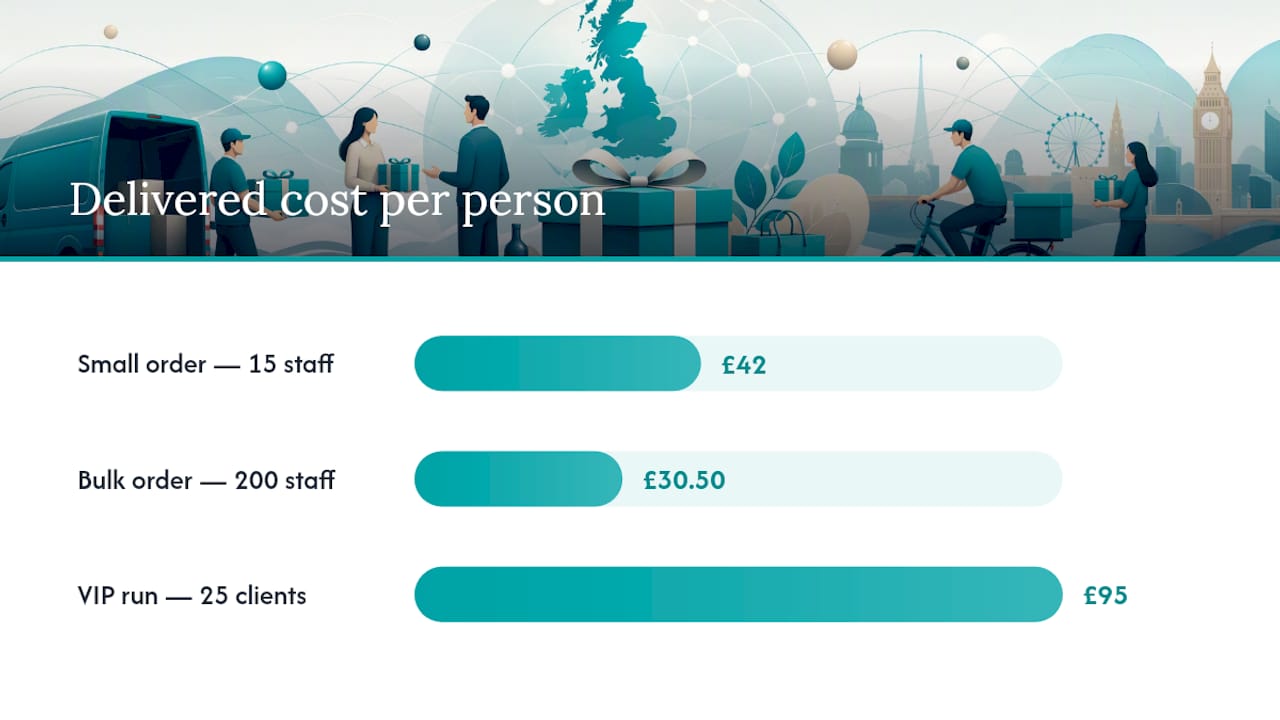
Here’s how a delivered cost actually breaks down for three common scenarios:
Small order, 15 staff Christmas gifts: Product £30 + branding £3 + packaging £4 + fulfilment/postage £5 = £42 per person delivered. No volume discount at this size, so unit costs stay close to list price.
Bulk order, 200 employee wellness boxes: Product £22 (discounted from £28 at volume) + branding £2 (spread across a larger print run) + packaging £3 + fulfilment £3.50 = £30.50 per person delivered. The discount on product and branding is where bulk orders earn their keep.
VIP run, 25 client hampers: Product £65 + bespoke branding £8 + premium packaging £10 + white-glove courier delivery £12 = £95 per person delivered. Low volume means no discount, and the fulfilment line is disproportionately larger because each hamper ships individually with tracked delivery.
Statistic to remember: HMRC’s VAT rule sets the deductible threshold at £50 net per person, per 12-month period. In scenario one, £42 sits safely under that line. In scenario three, £95 sails well past it, which means output VAT becomes payable on the full cost, not just the excess.
A corporate gift box prices guide can help you sanity-check quotes against typical UK benchmarks before you sign off a budget line, particularly if you’re comparing three or four suppliers at once and the quotes are structured differently.
What drives corporate gift pricing in the UK?
Five variables move the price of any order, and understanding each one tells you exactly where you have room to negotiate and where you don’t.
Product and materials. Glassware, leather goods and branded electronics sit at the top of the cost curve. Snacks, stationery and small wellness items sit at the bottom. The material itself, not the brand story around it, is usually the biggest single line in your quote.
Branding and personalisation. Custom printing, embossing, or engraving on the packaging or product typically adds anywhere from a small flat fee to a meaningful per-piece uplift, depending on the technique. Foil-blocked ribbon costs less to set up than laser-engraved glass, and setup fees get spread thinner across larger runs.
Packaging and presentation. A rigid box with tissue paper and a ribbon costs more than a printed mailer bag, but it also carries more of the perceived value, particularly for client-facing gifts where the unboxing moment matters as much as the contents.
Fulfilment model. Shipping 300 identical boxes to one office address costs far less per unit than shipping 300 individually addressed letterbox gifts to home addresses across the country. Multi-address fulfilment is a real cost driver, not a footnote.
Lead times, minimum order quantities, and import factors. Rushed turnaround compresses your negotiating power and often removes access to the better unit rates that come with planned, consolidated ordering. Quantity breaks and MOQ thresholds are a standard commercial lever that most suppliers will discuss openly if you ask early, rather than at the point of ordering.
Where you can save:
Ask about quantity breaks at 50, 100 and 250 units. Tiers are usually fixed, not negotiable, but knowing them lets you round your order up sensibly.
Choose one branding technique across the whole order rather than mixing methods, which avoids paying multiple setup fees.
Consolidate delivery to fewer addresses wherever the occasion allows it.
Lock in lead times of four to six weeks where possible. Rush fees are one of the least transparent costs in this category.
Pro Tip: Ask every supplier for a delivered unit cost broken into five lines: product, branding, packaging, fulfilment, and postage. Suppliers who resist itemising a quote this way are usually the ones with the least competitive base product cost.
How much should you budget for corporate gifts?
The clearest way to build a defensible gifting budget is headcount multiplied by moments multiplied by spend per recipient. Rather than setting one flat figure for “gifting” across the year, map out who gets a gift, how often, and what tier of spend each occasion justifies. Budget planning frameworks built on total delivered cost consistently outperform ones built on unit price alone, because they capture the contingency and packaging spend that otherwise gets missed until the invoice lands.
A three-tier recipient model works for most UK organisations:
Priority clients and key partners: £75 to £150 per recipient, once or twice a year. This tier justifies premium packaging and bespoke branding because the audience is small and the relationship value is high.
Staff and internal recognition: £25 to £60 per recipient, for onboarding, work anniversaries, and seasonal moments like Christmas. Employee gift boxes at this level tend to land well because the presentation does more work than the raw spend.
Broad-reach or introductory gifts: £8 to £20 per recipient, for large distribution lists, event attendees, or light-touch thank-yous where volume matters more than individual polish.
Once you know the tier, calculate total delivered cost by adding a contingency line. Add a separate one-off allowance for artwork proofs and physical samples, which suppliers often charge for on a first order and waive on repeat business.
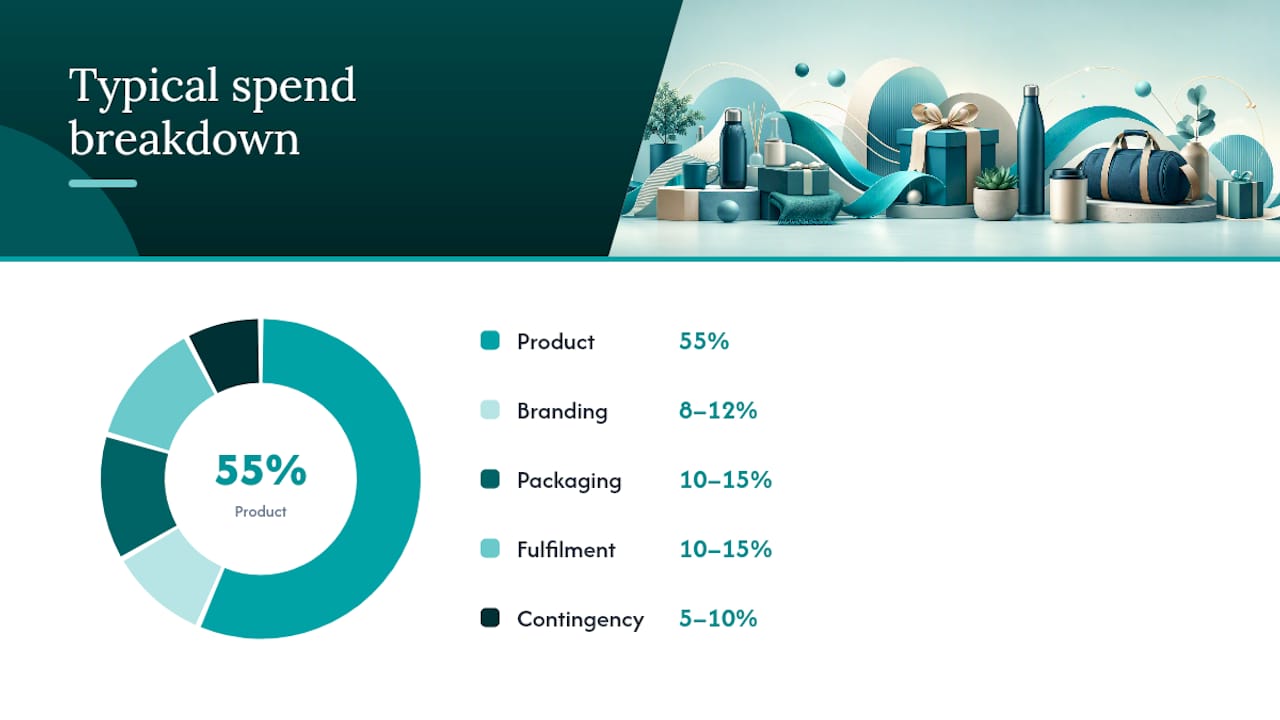
Budget item | What it covers | Typical share of total spend |
Product | Base item cost, including material and sourcing | 55% |
Branding/personalisation | Printing, embossing, engraving, setup fees | 8 to 12% |
Packaging | Box, tissue, ribbon, printed card | 10 to 15% |
Fulfilment and postage | Picking, packing, delivery per address | 10 to 15% |
Contingency | Damage, reorders, list corrections | 5 to 10% |
Take this to finance with a short approval checklist: confirm the recipient tier, confirm total headcount, confirm the occasion date and lead time, and confirm whether the £50 VAT threshold applies to any individual recipient across the 12-month period. That last check alone prevents most of the tax surprises procurement teams run into after the invoice arrives.
What are the VAT and tax rules for corporate gifts in the UK?
The rule that changes everything is simple to state and easy to miss in practice: gifts to the same person exceeding £50 net in any 12-month period trigger output VAT on the full cost, not just the amount over the threshold. A £60 hamper doesn’t cost you VAT on £10. It costs you VAT on the entire £60.
Corporation Tax treatment is separate, and less forgiving. HMRC generally treats business gifts the same way it treats business entertaining for Corporation Tax purposes, which means most client gifts are not deductible at all. The one meaningful exception is branded advertising gifts, and these have to meet specific conditions, such as carrying a conspicuous advert for the business and not being food, drink, tobacco, or exchangeable vouchers, to qualify.
Employee gifts have their own separate allowance under the trivial benefits exemption, though directors of close companies face a lower annual cap than general staff, so check that rule specifically before assuming the same threshold applies across your whole workforce.
Good record-keeping is what protects you if HMRC ever queries a claim. Practical guidance from UK tax advisers recommends four things procurement should require from every supplier and keep on file:
A gift log recording recipient name, date, cost, and business purpose for every item sent.
Itemised invoices that separate product, branding, and delivery costs.
Photographic evidence of the branding on the finished product, not just the artwork proof.
A running 12-month total per recipient, so the £50 threshold never gets breached by accident across multiple smaller gifts.
A business gift VAT guide or a deeper look at VAT on corporate gifts and the £50 rule is worth bookmarking for your finance team, since the threshold catches out even experienced buyers when gifting is spread across several occasions in one year.
What hidden costs affect corporate gift delivery pricing?
Delivery is where quotes diverge most sharply, and it’s the line most often underestimated at the budgeting stage. Bulk-to-office fulfilment, where one pallet ships to a single reception desk, costs meaningfully less per unit than direct-to-recipient fulfilment, where every gift ships individually to a home address with its own tracking number and courier fee.
Ask every supplier to itemise these before you compare quotes:
Per-address delivery fees for direct-to-home fulfilment versus a single bulk-to-office rate.
Returns and replacement allowances for items damaged in transit or sent to an incorrect address.
Artwork proof charges, particularly for a first order where the branding hasn’t been approved before.
Physical sample costs, since most suppliers charge for a pre-production sample but some waive it against a confirmed order.
Rush fees for lead times compressed below the standard four-to-six-week window.
Pro Tip: Request the rush-fee schedule upfront, even if you don’t need it yet. Knowing the cost of compressing a six-week lead time to two weeks lets you make a fast, informed call if a launch date moves, rather than negotiating blind under pressure.
A corporate gift delivery guide for UK office managers covers the practical scheduling side of this well, particularly for split deliveries across multiple sites or hybrid teams.
Say Hey Gifting’s perspective on pricing pitfalls
The most common pricing mistake we see at Say Hey Gifting is buyers comparing product prices instead of delivered costs, which makes a cheaper-looking supplier quietly more expensive once branding and postage land on the invoice. Corporate gifting done well rewards the buyers who ask for an itemised quote every time, and it punishes the ones who don’t. If you want to see supplier quality before committing budget, request a sample pack and check the branding and packaging in hand, not on a product page.
— Craig
How Say Hey Gifting can help with your corporate gifting budget
Say Hey Gifting builds custom corporate gifting around the exact delivered cost model this article walks through: design, fulfilment and product sourcing handled as one service, with company logo branding included at no extra charge and no hidden per-piece markup once your artwork is approved.
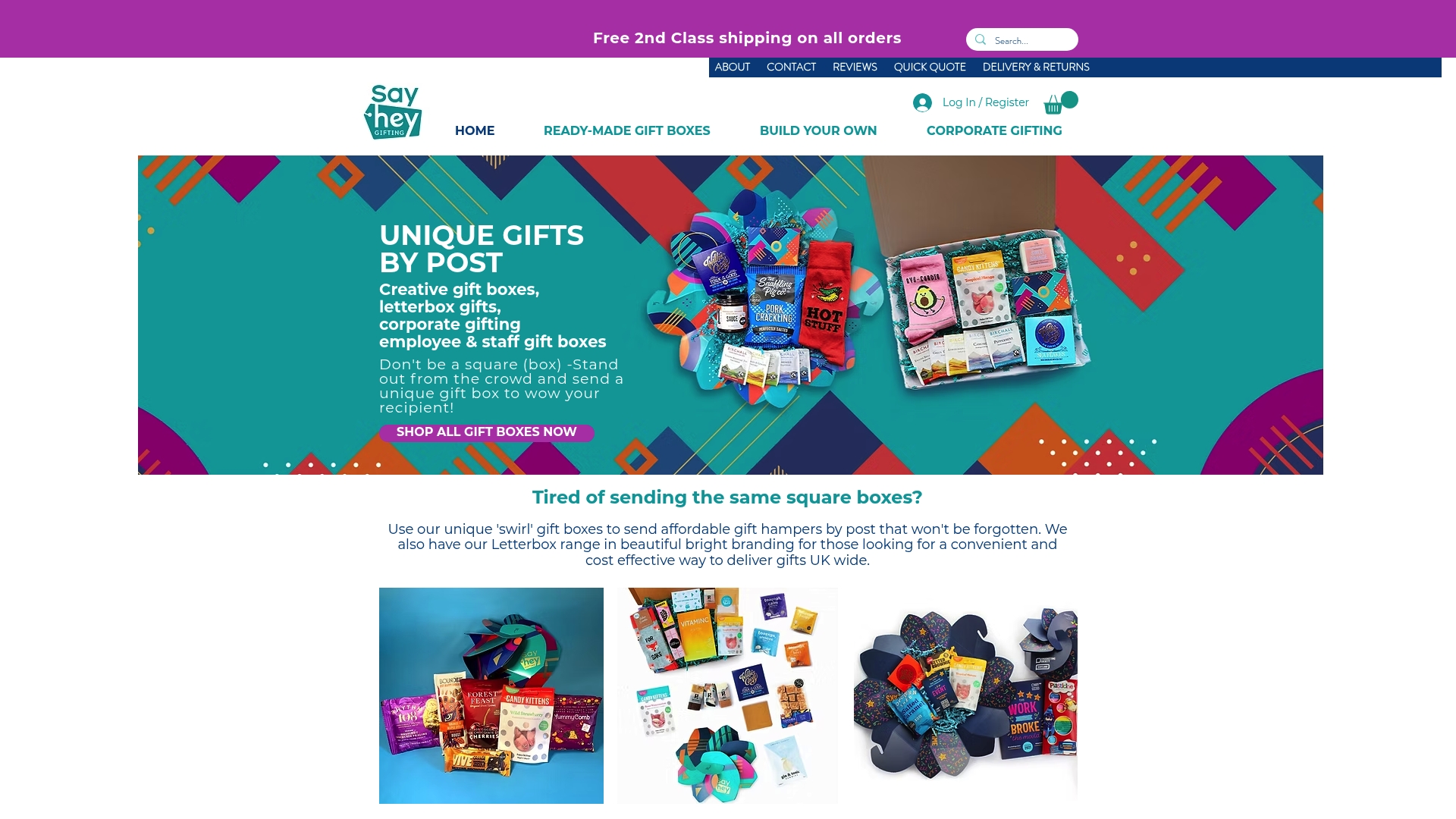
Boxes carry a distinctive swirl design and are shipped across the UK, aiming to balance good presentation with a workable budget. Whether you’re pricing up a small onboarding run or a VIP client hamper campaign, the build your own gift box option lets you set the price point first and choose contents that fit it, rather than working backwards from a fixed product catalogue. For teams gifting from home, the Letterbox gifts range is priced to work at scale without losing the personal touch that makes a gift land well.
The next step is straightforward: request a quote and a sample pack for your specific headcount and occasion, and get a delivered-cost breakdown before you commit any budget line to finance. Start with the corporate gifting page to see current options and get pricing tailored to your recipient tiers.
Sources
FAQ
How much can an employer give as a gift to an employee tax-free in the UK?
Employee gifts can qualify for the trivial benefits exemption, but directors of close companies face a lower annual cap than other staff, so check which rule applies to the recipient before assuming a blanket allowance. Outside that exemption, gifts are generally taxed like any other employee benefit.
How much do UK companies typically spend on corporate gifting?
Spend varies widely by recipient tier: broad-reach gifts typically run £8 to £20 per person, staff recognition sits at £25 to £60, and VIP client gifts often exceed £75 per recipient. Building a budget from total delivered cost rather than unit price gives a far more accurate annual figure than working from product price alone.
What are the HMRC rules for gifts to clients?
Client gifts are generally not deductible for Corporation Tax, since HMRC treats them similarly to business entertaining, with a narrow exception for branded advertising gifts that meet strict conditions. Separately, any gift over £50 net per person in a 12-month period triggers output VAT on the full cost.
What corporate gifting options are available in the UK?
UK buyers can choose from letterbox gifts, curated employee boxes, custom branded hampers, and build-your-own gift box services depending on budget and occasion. Say Hey Gifting offers custom corporate gifting with free logo branding and UK-wide delivery, alongside ready-made options like wellness gifts and vegan hampers for teams with specific dietary needs.
Does the £50 VAT rule apply per gift or per year?
The £50 threshold applies per person, per 12-month period, not per individual gift. If you send one recipient two gifts worth £30 each within a year, the combined £60 total exceeds the threshold and output VAT becomes due on the full amount.
Recommended
Comments