
Trivial benefits rules for UK employers: quick guide

Yes, small gifts to employees can be completely tax-free — provided they meet HMRC’s trivial benefits rules. The statutory exemption, introduced under section 323A ITEPA 2003, means you do not need to report or pay tax on a benefit if it satisfies all four conditions below.
The four conditions every employer must check:
Cost: the total cost to provide the benefit, including VAT and delivery, must not exceed the statutory trivial benefit financial limit per person.
Not cash or a cash voucher: the gift must be a non-cash item or a non-cash voucher.
Not contractual or salary sacrifice: the benefit must not be part of the employee’s contract or provided through a salary sacrifice arrangement.
Not a reward for services or performance: the gift must not recognise particular work done or results achieved.
All four conditions must be met. If even one fails, the full cost of the benefit becomes taxable, not just the amount over £50.
One additional rule applies to directors of close companies: a £300 annual cap applies across all trivial benefits received in a tax year, including those given to family or household members.
Key takeaways
HMRC’s trivial benefits rules allow UK employers to give tax-free gifts worth up to £50 (VAT-inclusive) per person, provided the gift is non-cash, not contractual, and not a reward for performance.
Point | Details |
£50 VAT-inclusive limit | The full cost, including VAT and delivery, must not exceed £50 per person or the entire amount is taxable. |
All four conditions must be met | Cash, contractual, and performance-linked gifts all fail the exemption regardless of cost. |
Directors face a £300 annual cap | Close company directors and their household members cannot receive more than £300 in trivial benefits per tax year. |
Document every gift briefly | A one-line purpose note and saved invoice is sufficient to demonstrate reasonable care to HMRC. |
Sayheygifting for compliant gifting | Pre-priced, VAT-inclusive gift boxes and letterbox gifts make it straightforward to stay within the £50 threshold. |
This article is general information, not a substitute for advice from a qualified financial advisor. Consult a qualified financial professional about your own circumstances before acting on anything here.
Table of Contents
What the trivial benefits exemption actually means in law
The statutory basis sits in section 323A of the Income Tax (Earnings and Pensions) Act 2003, with HMRC’s detailed guidance published in EIM21864. A matching Class 1 National Insurance disregard means qualifying trivial benefits are also disregarded for NICs purposes, as confirmed in NIM02403.
Before April 2016, employers had to negotiate discretionary arrangements with HMRC to treat small gifts as non-taxable. The statutory exemption replaced those arrangements to reduce the administrative burden on both employers and HMRC — a welcome simplification for small businesses that want to show appreciation without generating paperwork.
The statutory limit for trivial benefits is VAT-inclusive at a designated monetary threshold. Gifts exceeding this total cost do not qualify for the exemption.
The HS207 helpsheet provides a concise employer-facing summary of the conditions and is a useful quick reference for payroll teams.
The four statutory conditions explained for employers
Condition A: not cash or a cash voucher
Cash payments are never trivial benefits, regardless of the amount. A £20 note in a birthday card fails immediately. Cash vouchers — those exchangeable for cash — also fail. However, non-cash vouchers (such as a gift card for a specific retailer) can qualify, provided the other conditions are met. The practical test: could the employee convert it directly to cash? If yes, it is not exempt.
Condition B: cost does not exceed £50 (VAT-inclusive)
Always use the VAT-inclusive cost, including any delivery or packaging charges you pay. Employers frequently forget to add VAT when pricing staff gifts, which can push a gift over the limit unexpectedly. If the cost per person exceeds £50, the entire amount is taxable — not just the excess. See EIM21865 for HMRC’s worked examples on cost calculation.
Condition C: not contractual or salary sacrifice
A benefit promised in an employment contract, staff handbook, or through a salary sacrifice arrangement cannot qualify. The exemption is for genuine, discretionary gestures of goodwill. If employees expect a gift as part of their terms, it is contractual by nature.
Condition D: not a reward for services or performance
This is the condition most likely to trip employers up. A gift given to mark a sales target, a project completion, or a positive appraisal is a reward for work — and it fails. According to RSM UK, this condition is commonly the most difficult to satisfy, and they recommend documenting gifts clearly as gestures of goodwill or welfare rather than recognition of performance.
Pro Tip: When approving a gift, write a one-line purpose statement on the purchase record: “Birthday goodwill gesture — not linked to performance or contract.” That single line can resolve an HMRC query before it escalates.
How to calculate the cost correctly, including group gifts
The cost is always the VAT-inclusive amount you pay to provide the benefit, including delivery and packaging. EIM21865 confirms this and sets out how averaging works for group situations.

When you cannot itemise per person (a catered team lunch, a bulk hamper order), HMRC allows an average cost per employee. Divide the total VAT-inclusive cost by the number of recipients. If that average exceeds £50, the exemption fails for everyone in the group.
Repeated gifts across the tax year are treated as separate benefits, each assessed individually. However, if a series of small gifts is structured to circumvent the limit, HMRC may aggregate them. Occasional, genuinely ad-hoc gifts are fine; a monthly supply of the same item starts to look contractual.
For staff hamper contents and pricing, keeping the VAT-inclusive per-person figure clearly visible on the purchase invoice is the simplest way to demonstrate compliance.
Special rules for directors and close companies
A close company is broadly one controlled by five or fewer participators (shareholders), or by its directors. Most owner-managed businesses and small limited companies fall into this category.
Directors of close companies face an additional restriction: a £300 annual cap on trivial benefits across the whole tax year. Each individual benefit must still cost £50 or less, but the total received by the director — and by any family or household member — cannot exceed £300 in a single tax year.
Why the cap exists: without it, a director could receive six £50 gifts per year entirely tax-free, which HMRC considered disproportionate given the director’s ability to influence their own remuneration. The £300 cap limits that opportunity while still allowing genuine goodwill gestures.
Practical steps for close company employers:
Keep a running log of trivial benefits given to each director and their household members from 6 April each year.
Assign a central approver (typically the company secretary or finance lead) for any gift to a director.
Stop issuing trivial benefits to a director once their cumulative total reaches £300, even if individual gifts remain under £50.
What does not qualify as a trivial benefit?
Some gifts look small but fail the exemption. Knowing the common non-examples saves you from an unexpected tax liability.
Benefits that never qualify:
Cash payments of any amount
Cash vouchers (exchangeable for cash)
Reimbursements of employee expenses
Bonuses paid in gift card form
Performance awards or long-service awards structured as gifts
Benefits that often fail in practice:
Monthly wellness allowances paid as cash or cash-equivalent vouchers — these fail Condition A and are likely contractual.
Regular Friday afternoon treats provided every week — HMRC may treat these as an expected entitlement, making them contractual.
A gift given immediately after a successful project — the timing creates a strong inference of performance reward, failing Condition D.
A hamper ordered through salary sacrifice — the salary sacrifice arrangement disqualifies it under Condition C, regardless of cost.
A gift card for a major supermarket where the employee can buy anything, including items exchangeable for cash — borderline, but HMRC treats widely redeemable cards cautiously.
For guidance on distinguishing goodwill gifts from reward gifts, the employee gifting and team reward gifts resource explains the practical difference clearly.
Employer checklist and documentation template
A short record kept with the purchase invoice is usually sufficient to demonstrate reasonable care if HMRC asks. You do not need elaborate systems — just consistent, brief notes.
Checklist before purchasing a gift:
[ ] VAT-inclusive cost per person is £50 or less (including delivery and packaging)
[ ] The gift is not cash or a cash voucher
[ ] The gift is not promised in the employment contract or provided via salary sacrifice
[ ] The gift is not linked to a performance target, appraisal, or project completion
[ ] For directors: cumulative trivial benefits in the current tax year remain below £300
Documentation template (copy into payroll or HR records):
Pro Tip: Save the supplier invoice alongside this record. If HMRC queries the gift, the VAT-inclusive cost is immediately verifiable without reconstructing figures from memory.
Compliant gift examples with template entries:
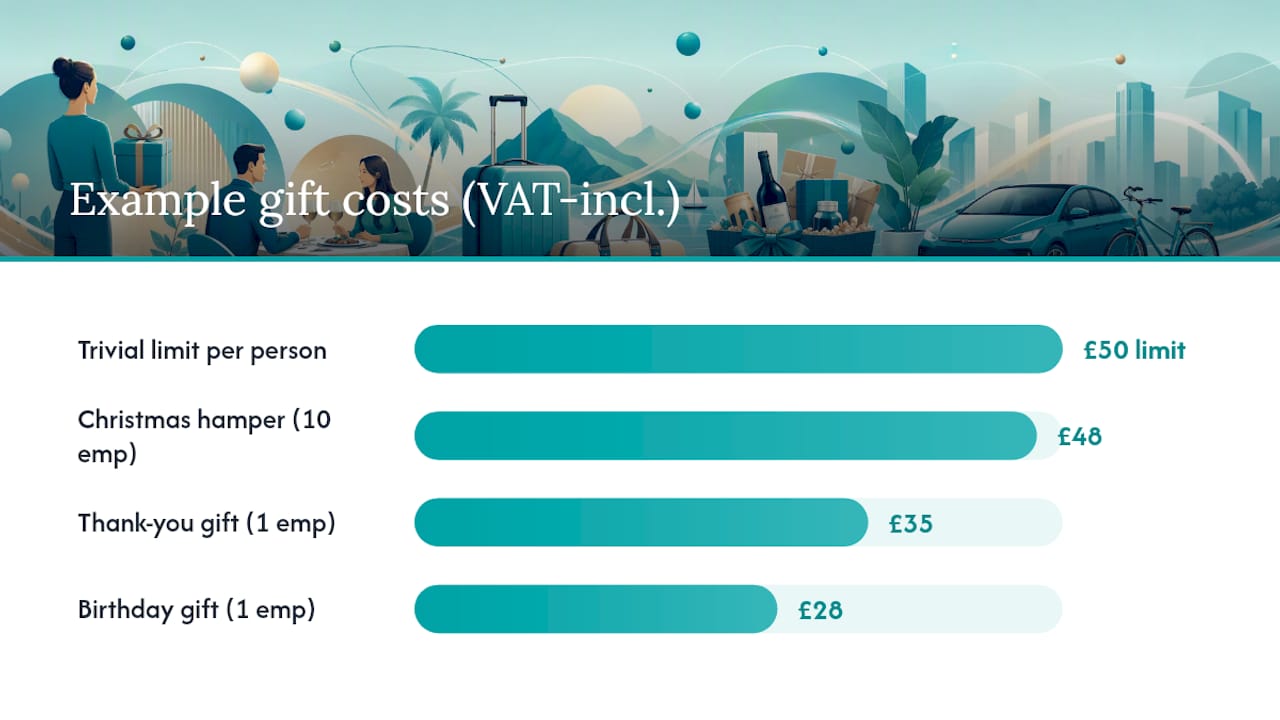
Christmas hamper (£48 VAT-incl., 10 employees): purpose — seasonal goodwill; not contractual; not performance-related. Exempt.
Ad-hoc thank-you gift box (£35 VAT-incl., 1 employee): purpose — welfare gesture following a difficult period; not linked to appraisal. Exempt.
Birthday letterbox gift (£28 VAT-incl., 1 employee): purpose — personal milestone goodwill; not contractual. Exempt.
For seasonal planning, the Christmas staff gifting guide covers how these rules apply in practice during the festive period.
What happens when the conditions are not met
If a benefit fails any of the four conditions, the full cost is taxable — not just the amount over £50. This matters because a £52 hamper does not generate a £2 liability; it generates a liability on the whole £52.
Tax and NIC consequences:
The benefit’s full cost is treated as employment income and subject to income tax.
Employer Class 1A NICs apply to most benefits in kind reported on a P11D.
Where a benefit is provided through a salary sacrifice arrangement, Class 1 NICs may apply instead.
Reporting steps:
Identify the taxable benefit and its VAT-inclusive cost.
Report it on the employee’s P11D (or through payroll if you have registered for payrolling benefits).
Calculate the employer’s Class 1A NIC liability (currently 13.8% on the taxable amount) and include it in your P11D(b) return.
Where salary sacrifice is involved, review Class 1 NIC treatment with your payroll provider.
The HS207 helpsheet sets out current reporting obligations clearly. If you are uncertain about a specific benefit, speaking with a tax adviser before the P11D deadline avoids penalties.
Quick decision checklist before you place a gift order
Run through this before purchasing any staff gift:
Is the VAT-inclusive cost per person £50 or less? If no, reduce the gift value or report it.
Is it a non-cash, non-voucher item? If no, it is not exempt — consider a physical gift instead.
Is it genuinely discretionary, not promised in any contract? If no, it is taxable employment income.
Is it unconnected to performance, targets, or appraisals? If no, document carefully or treat it as a taxable award.
For directors: is the cumulative total still below £300 this tax year? If no, stop issuing trivial benefits to that director until the next tax year.
If any answer is “no”: report the benefit on a P11D, calculate the Class 1A NIC liability, and consider whether the gift design can be adjusted for future occasions. Save the purchase invoice and your completed checklist together.
For a broader view of gifting occasions across the year, planning ahead by occasion makes it much easier to stay within the £50 limit consistently.
A practical note for small employers on getting gifting right
The trivial benefits rules are genuinely one of the more employer-friendly parts of the UK tax code. They exist to make it easy to show appreciation without generating administrative burden — and for most small businesses, a lightweight approach is entirely appropriate.
The risk for small employers is not usually deliberate non-compliance; it is forgetting to check the VAT-inclusive cost, or giving a gift immediately after a performance milestone and not documenting the purpose carefully. Both are easy to fix with a simple policy: set a price band (say, £40 maximum per gift to give yourself a comfortable margin below £50), require a one-line purpose note on every purchase, and assign a single approver for any gift to a director.
You do not need specialist software or a formal policy document. A shared spreadsheet tracking director gifts across the tax year and a folder of saved invoices with purpose notes is sufficient for most small businesses. The goal is to show HMRC, if asked, that you applied reasonable care — and that is genuinely achievable with minimal effort.
Thoughtful, compliant gifts your team will genuinely love
Choosing gifts that sit comfortably under the £50 limit is much easier when the pricing is transparent from the outset. Sayheygifting’s employee gift boxes are priced VAT-inclusively, so you can see at a glance whether a gift meets the threshold — no mental arithmetic required.
For bulk orders, the build your own gift box option lets you set a per-person budget and customise contents accordingly, keeping every recipient’s cost clearly within the £50 limit. If you want something quick and affordable, the letterbox gift under £10 range offers a genuinely thoughtful gesture with plenty of headroom below the threshold. Browse the full range and place your order at Sayheygifting.
Sources
FAQ
What are the four conditions for HMRC trivial benefits?
A benefit qualifies as trivial if it costs £50 or less (VAT-inclusive), is not cash or a cash voucher, is not provided under the employee’s contract or salary sacrifice arrangement, and is not a reward for services or performance. All four conditions must be satisfied.
How many trivial benefits can an employee receive per year?
There is no statutory limit on the number of trivial benefits an ordinary employee can receive, provided each one meets all four conditions individually. Directors of close companies are subject to a £300 annual cap across all trivial benefits received in a tax year.
Can trivial benefits be backdated?
No. HMRC’s trivial benefits exemption applies to benefits provided in the current tax year; you cannot retrospectively reclassify a taxable benefit as trivial after the fact. If a benefit failed the conditions when it was given, it remains taxable.
Do employers need to report trivial benefits on a P11D?
Qualifying trivial benefits do not need to be reported on a P11D and attract no income tax or NIC liability. If a benefit fails any of the four conditions, the full cost must be reported on a P11D and employer Class 1A NICs apply.
Recommended
Comments