
Role of gifting in event follow-up: boost relationships and ROI
- sayheystudio
- 1 day ago
- 9 min read

A well-chosen gift sent within days of an event is one of the most effective tools you have for turning a brief conversation into a lasting relationship. The role of gifting in event follow-up is to anchor positive memories, trigger the reciprocity impulse, and accelerate pipeline movement in ways that a follow-up email simply cannot replicate. Your single next step: segment your attendee list into three tiers (VIPs, engaged prospects, and speakers or staff), then select one gift format per tier before the week is out.
Three reference points worth keeping in mind from the start:
The American Psychological Association confirms that gift-giving activates dopamine and oxytocin pathways, producing a warm-glow effect that sustains trust long after the event ends.
The Wiley consumer gift-giving review identifies context and motivation as the two variables that most determine whether a gift creates or destroys value.
Sayheygifting offers ready-made and build-your-own gift boxes designed for exactly this kind of scalable, personalised post-event send.
Table of Contents
Why does gifting work so well after an event?
The science here is genuinely compelling. Giving and receiving gifts activate the brain’s reward regions, releasing dopamine (the anticipation and pleasure chemical) and oxytocin (the bonding hormone). The result is a warm-glow response that attaches positive feeling to the giver, not just the gift itself. For event planners, this means a thoughtfully chosen gift can make your brand the thing a recipient associates with that good feeling for weeks.
University of Arizona neuroscience research adds an important nuance: anticipation matters as much as the gift itself. A personalised note previewing what is on its way, sent the day after the event, can prime the recipient’s reward system before the box even arrives.
“Thoughtful gifting functions as a form of corporate diplomacy — it signals respect and appreciation, but only when it is personalised and timely. A generic gift can feel more transactional than no gift at all.” Psychology Today
Anthropological research published in Scientific American frames gifting through Marcel Mauss’s theory of reciprocity: giving, receiving, and reciprocating are the three acts that sustain human relationships. When you send a post-event gift, you are not closing a transaction; you are opening a cycle of ongoing connection.
When should you send gifts, and who should receive them?
Timing is the most common point of failure in post-event gifting. Send too soon (the day of the event) and the gift feels rushed. Send too late (three weeks after) and the recipient has mentally filed the event away. The sweet spot is three to seven days post-event, once recipients have returned to their normal routine but the conversations you had are still fresh. Post-event gifting best practices consistently reinforce this window as the point at which a gift feels like a meaningful continuation of the event rather than an afterthought.
Segmentation determines purpose. Use this framework:
Recipient segment | Purpose of gift | Recommended format |
VIPs (key clients, investors) | Deepen relationship, signal long-term value | Premium hamper or branded build-your-own box |
Engaged prospects | Maintain momentum, prompt next conversation | Mid-tier letterbox gift with personalised note |
Speakers and panellists | Express genuine gratitude, reinforce partnership | Curated experience or premium food-and-drink box |
Internal staff and event team | Recognise effort, sustain morale | Letterbox gift or team reward box |
For international recipients, e-gifts or digital vouchers sidestep customs delays entirely. For UK-based recipients, letterbox gifts are the most reliable format because they require no signature and arrive without fuss.
How do you choose the right gift for each recipient?
Work through this checklist before placing any order:
Prioritise usefulness and sustainability. Anthropological evidence shows that meaningful, personal gifts sustain connections more effectively than mass-produced items. Environmentally friendly packaging and locally sourced contents signal that you have thought beyond the obvious.
Budget tiers to guide your planning:
Entry tier (under £15 per head): Letterbox gifts, artisan tea or coffee selections, branded notebooks. Ideal for broad audience touches and large-scale sends. Sayheygifting’s letterbox gift under £10 with free UK delivery fits here perfectly.
Mid tier (£15–£40 per head): Curated food-and-drink boxes, vegan hampers, wellness care packages. Right for engaged prospects and speakers.
Pro Tip: Adding a recipient’s first name and a one-line event reference to the gift card costs nothing extra but consistently outperforms generic messaging on response rate and recall.
What do UK event teams need to check before sending gifts?
Logistics and compliance are where well-intentioned gifting programmes quietly unravel. Work through this checklist before fulfilment begins.
Logistics:
Verify delivery addresses at registration, not on the day of send. Stale addresses are the leading cause of failed deliveries.
For international recipients, check customs thresholds and declare gift value accurately. The UK’s HMRC guidance on import duties applies to inbound gifts; outbound gifts to EU recipients may attract VAT or import fees depending on destination country rules.
Use a tracked fulfilment service and build quality-control checks into your workflow. Sayheygifting’s logistics guide covers bulk distribution and quality assurance in detail.
Tax and benefits:
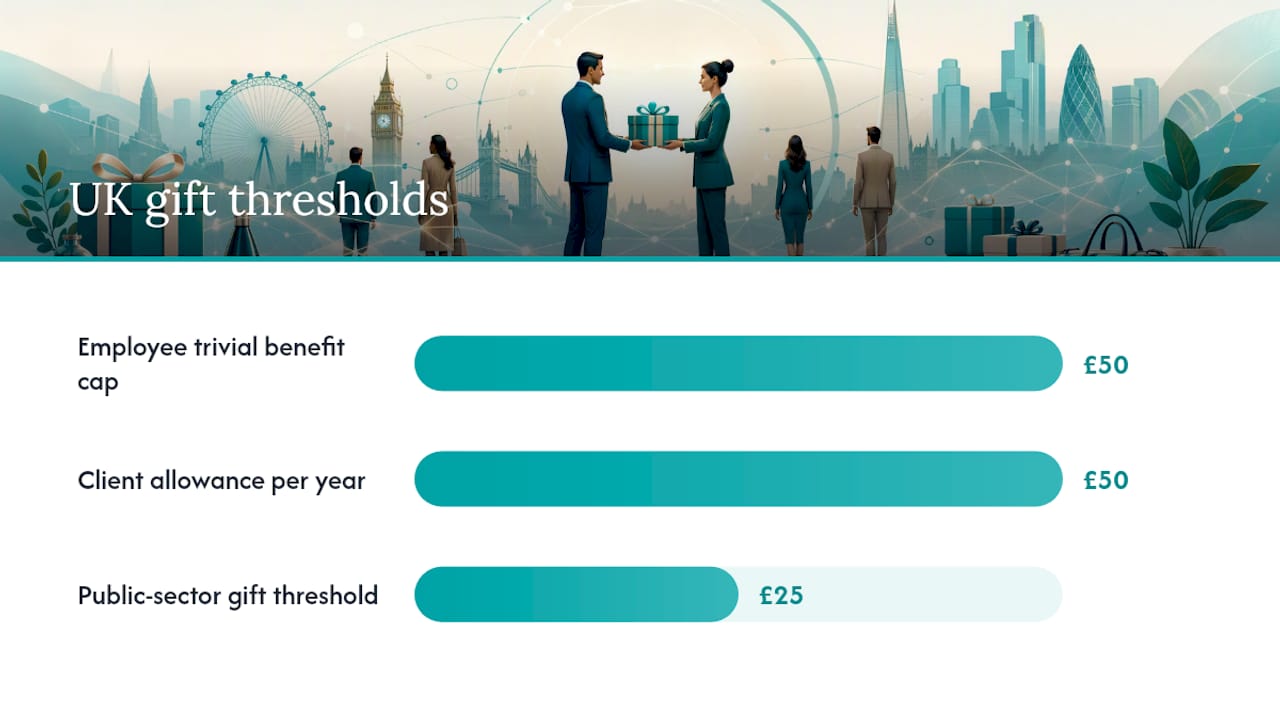
Under HMRC rules, gifts to employees may be treated as a taxable benefit unless they qualify as a trivial benefit (currently capped at £50 per employee per occasion). Gifts to clients are generally allowable as a business expense up to £50 per person per year, provided they carry a business advertisement and are not food, drink, tobacco, or vouchers. Confirm your specific position with a qualified tax adviser or check HMRC’s guidance on business entertainment and gifts directly.
Anti-bribery and corporate policy:
Check your organisation’s gift policy before sending anything above £25 in value to a public-sector contact or regulated professional.
Keep a brief record of what was sent, to whom, and why. This protects both the sender and the recipient.
Pro Tip: Build a simple gift register in your CRM or event management platform. One row per recipient, with gift value, date sent, and business rationale, takes minutes to maintain and provides full audit trail if questions arise.
How do you measure the impact and ROI of post-event gifting?
Measurement turns gifting from a feel-good activity into a defensible budget line. Start with these KPIs:
KPI | How to measure | Target benchmark |
Response rate lift | Compare reply rates: gifted vs. non-gifted follow-up cohort | Meaningful uplift vs. control group |
Meeting conversion rate | Meetings booked within 30 days of gift send | Track in CRM against event cohort |
Pipeline value influenced | Opportunities opened or advanced within 60 days | Assign in CRM at opportunity stage |
NPS or qualitative feedback | Post-event survey with one gifting-specific question | Positive sentiment score |
Repeat engagement rate | Re-attendance, referrals, or repeat purchase over time | Year-on-year comparison |
For attribution, use UTM-tagged links in your gift card message to track website visits. Create a CRM field for “gift sent” and a follow-up task 10 days later. A simple ROI calculation: if a £30 gift contributes to a single £3,000 contract renewal, the return is 100x on that send. Sayheygifting’s corporate gifting ROI analysis provides further KPI frameworks you can adapt directly.
What are the best UK-friendly gift ideas and message templates?
Entry tier (under £15): artisan tea or coffee sachets, seed packets with a sustainability message, branded enamel pin badges, mini candles, letterbox snack selections. For a curated food-and-drink option, East View Coffee Company’s gift range offers locally sourced options that travel well in letterbox format.
Mid tier (£15–£40): vegan gift hampers, wellness boxes (bath salts, herbal teas, a journal), locally sourced cheese and chutney sets, curated stationery kits, build-your-own letterbox gifts with branded inserts.
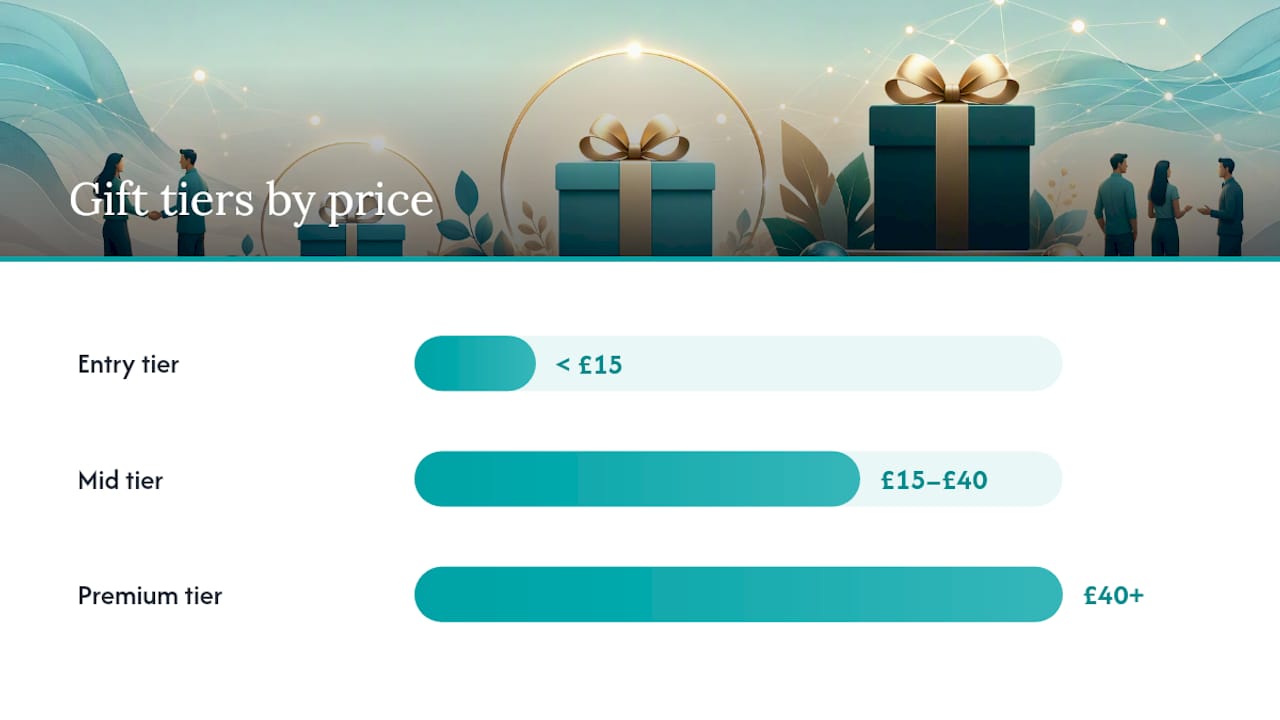
Premium tier (£40+): fully branded corporate hampers, experience vouchers (cookery class, spa day), premium spirits or wine selections with engraved packaging, employee gift boxes with custom branding and handwritten notes.
Sample message templates:
VIP client: “It was genuinely great to speak with you at [Event Name]. We’ve put together a small thank you that we hope reflects how much we value the relationship. Looking forward to continuing the conversation.”
Engaged prospect: “Thank you for the conversation at [Event Name] — your thoughts on [specific topic] stayed with me. This is a small token of appreciation; I’d love to pick up where we left off.”
Speaker: “Your session at [Event Name] set the tone for the whole day. This is a small thank you from the whole team — we’re grateful for your time and expertise.”
Staff: “You made [Event Name] what it was. This is a well-deserved thank you from everyone who benefited from your hard work.”
For creative corporate gifting ideas that go beyond the standard hamper, Sayheygifting’s blog offers practical inspiration across formats and budgets.
What pitfalls and red flags should you watch for?
Most gifting mistakes are avoidable with a short pre-send check.
Red flags:
Sending gifts more than two weeks after the event, when the connection has faded
Choosing gifts with no relevance to the recipient’s context or the event theme
Ignoring dietary requirements or cultural sensitivities (alcohol to a non-drinker, pork products to a Muslim or Jewish recipient, for example)
Exceeding corporate gift policy thresholds without documentation
Using generic, unbranded packaging that signals low effort
Cultural sensitivity checklist for international recipients:
Confirm dietary restrictions and religious observances before selecting consumables
Avoid white flowers or white packaging in East Asian contexts (associated with mourning)
In some cultures, gifts are not opened in front of the giver; a note acknowledging this is a thoughtful touch
Check local customs rules to avoid gifts being held at customs or attracting unexpected charges
If a gift does misfire, act quickly: a personal phone call or handwritten note acknowledging the misstep, with a sincere apology and no over-explanation, is the fastest way to recover goodwill.
Key takeaways
Post-event gifting works because it activates the brain’s reward and bonding chemistry, and the relationship value it creates is measurable when you track the right KPIs from the outset.
Point | Details |
Timing is critical | Send gifts three to seven days post-event, once recipients are back in routine but the event is still fresh. |
Segment before you send | Match gift tier and format to recipient type: VIPs, prospects, speakers, and staff each need a different approach. |
Personalisation multiplies value | A name, an event reference, and a two-sentence note lift perceived value without raising cost. |
Measure with CRM and UTM tags | Track response rate, meeting conversion, and pipeline value to build a defensible ROI case for stakeholders. |
Sayheygifting for scalable sends | Sayheygifting’s letterbox gifts, vegan hampers, and build-your-own boxes cover every tier with UK fulfilment and sustainable packaging. |
A practitioner’s view on what actually moves the needle
Most event teams underestimate how much the gift itself matters relative to the message that accompanies it. The neuroscience is clear: the warm-glow response is triggered by the act of giving, not the monetary value of what is given. Yet the most common mistake I see is organisations spending significant budget on premium gifts and then attaching a two-line generic email. The gift lands, the recipient feels mildly pleased, and the connection fades within a week.
The organisations that get the most from post-event gifting treat the message as the primary vehicle and the gift as the physical proof of that message. Three things that consistently make a difference:
Reference something specific from the event in the gift card. Not “thank you for attending” but “your question about [topic] sparked a great conversation — we wanted to acknowledge that.”
Send a preview note the day after the event, before the gift arrives. This builds anticipation and keeps the conversation alive during the delivery window.
Build a 10-day follow-up task into your CRM the moment the gift is dispatched. The gift opens the door; the follow-up call or email is what walks through it.
For deeper reading on why personalised gifting builds lasting client relationships, Sayheygifting’s blog covers real-world examples that illustrate these principles in practice.
Sayheygifting makes post-event gifting straightforward
Post-event gifting at scale has one genuine challenge: maintaining personalisation without losing operational control. Sayheygifting is built for exactly that. Whether you need a batch of letterbox gifts for a broad prospect list, vegan hampers for dietary-conscious VIPs, or a fully custom build-your-own box with branded inserts for your top ten clients, every option ships with environmentally friendly packaging and UK-wide tracked delivery.
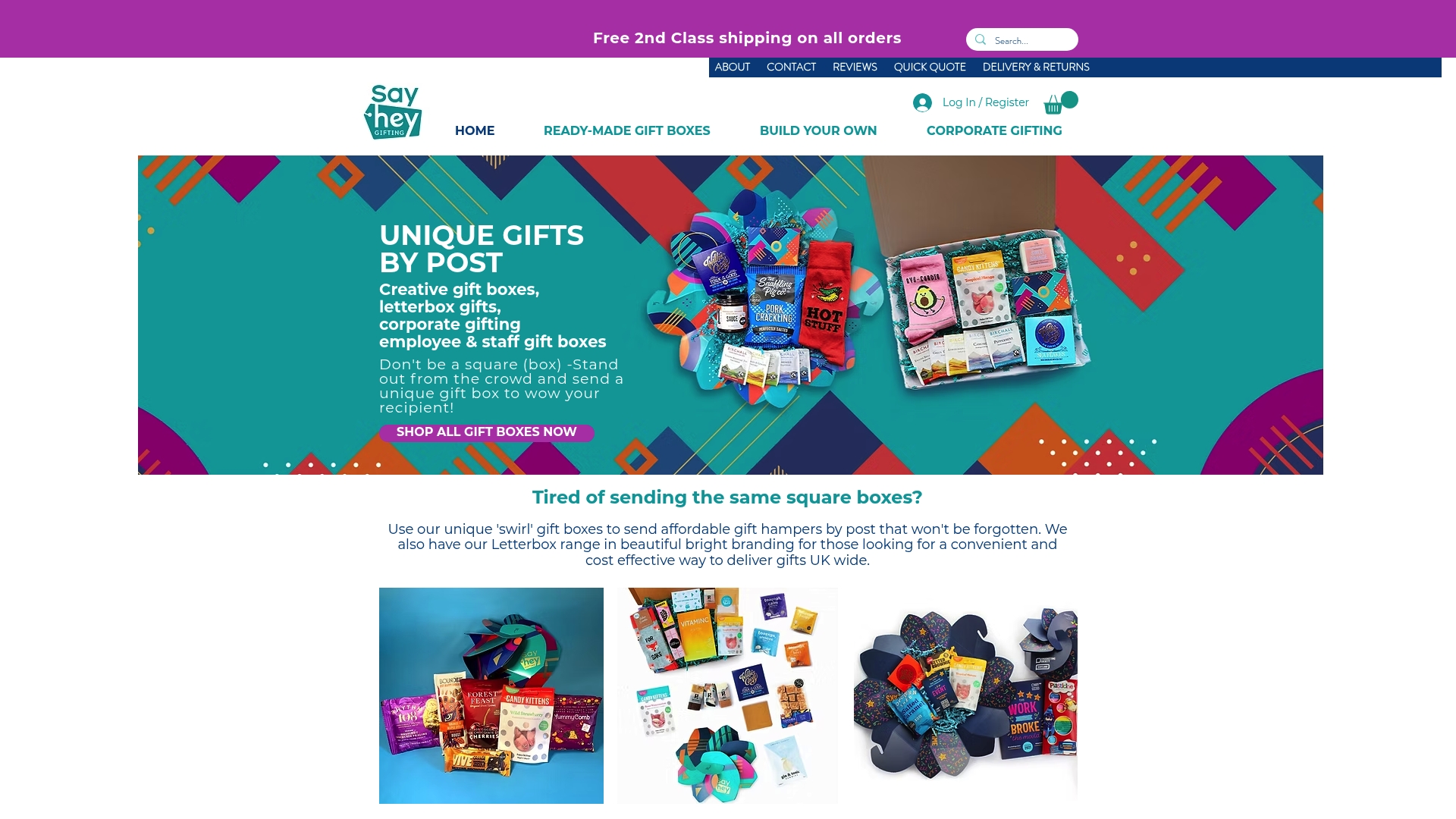
The range covers every budget tier discussed in this article, from entry-level letterbox sends to premium branded hampers, and the team understands UK compliance requirements so you do not have to navigate HMRC gift rules alone. Start with a small pilot: choose one recipient segment, select a gift tier, and measure the response rate against your next email-only follow-up. Browse the ready-made gift box range to find the right fit for your next event.
Useful sources and further reading
The claims in this article draw on peer-reviewed research, practitioner guides, and Sayheygifting’s own published resources. Key references:
What happens in your brain when you give a gift?
The psychology of gift-giving | Psychology Today
Why Do We Give Gifts? An Anthropologist Explains This Ancient Human Behavior | Scientific American
Understanding the brain science behind giving and receiving gifts | University of Arizona (news)
Comprehensive review of consumer gift-giving literature (Wiley journal)
Post-Event Corporate Gifts: Follow-Up Best Practices That Build Relationships
Why gifting builds client relationships that last
Corporate gifting ROI benefits: the 2026 business case
Corporate gifting logistics explained: your 2026 guide
Recommended