
3 Checks Before You Send: Corporate Gifting Etiquette That Passes HMRC
Corporate gifts are acceptable when they are proportionate, transparent and never timed to influence a business decision. Before you send anything, run three checks: does it comply with the recipient’s gift policy, would you happily record it and explain it to your manager, and does it fall within HMRC’s £50 tax treatment? If any answer is unclear, pause the gift.
TL;DR:
Gifts should be proportional to the relationship and avoid timing during procurement, negotiations, or decision points to prevent misinterpretation.
Client gifts must stay within the annual £50 total per recipient, have clear branding, and exclude food, vouchers, or luxury items to qualify for tax deductibility.
Internal gifts to employees should flow down reporting lines, include transparent budgets, and avoid gift exchanges during performance review periods.
Proper gift logging, transparent approval thresholds, and adherence to clear policies significantly reduce compliance risks and potential HMRC disputes.
Using managed gifting providers that offer branded, compliant gift options helps standardize processes and maintain transparency across bulk campaigns.
Table of Contents
The core rules of corporate gifting etiquette
Getting corporate gifting etiquette right comes down to seven habits, and most compliance headaches trace back to skipping one of them.
Apply the transparency test first. If you hesitated to log the gift or explain it openly to your manager, that hesitation is your answer. This simple check, used by many organisations managing gifts and hospitality, catches most problems before they start.
Match value to the relationship, not your budget. A long-standing supplier and a brand-new prospect do not warrant the same spend; proportionality is the whole point.
Avoid procurement and negotiation windows entirely. Gifts sent while a tender is live or a contract is being renegotiated raise questions regardless of value.
Check the recipient’s own policy before sending anything. Many organisations, particularly in the public sector and financial services, ban gifts outright or cap them well below £50.
Treat cash and cash-equivalent vouchers as a hard no. They read as an inducement, not a courtesy, and HMRC excludes them from tax relief entirely.
Set an internal approval threshold. Anything above a set value (commonly £25 to £50) needs sign-off before it leaves the building.
Log every gift in a register. Recipient, date, cost and reason take thirty seconds to note and save hours if anyone ever asks why a gift was sent.
Pro Tip: If a client’s procurement window opens unexpectedly right after you’ve approved a gift, delay dispatch rather than cancel outright. A note explaining the short delay reads as considerate, not evasive.
What corporate gifts are safe to give, and which ones to avoid
Safe choices share three traits: modest cost, clear branding and no ambiguity about intent. Good categories include branded desk accessories, practical tech add-ons (a decent charging cable, a webcam cover), wellbeing items like a quality candle or tea selection, and small experience vouchers for things like a coffee subscription.
Riskier categories cluster around a few repeat offenders:
Food and drink hampers — HMRC excludes these from the £50 relief entirely, whatever they cost.
Exchangeable vouchers — treated as cash equivalents, so they fail the tax test outright.
Anything visibly luxury — watches, premium spirits, designer items — regardless of who it is going to.
Personal apparel — clothing choices can misjudge size, taste or cultural fit and rarely land the way you hope.
Branding matters more than most people realise. A mug with a conspicuous, permanent logo meets HMRC’s deductibility test; the same mug tucked inside an unbranded hamper alongside chocolates does not, because the food content disqualifies the whole parcel. Subtle branding might look classier on the shelf, but it can also blur the line between “marketing gift” and “personal favour” when questions get asked later.
When should you send a corporate gift?
Timing carries more legal weight than most professionals assume. The safest moments are the ones with no live commercial decision hanging over them: after a contract is signed, during onboarding, on work anniversaries, or around a genuinely quiet period in the relationship.
The riskiest windows are the ones where a gift could look like it is nudging an outcome:
Active procurement or tender evaluation
Contract renewal negotiations
Performance review periods, internally or with a client account under review
Immediately before or after a major decision point
If timing feels ambiguous, don’t guess. Delay the gift by a few weeks, ask the recipient’s office manager or EA whether gifts are acceptable right now, or send something genuinely neutral instead, a handwritten note or a small charitable donation in their name.
Bribery Act principles and HMRC gift rules explained
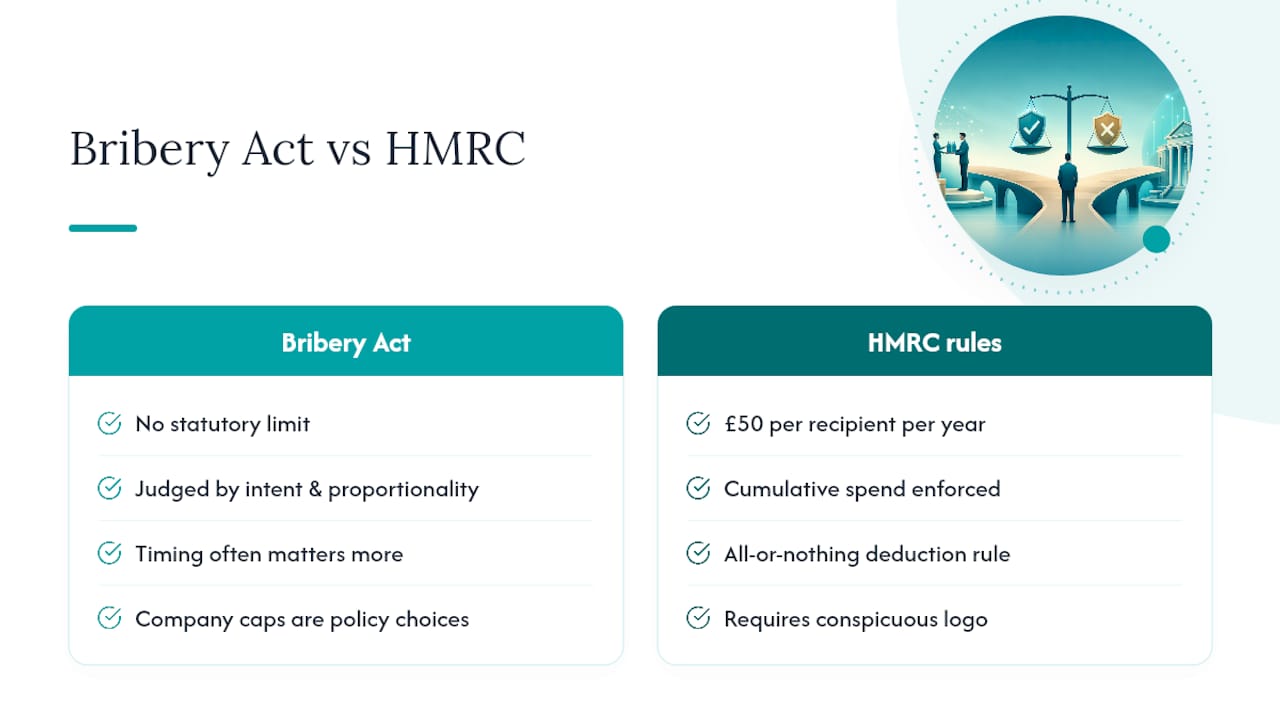
There is no legally defined “safe” figure for a corporate gift. The Bribery Act 2010 sets no statutory monetary limit at all; instead, it judges gifts on proportionality, transparency and whether there is any intent to improperly influence a decision. Some companies adopt an internal cap of £25 to £50, but that is a policy choice, not a legal floor. Official guidance on the Bribery Act reinforces that timing and intent matter more than price: a £15 item sent the week before a contract decision can create more exposure than a £45 item sent six months later.
HMRC’s rules are separate but just as unforgiving.
£50 per recipient, per tax year, or none of it is deductible. HMRC only allows client gifts as a tax-deductible expense when the total cost per recipient stays at £50 or under across the whole tax year, the item carries a conspicuous logo, and it is not food, drink, tobacco or an exchangeable voucher. Go one penny over the cumulative £50 for that recipient, and the entire amount loses its relief, not just the excess.
The practical fallout is worth understanding properly. Because the £50 cap is cumulative, a £30 gift in March and a £25 gift in November to the same client tips the whole £55 into non-deductible territory, and VAT treatment follows the same all-or-nothing logic. The fix is unglamorous but effective: track cumulative spend per recipient across the tax year, keep invoices and photos of the branding, and flag anything close to the threshold to finance before it ships. When a gift genuinely sits in a grey area, five minutes with your accountant beats an uncomfortable conversation with HMRC later.
Gifting rules inside your own workplace
Office gift etiquette needs its own guardrails, mostly because internal power dynamics make coercion easy to miss. The general rule: gifts should flow down the reporting line, not up. A manager buying something small for the team is warm; a team quietly clubbing together for the manager’s birthday can feel obligatory to anyone who would rather not contribute.
Secret Santa needs a firm budget cap and a genuine opt-out, with no pressure applied to colleagues who skip it.
Keep the exchange confidential until the reveal, and appoint one coordinator so nobody feels chased for contributions.
Managers gifting their team should give equal value to everyone, no exceptions based on performance or favouritism.
Never time manager gifts around review periods. A gift that lands the same week as a pay rise decision looks like a reward for compliance, not appreciation.
Document any gift a manager gives an individual report, the same way you would a client gift, for the same transparency reasons.
How to present and personalise a gift without crossing a line
A handwritten note or a short personalised message often does more for the relationship than a bigger price tag ever could, according to corporate gifting etiquette guidance that consistently finds thoughtfulness beats spend. Keep notes warm but professional. “Thank you for a great year working together” lands well; anything that references a personal favour, a private joke, or sounds like it is buying goodwill ahead of a decision does not.
Put branding somewhere visible and permanent, engraved or printed, never a removable sticker, both for HMRC’s conspicuous-logo test and for clarity of intent.
Personalise with initials, a favourite colour, or a dietary preference rather than anything that assumes a relationship you don’t actually have.
Keep personalisation inclusive across your team, especially where cultural or dietary differences mean one-size-fits-all gifts (particularly food and alcohol) can unintentionally exclude people.
Pro Tip: Ask for allergy and dietary information once, store it centrally, and reuse it for every campaign rather than asking each colleague repeatedly. It respects their time and keeps your data footprint small.
Building a company gifting policy and gift register
A workable policy needs four elements: an approval threshold above which sign-off is required, a list of prohibited items (cash, vouchers, anything alcohol-related where the business bans it), any sector-specific restriction (public sector clients often ban gifts outright), and a review date so the policy doesn’t quietly go stale.
Draft the policy with input from finance and whoever handles client relationships day to day.
Build a gift register that captures the fields finance actually needs at tax time.
Run every gift through the same workflow: request, approval, log, delivery confirmation, then a VAT check at year end.
Register field | Why it matters |
Recipient name and organisation | Tracks cumulative spend against the £50 cap |
Date sent | Establishes the tax year and checks against sensitive timing |
Net cost and VAT | Confirms whether the £50 threshold and VAT relief apply |
Business purpose | Supports the transparency test if ever questioned |
Approver | Shows the internal sign-off threshold was followed |
Photo of branding | Evidence the conspicuous-logo requirement is met |
Accountants routinely recommend exactly this kind of gift log precisely because it is the cheapest insurance a business can buy against a difficult HMRC conversation.
Planning bulk orders without the logistics falling over
Fulfilment failures cause more compliance problems than most people expect, mostly because rushed orders skip the checks that keep a campaign defensible. Build in lead time for seasonal peaks; ordering with a comfortable buffer before Christmas or a major conference avoids the rush fees and quality slips that come with last-minute panic-buying.
Collect personalisation data (names, sizes, dietary needs) through one secure form, not scattered email threads.
Choose recyclable or reusable packaging where you can; it reflects well on the brand and increasingly matters to recipients too.
Spot-check a sample from any bulk batch before the full run ships, branding placement is the most common defect.
Confirm last-mile delivery windows with the courier, especially for multi-site offices or remote teams receiving letterbox gifts.
What to do when you receive a gift from a client or partner
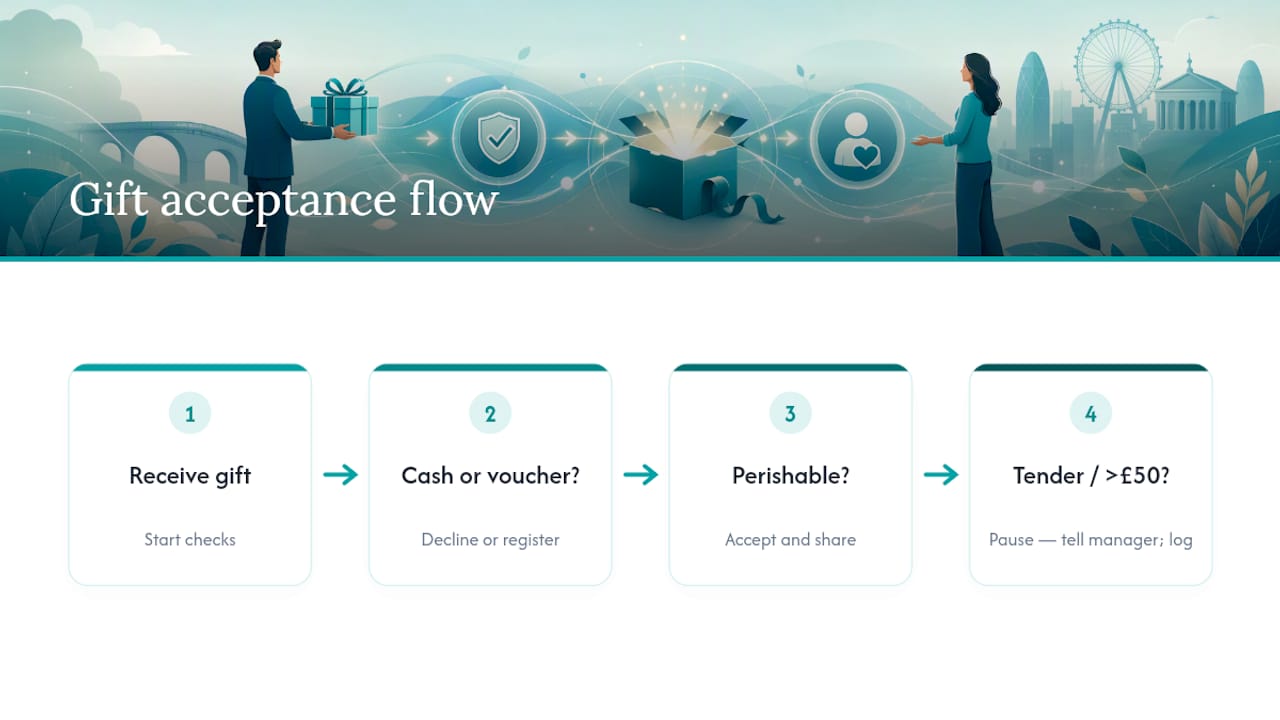
Receiving gifts needs the same rigour as sending them, and most companies underprepare for this side of the equation. Start with a simple acceptance policy: gifts under a set value (often aligned with the £50 HMRC threshold) can usually be accepted and kept, while anything above that, or anything unusual for the relationship, should be declared to a manager or logged in the same gift register used for outgoing gifts.
Disclosure protects the individual as much as the business. If a client sends something during an active negotiation or tender, the safest move is to log it immediately and flag it to whoever owns that commercial relationship, even if you intend to keep it. Silence is what turns an innocent gift into a problem; a documented, declared gift rarely raises concern even when it’s a genuinely generous one.
A few practical defaults work well. Cash or vouchers received from a client should be politely declined or handed to the register for a decision, not pocketed on the spot. Perishable items (a hamper, a bottle) are usually fine to accept and share with the team, since there’s no ongoing benefit to disclose. And anything that arrives during a live tender or contract discussion deserves a pause and a conversation with your line manager before it’s accepted at all, regardless of size. The same proportionality and timing tests you apply outbound apply here too, just in reverse.
What actually goes wrong with corporate gifting
Three mistakes come up again and again. Gifts sent mid-negotiation, because nobody checked the calendar against the deal timeline. Cumulative HMRC spend per client going untracked until the accountant flags it in April. And gifts that never make it into any register at all, so nobody can explain them months later. Fix each with one habit: check timing before you check price, log spend as you go rather than at year end, and treat the register as mandatory, not optional paperwork.
— Craig
How Sayheygifting helps you send gifts that stay on the right side of the rules
A managed gifting provider can simplify compliant, well-received corporate gifting without the need to build logistics from scratch. Such providers often offer employee gift boxes, custom letterbox gifts and bulk hampers designed with branding placement and packaging choices that support transparency and HMRC compliance.
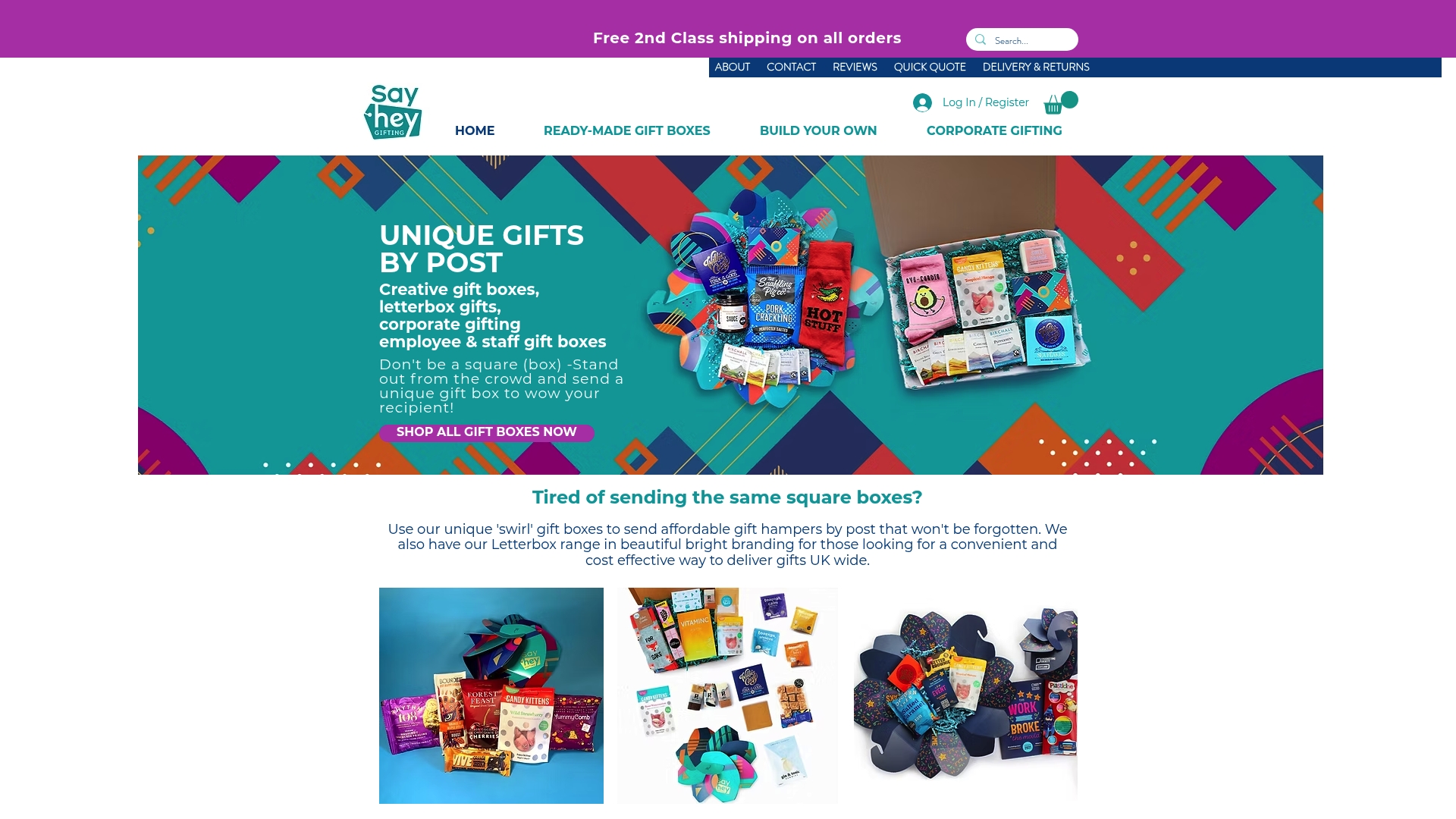
A managed provider takes the guesswork out of the parts that trip businesses up most: consistent conspicuous branding across a batch, clear invoicing for your VAT records, and packaging that holds up through bulk fulfilment without quality slipping on the fiftieth box. Whether you’re sending appreciation gifts to your own team or building a client campaign that needs to stay under the £50 threshold, our employee gift boxes and build-your-own gift box options give you a documented, repeatable process rather than a one-off scramble. Get in touch with a gifting provider for a bulk-order checklist and a quote tailored to your next campaign.
FAQ
What is the £50 rule for corporate gifts?
HMRC allows client gifts as a tax-deductible expense only when the total cost per recipient stays at £50 or under for the whole tax year, the item has a conspicuous logo, and it isn’t food, drink, tobacco or a voucher.
What are the etiquette rules for gift giving in the workplace?
Gifts should generally flow down the reporting line, stay proportionate to the relationship, avoid sensitive timing like review periods, and never pressure colleagues into group contributions such as Secret Santa.
What are some examples of good corporate gifts?
Branded desk accessories, practical tech add-ons, wellbeing items like tea or candles, and small experience vouchers all tend to meet both etiquette expectations and HMRC’s deductibility rules; ready-made options like employee gift boxes make this easier to standardise across a team.
Is it ethical to give gifts while doing business?
Yes, provided the gift is proportionate, given transparently and not timed to influence an active decision; the Bribery Act 2010 judges gifts on exactly these principles rather than a fixed monetary limit.
Should I accept a gift from a client during a live negotiation?
Log it and disclose it to a manager rather than declining automatically. Timing is the main risk factor, so documentation protects everyone even when the gift itself is entirely innocent.
Recommended
Comments